

AT A GLANCE
- Common Name: Lion’s Mane Mushroom
- Scientific Name: Hericium erinaceus
- Category: Fungi
- Subcategory: Tooth Fungi
- Size: Fruiting body diameter: 4–12 in (10–30 cm); Spine length: 0.4–2.0 in (1–5 cm)
- Weight: 0.5–2.5 lb (225–1,100 g); record specimens exceed 4 lb
- Lifespan: Fruiting body persists 2–4 weeks; internal mycelium persists in host heartwood for decades
- Diet: Saprotrophic and Parasitic (causes white rot by decomposing lignin and cellulose in hardwood heartwood)
- Habitat: Old-growth temperate deciduous broadleaf forests, growing as a wound parasite and saprotroph on dead or decaying hardwood trees (especially oak, beech, and maple)
- Range: Temperate Northern Hemisphere forests across North America (Eastern US and Canada), Europe, and East Asia (China, Japan, and Korea)
- Conservation Status: Least Concern (IUCN / Globally Secure; Red-listed as Endangered in several European countries)
Overview
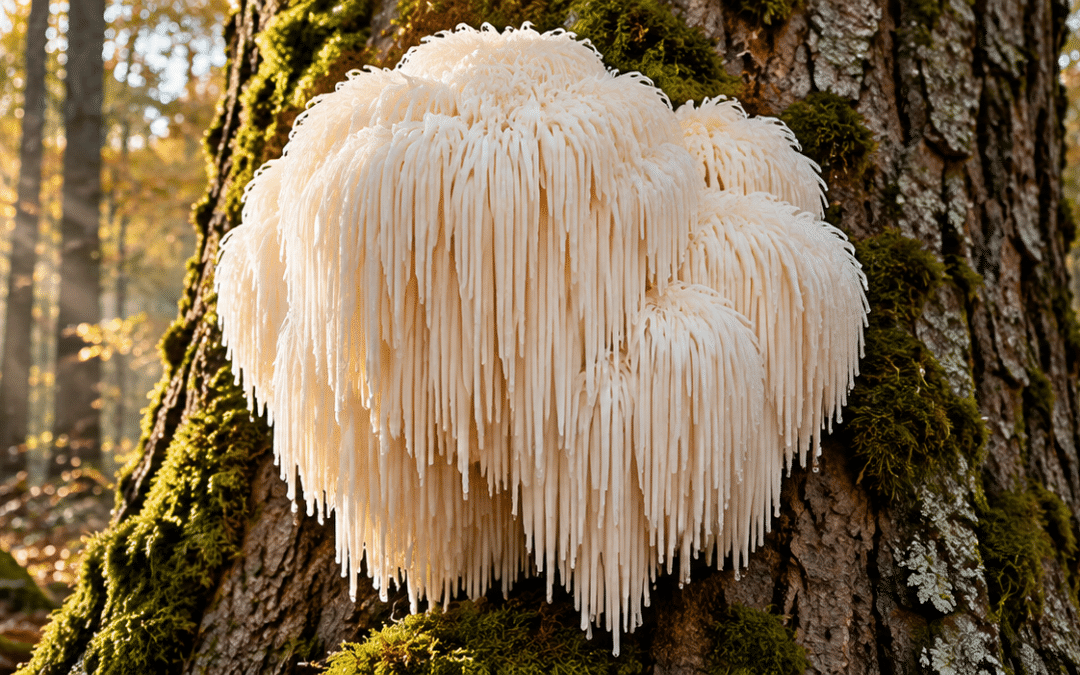
The Lion’s Mane Mushroom (Hericium erinaceus), celebrated across East Asia as ‘Yamabushitake’ (named for Japanese mountain hermit monks) and the ‘monkey head mushroom,’ is an extraordinary tooth fungus celebrated for its striking visual form, culinary delicacy, and potent biomedical properties. Appearing on the trunks of decaying hardwood trees like a cascading, crystalline waterfall of snowy-white icicles, this spectacular basidiomycete lacks the traditional cap and gills of typical mushrooms, boasting instead a dense, cascading beard of soft, elongated spine-like teeth. Native across the temperate broadleaf forests of North America, Europe, and Asia, Lion’s Mane represents a pinnacle of fungal elegance and physiological utility.
Surpassing its striking presence on mossy tree trunks, Hericium erinaceus is renowned globally in medicinal mycology and neuroscience for producing novel bioactive compounds (hericenones and erinacines) that stimulate the synthesis of Nerve Growth Factor (NGF) in the human brain. Functioning ecologically as a vital wound parasite and wood-decaying saprotroph, Lion’s Mane breaks down stubborn heartwood celluloses, recycling essential carbon and nutrients back into old-growth forest soils while creating vital nesting cavities for forest wildlife.
Biology and Physical Characteristics
The unique morphology of Hericium erinaceus is categorized within the tooth fungi (hydnoid fungi). Rather than dispersing spores from gills beneath a cap, the entire fruiting body develops as a compact, bulbous, unbranched fleshy tubercle firmly anchored to tree heartwood. From this central mass cascade hundreds of pendulous, parallel, icicle-like spines (teeth) that measure up to two inches (5 cm) in length. Each downward-hanging spine is enveloped in a fertile hymenial spore-bearing layer, maximizing the total surface area available for spore discharge while utilizing gravity to drop millions of microscopic, smooth, amyloid spherical basidiospores directly into circulating forest breezes.
Young fruiting bodies emerge as pure, glistening snowy-white or cream mounds that gradually shift to a pale yellowish-tan or amber as spores mature. Biochemically, the mushroom is a chemical powerhouse: it synthesizes two distinct families of cyathane diterpenoids—hericenones (concentrated in the fruiting body) and erinacines (concentrated in the vegetative mycelium)—which cross the blood-brain barrier and induce neurite outgrowth and myelin sheath protection, making Lion’s Mane the subject of intense ongoing biomedical research into Alzheimer’s, Parkinson’s, and cognitive neuro-regeneration.
Behavior and Ecology
Hericium erinaceus operates as both a wound parasite on living mature hardwoods and a primary saprotrophic recycler on dead fallen timber. It infects host trees—predominantly American beech (Fagus grandifolia), English oak (Quercus robur), and sugar maple (Acer saccharum)—through broken branch wounds, frost cracks, or woodpecker excavations, using powerful oxidative enzymes (including laccases and lignin peroxidases) to cause a slow, non-aggressive white rot that dissolves lignin and leaves behind soft, spongy cellulose.
Fruiting occurs in late summer and autumn, often reappearing annually in the exact same tree wound for multiple decades until the internal wood is completely digested. By slowly hollowing out living tree trunks from the inside without toppling them immediately, the mycelium creates insulated, hollow tree cavities that provide essential roosting and nesting refugia for screech owls, flying squirrels, bats, and wood-boring beetles, fulfilling an indispensable architectural role in the forest ecosystem.
Conservation and Human Impact
Globally, Hericium erinaceus is evaluated as Least Concern by the IUCN, remaining common across mature deciduous woodlands of the Eastern United States and East Asia, where it is also cultivated extensively on sawdust substrates. However, in Europe, the species is severely threatened and red-listed as Critically Endangered in multiple nations (including the United Kingdom, Sweden, and Poland), where it receives strict legal protection against harvesting.
The primary driver of European decline is the systematic commercial forestry removal of veteran, hollow, and dead deciduous trees (‘over-sanitization’ of woodlands), which eliminates the mature host substrates necessary for fungal colonization. Conservation initiatives advocate for retention of fallen woody debris, preservation of ancient beech-oak forests, and the rewilding of managed timber reserves to safeguard wild genetic strains.
Interesting Factoid
Lion’s Mane contains unique bioactive compounds that stimulate the production of Nerve Growth Factor (NGF), and in pre-clinical studies, extracts have been shown to help repair damaged neural pathways and stimulate brain plasticity.