
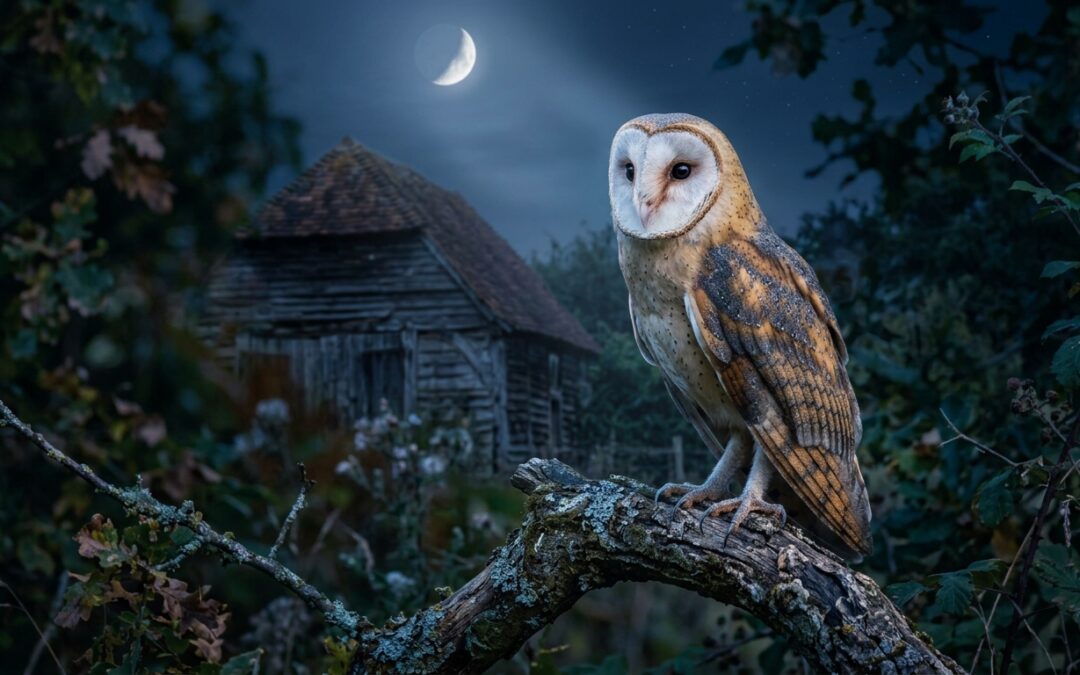
Overview
The Barn Owl (Tyto alba) is among the most widely distributed terrestrial avian raptors in the world, renowned for its ghostly pale plumage, heart-shaped facial disc, and uncanny ability to hunt in total darkness. Soaring soundlessly over open meadows, farmsteads, and rough grasslands, this peerless nocturnal predator serves as an indispensable natural regulator of small rodent populations. With an acoustic sensory apparatus that outperforms any other recorded bird of prey, the barn owl represents a pinnacle of nighttime evolutionary biomechanics.
Biology and Physical Characteristics
The predatory anatomy of Tyto alba is engineered for silent pursuit and acoustic triangulation. Its leading-edge primary wing feathers feature microscopic comb-like serrations (flutings) and a velvet-like down fringe that breaks up air turbulence, allowing the owl to glide with virtually imperceptible acoustic noise. Its concave, heart-shaped facial disc functions as a natural parabolic sound reflector, funneling the faintest rustles of rodents straight toward asymmetrical ear openings positioned at slightly different heights on the skull, permitting millisecond vertical and horizontal sound-source localization.
Behavior and Ecology
Barn owls are strictly nocturnal hunters that cruise low over grassy fields in buoyant, quartering search flights. Once prey is acoustically pinpointed beneath dense ground cover or snow, the owl stalls mid-air and plunges feet-first, its long, needle-sharp talons penetrating thick grass to seize voles and field mice. Pairs form lifelong monogamous bonds, nesting in dark tree hollows, cliff crevices, or traditional rustic haylofts. Because rodents are swallowed whole, the owl’s muscular gizzard compacts indigestible fur and bones into dry, cylindrical pellets that are regurgitated daily at roosting perches.
Conservation and Human Impact
Although globally evaluated as Least Concern due to its vast cosmopolitan distribution, localized barn owl populations face steep declines in industrialized agricultural belts. Key hazards include modern barn modernization that seals historical nesting lofts, hedgerow clearing, and primary and secondary toxicity from rodenticides. Agricultural stewardship initiatives that promote artificial wooden nest box installations and biological pest control across vineyard and farming cooperatives have successfully bolstered regional breeding densities.
Interesting Factoid
A barn owl’s asymmetrical ears allow it to capture prey in complete pitch-black darkness by hearing alone, striking a vole moving beneath two feet of deep snow with surgical accuracy.
Last updated: October 2026