
Overview
The Pink Fairy Armadillo (Chlamyphorus truncatus), affectionately known in its native Argentina as the pichi ciego (blind armadillo), represents one of the most enigmatic, anatomically specialized, and elusive mammalian oddities on Earth. Measuring scarcely 3.5 to 4.5 inches in total body length, it holds the biological distinction of being the absolute smallest extant species within the entire order Cingulata. Endemic exclusively to the dry scrublands and sand plains of central Argentina, this subterranean phantom navigates sandy subterranean strata with the fluid grace of a burrowing fish, remaining largely unseen by human eyes throughout its evolutionary history.
Biologically classified within the family Chlamyphoridae of the superorder Xenarthra, the pink fairy armadillo is an ancient evolutionary relic whose ancestors branched off millions of years ago. Its remarkable pale rose-tinted carapace, snow-white silky undercoat, and unusual rear armor plate make it instantly recognizable among zoologists. Because the species spends the overwhelming majority of its life underground foraging for insects and plant matter, wild populations remain notoriously difficult to study, elevating every verified sighting to a significant ecological event.
AT A GLANCE
Species Profile
Pink Fairy Armadillo
Chlamyphorus truncatus
Mammal (Armadillo, Chlamyphoridae)
Length: 3.5–4.5 in (9–11.5 cm); Tail: 1.0–1.4 in (2.5–3.5 cm)
3.0–4.2 oz (85–120 g); tiny enough to fit inside a human palm
5–10 years in the wild; rarely survives in captive care
Insectivore / Omnivore (ants, larvae, worms, roots)
Arid scrublands, dunes, and sandy plains of the Monte Desert
Endemic to central Argentina (Mendoza, San Juan, La Pampa, Buenos Aires)
Data Deficient (IUCN Red List)
Biology and Physical Characteristics
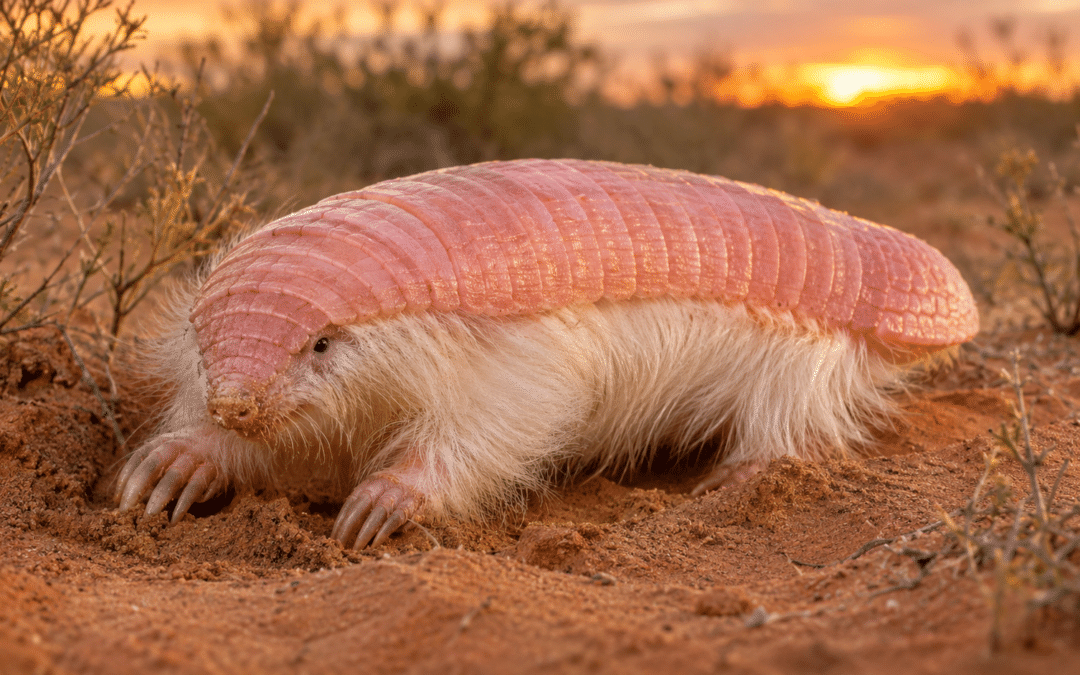
The anatomical architecture of Chlamyphorus truncatus presents some of the most radical morphological specializations found in placental mammals. Unlike any other armadillo species, its dorsal carapace consists of 24 flexible, band-like osteoderm rows attached only along a narrow dorsal membrane running parallel to the spine. This unique structural decoupling allows the protective shell to float freely above the animal’s flank musculature, functioning not merely as defensive armor but as a sophisticated thermoregulatory radiator. An extensive vascular network located beneath the thin, translucent pink shell permits rapid heat exchange across arid desert extremes.
At the posterior end of the animal, the dorsal carapace terminates abruptly in a vertical, circular plate known as the pygidial shield. This flattened, disc-like armor plate functions as a biological cork or ‘buttress plug’ (phragmosis). When threatened inside its underground burrows, the armadillo wedges its flat posterior against the tunnel entrance, presenting an impenetrable armored barrier to pursuers. Complementing this defensive marvel are oversized, curved, spade-like foreclaws anchored to hypertrophied shoulder muscles, enabling rapid excavation through loose subterranean sediment.
Behavior and Ecology
The pink fairy armadillo is strictly nocturnal and highly fossorial, spending approximately 95 percent of its existence below ground. Rather than excavating semi-permanent open tunnel complexes like badgers or moles, it ‘swims’ through loose, uncompacted sandy soil, immediately backfilling the space behind its body with its armored posterior disc and modified spatulate tail. This continuous subsurface movement allows the animal to hunt subterranean ant colonies, ant pupae, beetle grubs, and subterranean plant roots while avoiding the harsh desiccating heat and temperature swings of the Argentine Monte.
Because rainfall is infrequent in its arid habitat, heavy precipitation events represent significant hazards. When desert downpours saturate the sandy substrate, water infiltrates subterranean burrows, threatening the animal with hypothermia due to waterlogging of its fine, dense ventral fur. Consequently, pink fairy armadillos are forced to emerge onto the desert surface during or immediately following heavy storms to avoid drowning and thermoregulatory shock, rendering them temporarily vulnerable to terrestrial predators such as maned wolves, owls, and foxes.
Conservation and Human Impact
The conservation status of Chlamyphorus truncatus is currently classified as Data Deficient by the International Union for Conservation of Nature (IUCN) Red List, primarily due to the animal’s secretive subterranean habits and the scarcity of comprehensive field surveys. Nevertheless, conservation biologists express profound concern regarding ongoing population pressures across its restricted geographical distribution. Agricultural expansion, cattle ranching, and heavy machinery compact delicate sandy soils, rendering them impenetrable to burrowing armadillos and destroying essential insect nesting sites.
Domestic and feral dogs pose another critical threat, easily excavating disoriented armadillos that emerge following torrential rains. Furthermore, illegal poaching for the exotic pet trade remains a severe problem; due to extreme physiological stress susceptibility and specialized dietary needs, captured pink fairy armadillos experience nearly 100 percent mortality within days of removal from the wild. Argentine environmental agencies and wildlife research institutes are actively working to preserve core habitats within protected desert reserves and expand educational campaigns discouraging wild animal extraction.
Interesting Factoid
The distinctive pink coloration of the pink fairy armadillo’s shell is not produced by pigments, but by blood coursing through superficial capillary vessels immediately beneath its translucent keratinous armor. When ambient temperatures rise, increased blood flow flushes the shell a vibrant rosy pink to radiate excess heat, while cool conditions cause the vessels to constrict, bluing or paling the shell to conserve core body warmth!
Scientific References
- International Union for Conservation of Nature (IUCN) Red List of Threatened Species: Chlamyphorus truncatus (Pink Fairy Armadillo).
- Superina, M. & Loughry, W.J., Life on the Half-Shell: Consequences of a Peculiar Carapace among the Armadillos (Journal of Mammalian Evolution).
- Möller-Krull, M. et al., Retroposed elements and the evolution of Xenarthra (Molecular Biology and Evolution).