

Overview
The Axolotl (Ambystoma mexicanum), affectionately known in Aztec mythology as the aquatic canine incarnation of the fire and lightning god Xolotl, is one of the biological world’s most enigmatic and medically significant amphibians. Strictly endemic to the ancient canal remnants of Lake Xochimilco on the southern fringes of Mexico City, this charming salamander exhibits obligate neoteny, spending its entire life cycle in a juvenile, gilled aquatic form. Celebrated globally in biomedical laboratories for indoor reproduction, the wild axolotl teeters precariously on the brink of extinction due to rapid urban degradation of its ancestral waters.
Biology and Physical Characteristics
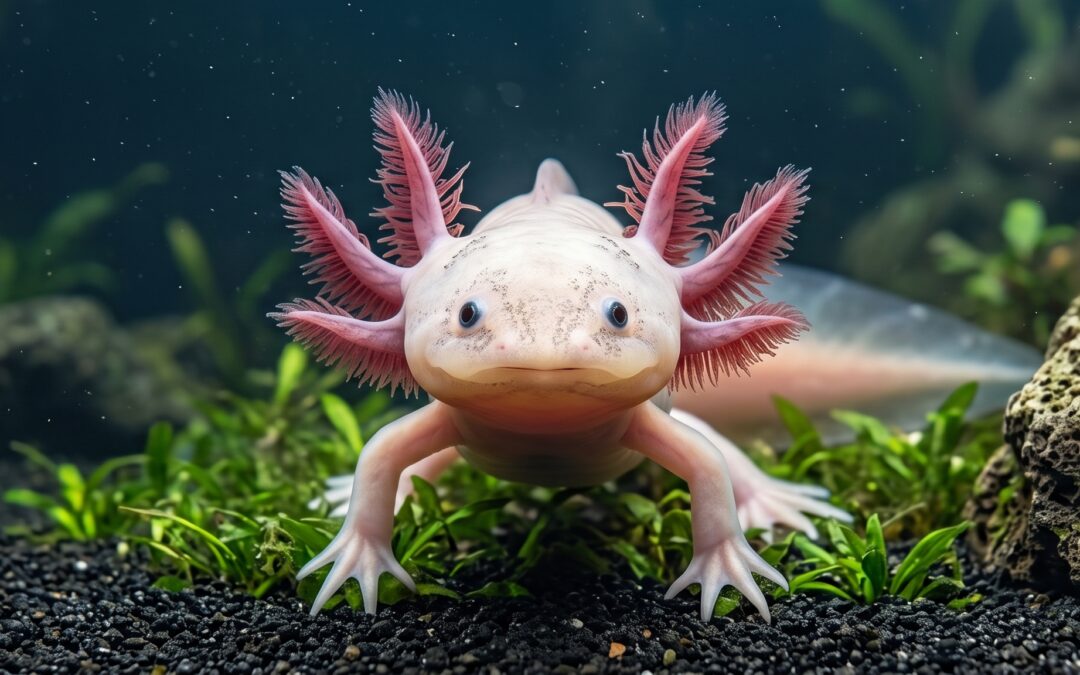
The physical profile of Ambystoma mexicanum is defined by its permanent larval morphology. Rather than undergoing complete metamorphosis into a terrestrial, lung-breathing adult like other mole salamanders, the axolotl retains its wide, flat head, lidless eyes, broad tail fin, and three pairs of external, feathery gill rami that billow like crimson headdresses to absorb dissolved oxygen from the water. While wild individuals typically exhibit dark, mottled olive-brown or charcoal pigmentation that camouflages them against muddy lake floors, captive populations frequently display leucistic (pinkish-white with dark eyes) and albino morphs. Most astonishingly, the axolotl possesses near-limitless biological regeneration, capable of completely regrowing amputated limbs, tail segments, heart muscle, spinal cord nerves, and parts of its brain without forming scar tissue.
Behavior and Ecology
Axolotls are quiet, bottom-dwelling suction foragers that spend daytime hours resting quietly among submerged roots and aquatic vegetation. When hunting, they rely on a combination of visual motion detection, lateral-line water pressure sensing, and chemical olfaction; when an aquatic worm or small crustacean moves nearby, the axolotl expands its buccal cavity with lightning speed, creating a sudden vacuum that draws the prey whole into its mouth. Reproduction occurs in late winter, with courtship consisting of an aquatic dance where the male nudges the female before depositing a gelatinous spermatophore on water plants, which the female takes up into her cloaca to fertilize hundreds of individually attached eggs.
Conservation and Human Impact
The wild axolotl is classified as Critically Endangered by the IUCN, with recent scientific censuses recording fewer than 50 to 100 individuals per square kilometer in its remaining strongholds—down from thousands two decades ago. Primary drivers of this catastrophic decline include the historic drainage of the Valley of Mexico lake basins, ongoing chemical pollution and untreated runoff from urban Mexico City, and the intentional introduction of invasive predatory fish (carp and tilapia) that devour juvenile axolotls and consume native aquatic vegetation. Ecological restoration initiatives focus on re-establishing traditional chinampa agricultural canals lined with biological filters to create secure aquatic sanctuaries free from invasive predators.
Interesting Factoid
The axolotl can regenerate entire functional limbs—complete with bones, muscles, blood vessels, and nerves—hundreds of times throughout its life, and can even accept transplanted organs from other individuals without immunological rejection.