
AT A GLANCE
- Common Name: Black Caiman
- Scientific Name: Melanosuchus niger
- Category: Reptiles
- Subcategory: Alligatorids & Crocodilians
- Size: Adult total length: 3.5–5.0 m (11.5–16.4 ft); verified historical giants reached 5.5–6.0 m (18–20 ft); largest member of Alligatoridae
- Weight: Adult mass: 200–500 kg (440–1,100 lb); massive bull males exceed 600–800 kg (1,320–1,760 lb)
- Lifespan: 50–80 years in the wild; long-lived apex crocodilian reptile
- Diet: Carnivorous apex predator: capybaras, giant otters, anacondas, river turtles, catfish, tapirs, deer, and monkeys
- Habitat: Deep, quiet freshwater rivers, oxbow lakes, and seasonally inundated Amazon floodplains
- Range: Amazon Basin of South America
- Conservation Status: Conservation Dependent (IUCN Red List)
Overview
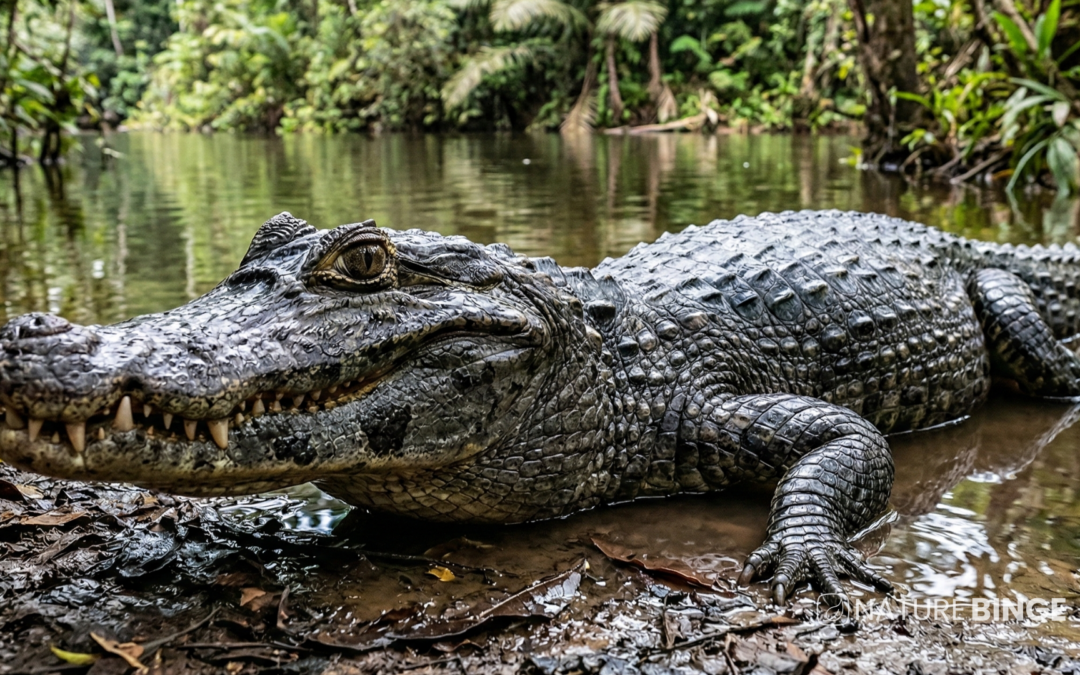
The Black Caiman (Melanosuchus niger), celebrated across herpetology as the undisputed dark sovereign of the Amazon River basin, is a colossal crocodilian belonging to the family Alligatoridae. Indigenous to the slow-moving rivers, flooded forests, and secluded oxbow lakes of South America, this magnificent aquatic apex predator is the largest predator in the entire Amazon ecosystem and the largest living member of the alligator family, with massive males regularly exceeding four to five meters (16 feet) in length.
Operating as the dominant apex aquatic regulator across the Amazon Basin, Melanosuchus niger maintains the ecological balance of freshwater ecosystems by preying upon large mammals, piranhas, river turtles, and anacondas, while recycling vital nutrients through seasonally flooded wetlands. Clad in heavily armored, jet-black osteoderm scales that absorb solar heat during nocturnal forays, the black caiman was hunted to near-extinction during the mid-20th century for its prized black leather hides. Thanks to stringent international legal protection and large-scale Amazonian wetland reserves, populations have mounted a spectacular recovery, evaluated as Conservation Dependent on the IUCN Red List.
Biology and Physical Characteristics
The physical and physiological engineering of Melanosuchus niger is an evolutionary masterwork of aquatic armor and mechanical power: its heavily ossified dorsal skin is dark grey to pitch-black, a melanistic coloration that provides superb nocturnal camouflage while absorbing thermal solar radiation during cool morning basks to power nighttime hunting. Its skull is heavy, broad, and reinforced with thickened cranial bones, supporting massive adductor mandibular muscles capable of generating crushing bite forces exceeding 3,700 pounds per square inch—enough to shatter turtle carapaces, crack mammal bones, and snap the spines of large catfish. Its large, luminous brown eyes and slit pupils are protected by transparent nictitating membranes and equipped with a tapetum lucidum that reflects light in brilliant crimson flashes in the dark. Its powerful, laterally compressed tail propels it through water with explosive bursts of speed during ambush lunges.
Behavior and Ecology
Black caimans are solitary, nocturnal ambush predators that spend daylight hours submerged among aquatic hyacinths or sunning themselves on secluded muddy riverbanks. At night, they patrol open oxbow lakes and river channels, floating virtually invisible with only their nostrils and eyes breaking the surface film. When an unsuspecting capybara, tapir, or wading deer comes to drink at the water’s edge, the caiman surges from the water in a blinding fraction of a second, clamping its crushing jaws onto the animal’s neck or snout and dragging it into deep water to drown it. Reproduction is characterized by intense maternal care: during the dry season, the female builds an enormous mound nest of mud and decaying vegetation up to 1.5 meters high and two meters wide, laying 30 to 65 hard-shelled eggs. The rotting vegetation acts as a natural biological incubator, maintaining steady incubation temperatures; when the hatchlings begin chirping inside the nest, the mother digs them out and carries them gently in her jaws to a sheltered aquatic nursery, protecting them fiercely from predators for up to a year.
Conservation and Human Impact
Melanosuchus niger is classified as Conservation Dependent on the IUCN Red List and listed on CITES Appendix I (with managed ranching populations in Brazil and Ecuador on Appendix II). Between the 1940s and 1970s, an estimated 80 to 99 percent of the wild population was slaughtered by commercial hide hunters supplying the international luxury leather market for boots and handbags, extirpating the species from vast river basins. However, nationwide hunting bans across Brazil, Peru, and Colombia, coupled with the establishment of massive protected reserves such as the Mamirauá Sustainable Development Reserve, enabled black caimans to make an astonishing demographic comeback. Today, localized conflict with commercial fishermen over fishing nets and illegal hunting for meat represent primary management challenges.
Interesting Factoid
The black caiman is the largest predator in the entire Amazon rainforest, growing up to 18 feet long with a bite force so bone-shattering it routinely preys on anacondas, giant river otters, and full-grown deer.