

AT A GLANCE
- Common Name: Blue Jay
- Scientific Name: Cyanocitta cristata
- Category: Birds
- Subcategory: Songbirds
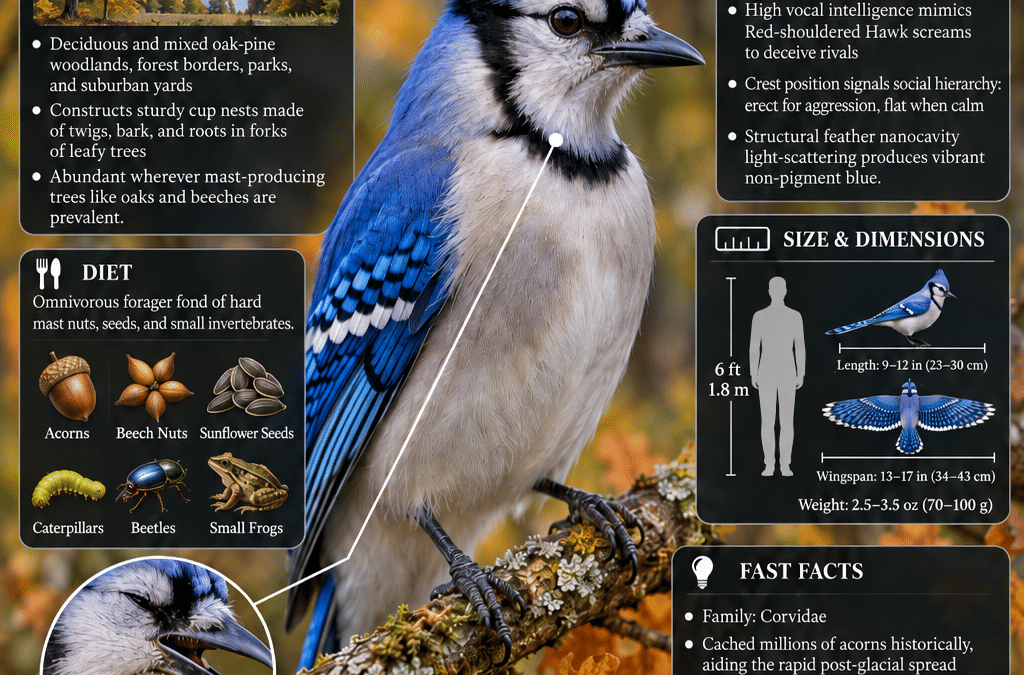
- Size: Body length: 9–12 in (22–30 cm); Wingspan: 13–17 in (34–43 cm)
- Weight: 2.3–3.8 oz (65–109 g)
- Lifespan: 5–7 years in the wild; documented banding record of over 26 years
- Diet: Omnivore / Opportunist (acorns, beech nuts, seeds, wild berries, insects, and occasionally small vertebrates)
- Habitat: Oak-hickory forests, suburban woodlands, forest ecotones, and residential feeder stations
- Range: Widespread across North America east of the Great Plains, expanding into northwestern regions
- Conservation Status: Least Concern (IUCN Red List)
Overview
The Blue Jay (Cyanocitta cristata) is an intelligent, boldly patterned, and vocal songbird belonging to the corvid family Corvidae. Native to the deciduous and mixed forests of eastern and central North America, the species is celebrated for its brilliant sky-blue crest and mantle, clean white underside, black necklace collar, and intricate white-and-black barring on its wings and tail. Endowed with the remarkable problem-solving acuity typical of corvids, blue jays exhibit complex social networks, high curiosity, and sophisticated vocal repertoires.
Ecologically, blue jays are essential forest regenerators, functioning as North America’s premier long-distance seed and acorn dispersers. Historical paleoecological models demonstrate that the rapid post-glacial northward expansion of oak (Quercus) and beech (Fagus) forests following the last glacial maximum was directly propelled by the hoarding behavior of blue jays. Their vigilant alarm calls also provide vital sentinel warnings that alert entire mixed-species forest bird communities to approaching raptors.
Biology and Physical Characteristics
A captivating biological characteristic of Cyanocitta cristata is that its brilliant plumage contains zero blue pigments. The vibrant blue appearance is entirely a product of structural coloration: microscopic keratin and air-pocket matrices within the feather barbs scatter shorter blue wavelengths of light (Tyndall / Rayleigh-like scattering) while an underlying layer of dark melanin absorbs longer wavelengths. Blue jays possess strong, generalist beaks supported by powerful cranial muscles, allowing them to hammer open tough acorn shells while holding them securely against a branch with their zygodactyl-like grasping feet.
Behavior and Ecology
Blue jays display complex social structures, forming monogamous, lifelong breeding pairs and participating in dynamic seasonal foraging flocks. They are proficient cache-hoarders, individually burying thousands of acorns and beech nuts each autumn across forest landscapes, navigating back to hidden caches using spatial cognitive mapping. Blue jays are also master mimics, frequently delivering convincing vocal imitations of Red-shouldered and Red-tailed Hawks, a deceptive acoustic strategy utilized to test forest foliage for hidden predators or frighten competitors away from rich feeding sites.
Conservation and Human Impact
Classified as Least Concern by the IUCN Red List, the blue jay maintains a stable, resilient population estimated at over 17 million individuals across North America. The species has adapted seamlessly to suburban landscapes, flourishing in mature suburban neighborhoods, parks, and backyard gardens with supplemental feeding stations. While broad forest clearing historically altered regional distributions, current management concerns center around susceptibility to mosquito-borne West Nile virus, which caused noticeable localized mortality events during early epidemic waves.
Interesting Factoid
A single blue jay can transport up to five acorns simultaneously—storing three in an elastic pouch inside its esophagus called the crop, one in its mouth, and carrying the final acorn clamped firmly in the tip of its bill.