
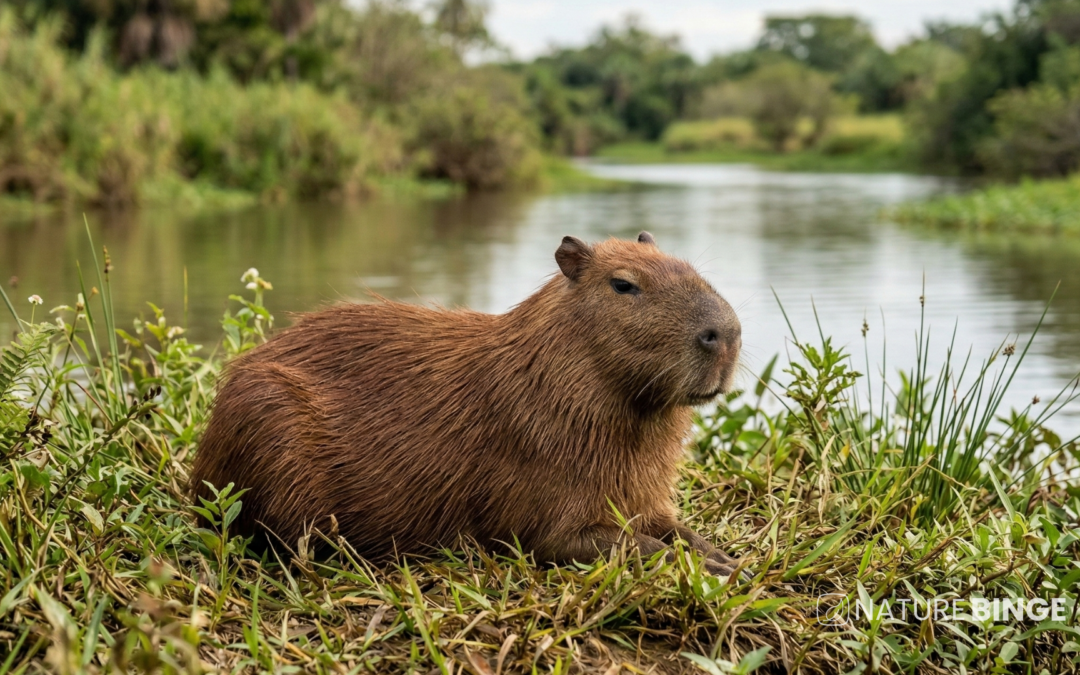

AT A GLANCE
- Common Name: Capybara
- Scientific Name: Hydrochoerus hydrochaeris
- Category: Mammals
- Subcategory: Rodents
- Size: Length: 106–134 cm (3.48–4.40 ft); Shoulder height: 50–62 cm (20–24 in)
- Weight: 35–66 kg (77–146 lb); exceptional females up to 91 kg (200 lb)
- Lifespan: 8–10 years in the wild; up to 12 years in captivity
- Diet: Herbivore: grasses, sedges, aquatic plants, bark, and fruit
- Habitat: Seasonally flooded grasslands, swamps, marshes, and low-gradient river corridors
- Range: South America east of the Andes, throughout the Amazon and Orinoco basins and Pantanal
- Conservation Status: Least Concern (IUCN Red List)
Overview
The Capybara (Hydrochoerus hydrochaeris) is the world’s largest extant rodent, belonging to the caviid family and serving as a keystone grazer throughout South America’s expansive freshwater river basins and wetland biomes. Possessing a barrel-shaped body, dense reddish-brown pelage, and partially webbed digits, this semi-aquatic giant exhibits evolutionary adaptations finely tuned to an amphibious life alongside slow-moving rivers, lagoons, and flooded savannas. Its lineage traces back to massive caviomorph rodents that radiated across isolated South America during the Miocene epoch.
As an ecological engineer and foundational herbivore, the capybara maintains open marshlands by grazing heavy stands of riparian grasses and emergent macrophytes, thereby shaping vegetative succession and supporting nutrient cycling across wetland food webs. Furthermore, its communal social structures, cooperative sentinel behaviors, and docile interactions with waterbirds, reptiles, and fish make it a quintessential pillar of South American wetland ecology. Capybaras form stable matriarchal herds of 10 to 40 individuals, relying on collective vigilance to detect apex predators like jaguars, anacondas, and black caimans.
Biology and Physical Characteristics
Anatomically, the capybara displays a suite of specialized amphibious adaptations: its eyes, nostrils, and small rounded ears are positioned high atop its elongated head, enabling the animal to breathe and surveil its surroundings while remaining virtually submerged. Its feet feature four digits on the forelimbs and three on the hindlimbs, linked by rudimentary swimming webs and tipped with hoof-like claws that facilitate propulsion through muddy substrates. As an obligate hindgut fermenter, Hydrochoerus hydrochaeris possesses an enlarged, highly vascularized cecum packed with symbiotic cellulolytic microorganisms to break down fibrous cellulose. To maximize nutrient absorption, the species engages in autocoprophagy (cecotrophy), re-ingesting nutrient-dense cecal pellets rich in microbial proteins and B vitamins produced during overnight digestion.
Behavior and Ecology
Capybaras exhibit highly coordinated social dynamics governed by a dominant breeding male, subordinate males, a matrilineal core of females, and juveniles. Territory defense is mediated through vocalizations—ranging from low-frequency clicks and whines to sharp, percussive alarm barks—and chemical signaling via two specialized sebaceous glands: the ‘morrillo’ situated atop the snout of adult males and paired anal scent pockets. Highly adapted for evasion, capybaras can submerge entirely for up to five minutes when alarmed, drifting beneath surface vegetation or maintaining only their nostrils above the waterline. Mutualistic associations are frequent; various bird species, such as yellow-headed caracaras and wattled jacanas, regularly groom basking capybaras, gleaning ticks, horseflies, and parasites from their dense hide.
Conservation and Human Impact
Hydrochoerus hydrochaeris is categorized as Least Concern on the IUCN Red List due to its wide distribution, adaptable foraging behavior, and high reproductive potential, with females producing litters of up to eight precocial pups annually. Despite healthy overall numbers, localized populations suffer from illegal commercial hunting for meat and leather, seasonal wetland drainage for agricultural conversion, and competition with domestic livestock in the Pantanal and Llanos. Effective conservation relies on maintaining contiguous riparian corridors, regulating seasonal harvesting quotas, and protecting expansive wetland reserves against hydrologic alteration.
Interesting Factoid
In the 16th century, Catholic missionaries in Venezuela petitioned the Vatican to classify the semi-aquatic, fish-like swimming capybara as a fish, allowing its consumption during Lent—a religious dietary classification that persists in several South American regions today.