
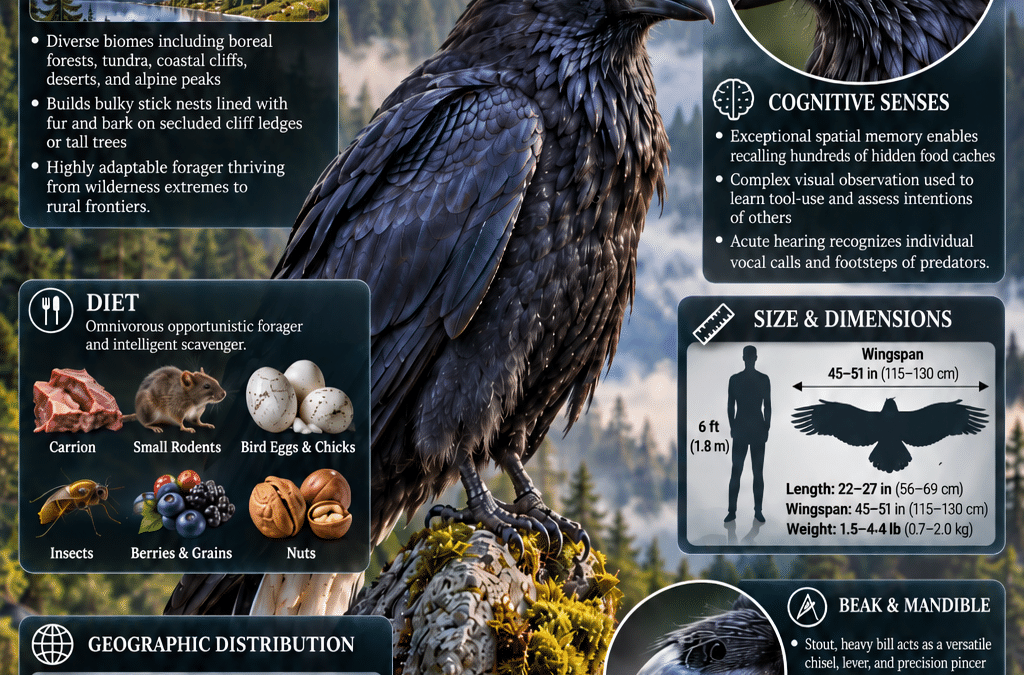

AT A GLANCE
- Common Name: Common Raven
- Scientific Name: Corvus corax
- Category: Birds
- Subcategory: Corvids & Perching Birds
- Size: Total length: 54–67 cm (21–26 in); Wingspan: 115–130 cm (45–51 in)
- Weight: 0.7–1.6 kg (1.5–3.5 lb); largest extant species within the passerine order
- Lifespan: 10–15 years in the wild; documented up to 40+ years in captive care
- Diet: Opportunistic omnivore: large ungulate carrion, rodents, eggs, insects, grains, and human refuse
- Habitat: Remote boreal wilderness, windswept alpine crags, and coastal headlands
- Range: Circumpolar across the Northern Hemisphere
- Conservation Status: Least Concern (IUCN Red List)
Overview
The Common Raven (Corvus corax) is the largest, most ecologically versatile, and intellectually sophisticated passerine bird on Earth, belonging to the crow family Corvidae. Widely distributed across the vast biomes of the Holarctic realm—from the freezing pack ice of the High Arctic to the arid rock canyons of the Mojave Desert—this imposing, glossy all-black bird is instantly recognized by its heavy, chisel-like bill, shaggy throat hackles, wedge-shaped tail in flight, and deep, resonant, bell-like croaks. Revering in human folklore and mythology across Norse, Celtic, and indigenous Pacific Northwest cultures for millennia, it stands as an enduring emblem of wild intelligence.
Operating as an essential apex scavenger and opportunistic predator, Corvus corax performs indispensable ecosystem sanitization services by locating and rapidly consuming large mammal carcasses, thereby halting the spread of infectious pathogens across boreal and tundra landscapes. Renowned among cognitive ethologists for problem-solving abilities that rival great apes, ravens demonstrate insight, abstract reasoning, future planning, and intentional deception. Thriving across undisturbed wilderness and human-modified rural landscapes alike, the species maintains a secure global population categorized as Least Concern on the IUCN Red List.
Biology and Physical Characteristics
The physiological and cognitive architecture of Corvus corax reflects extraordinary evolutionary refinement: while its overall brain mass is modest in absolute terms, its forebrain possesses a densely packed nidopallium with an exceptionally high neuronal density comparable to non-human primates, enabling advanced executive function and episodic-like memory. Its massive, sharply curved bill is driven by heavy jaw musculature capable of tearing through frozen carcasses and cracking bone, while specialized rictal bristles shield its nostrils from blowing snow and dust. In the air, the raven is an acrobatic master, utilizing its long primary flight feathers and wedge-shaped tail to execute sustained soaring on thermal updrafts, barrel rolls, inverted flight, and high-speed mock dogfights.
Behavior and Ecology
Common ravens form lifelong monogamous pair bonds that jointly defend expansive breeding territories of up to 40 square kilometers, maintaining contact through an elaborate vocal repertoire of over 30 distinct calls. Unmated juveniles form roving bachelor gangs that roam across vast landscapes, roosting together in large communal gatherings where they share information regarding the locations of abundant food resources. In cognitive laboratory trials and wild observations, ravens have solved multi-step string-pulling puzzles without trial-and-error learning, crafted and modified hook tools from twigs, and cached meat while taking deliberate evasive maneuvers to deceive potential onlookers. In the wilderness, ravens exhibit a famous cooperative foraging symbiosis with gray wolves (Canis lupus), following wolf packs on hunting runs and calling loudly to lead predators to wounded prey, subsequently scavenging the leftovers.
Conservation and Human Impact
Corvus corax is categorized as Least Concern on the IUCN Red List, supported by an immense circumpolar breeding range and an estimated global population exceeding 20 million mature individuals. Following historical extermination campaigns and poison-baiting programs by 19th-century ranchers that cleared ravens from much of eastern North America and western Europe, the species has mounted an impressive ecological comeback over the past half-century thanks to legal protection under the Migratory Bird Treaty Act and their ability to exploit anthropogenic landfills. In certain western arid landscapes, expanding raven numbers have raised localized conservation concerns regarding opportunistic predation on threatened desert tortoise hatchlings and sage-grouse nests.
Interesting Factoid
Ravens are one of the few non-human animals known to engage in spontaneous, non-functional play purely for pleasure; wild ravens have been repeatedly documented sliding on their backs down steep snowy hillsides and intentionally dropping and catching twigs mid-air during gale-force winds.