

Overview
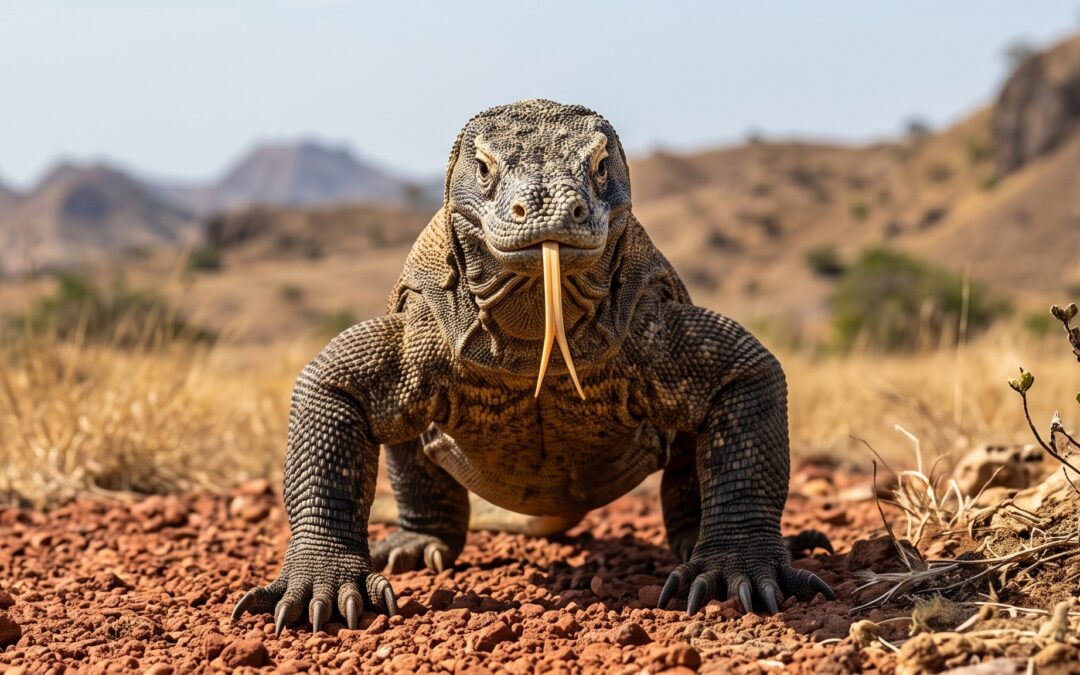
The Komodo Dragon (Varanus komodoensis) is the largest living lizard species on Earth, a formidable reptilian titan that rules the arid, volcanic islands of Indonesia’s Lesser Sunda archipelago. Evolving in geographic isolation over millions of years, this monumental monitor lizard can exceed ten feet in length and weigh over 200 pounds, occupying the supreme apex predator niche in its ecosystem. Armed with serrated teeth, reinforced osteoderm armor, and complex venom delivery glands, the Komodo dragon embodies a prehistoric predator lineage capable of bringing down large ungulates ten times its size, maintaining stability across fragile island wilderness environments.
Biology and Physical Characteristics
The anatomy of the Komodo dragon is an engineering marvel of reptilian dominance. Its scaly hide is embedded with thousands of tiny bone plates called osteoderms, forming a natural chainmail armor that protects it during violent intraspecific combat. Its long, deeply forked yellow tongue works in tandem with a specialized vomeronasal (Jacobson’s) organ to taste microscopic airborne scent molecules, allowing the dragon to detect decaying carrion or hunting quarries from over six miles (9.5 km) away. Research has revealed that the dragon possesses complex venom glands situated in its lower jaw; during a bite, these glands secrete specialized anticoagulant and hypotensive proteins that inhibit clotting, induce rapid hypovolemic shock, and accelerate blood loss in bitten prey.
Behavior and Ecology
Komodo dragons are patient ambush predators that lie completely motionless along game trails, concealed by their mottled gray-brown coloration. When a target passes within striking range, the dragon lunges with surprising explosive speed—reaching sprint bursts of 12 miles per hour (20 km/h)—delivering deep, tearing lacerations with its 60 serrated, shark-like teeth. If the prey breaks free, the dragon calmly tracks the dying animal across the landscape until it collapses from blood loss and venom-induced shock. Because large dragons readily practice cannibalism, young hatchlings spend their first several years living almost exclusively high in tree branches, rolling in feces to deter adult predation until they grow large enough to defend themselves.
Conservation and Human Impact
With an estimated wild population of fewer than 3,500 mature individuals restricted to a tiny, fragmented island range, the Komodo dragon was reclassified by the IUCN from Vulnerable to Endangered in 2021. Primary ecological threats include habitat encroachment from human settlements, illegal poaching of its primary prey species (Timor deer), and climate change-induced sea level rise that threatens to inundate low-lying coastal savannas across its island habitats. Strict protections within Komodo National Park, community ranger patrols, and sustainable ecotourism regulations continue to serve as the front line for the species’ ongoing survival.
Interesting Factoid
Female Komodo dragons are capable of virgin birth (parthenogenesis); in the complete absence of males, females can self-fertilize their own eggs to produce viable, all-male offspring, an evolutionary adaptation that enables solitary females to establish entirely new island colonies.