

AT A GLANCE
- Common Name: Red Fox
- Scientific Name: Vulpes vulpes
- Category: Mammals
- Subcategory: Carnivorans
- Size: Head and body length: 18–35 in (45–90 cm); Tail length: 12–22 in (30–55 cm)
- Weight: 6.5–24 lb (3.0–11.0 kg); adult dog-foxes average 15% heavier than vixens
- Lifespan: 2–5 years in the wild; up to 12–14 years in captivity
- Diet: Omnivore / Opportunistic mesopredator (voles, mice, rabbits, fruit, earthworms, insects, and carrion)
- Habitat: Forest mosaics, meadow edges, agricultural hedgerows, scrublands, and suburban greenbelts
- Range: Circumpolar Holarctic distribution across North America and Eurasia, plus introduced Australia
- Conservation Status: Least Concern (IUCN Red List)
Overview
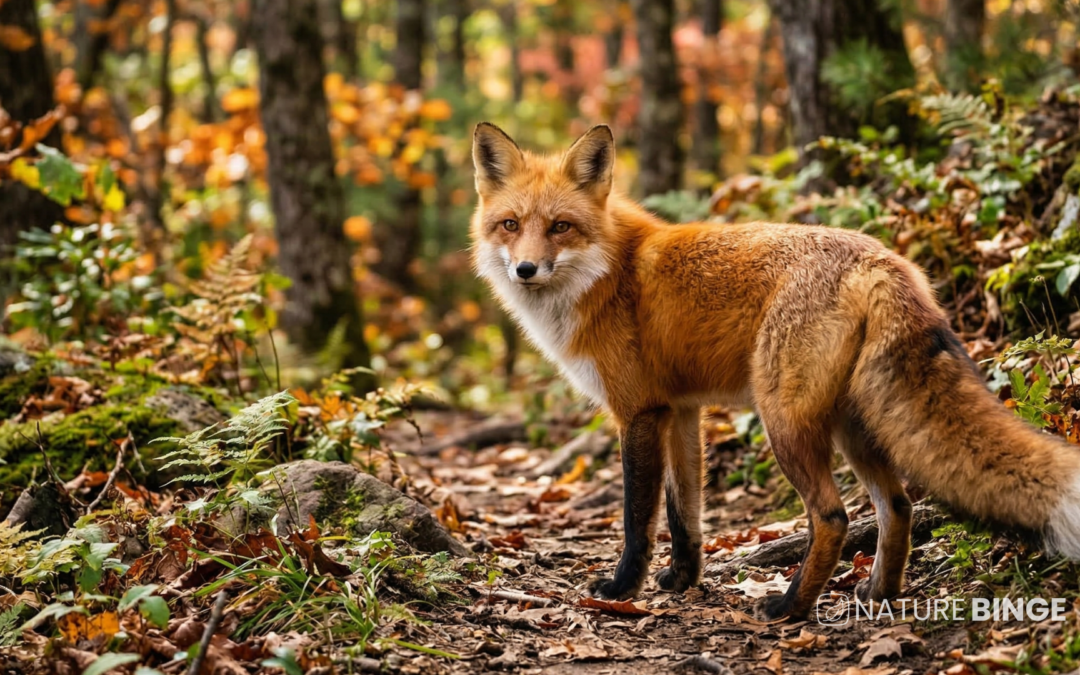
The Red Fox (Vulpes vulpes) is the largest true fox species within the genus Vulpes and the most geographically widespread terrestrial carnivoran on the planet. Recognized by its fiery rust-red coat, snow-white throat and chest, black ear backs and lower limb ‘stockings,’ and an iconic bushy tail tipped with clean white fur, the red fox is a masterpiece of evolutionary versatility. Renowned in global folklore for cunning wit and adaptability, it thrives across a spectrum of landscapes ranging from subarctic tundras and dense temperate woodlands to the heart of modern metropolitan cities.
In terrestrial ecosystems, red foxes fulfill a crucial ecological role as adaptable mesopredators, suppressing agricultural rodent pests such as field mice and voles while dispersing seeds of wild berries and consuming carrion. Their broad dietary plasticity and extraordinary behavioral flexibility have allowed them to survive alongside apex predators and exploit human-altered landscapes. However, in regions where they were introduced as non-native species—most notably Australia—their intense predatory pressure has driven catastrophic declines among small indigenous marsupials and ground-nesting birds.
Biology and Physical Characteristics
The morphology of Vulpes vulpes is an exquisite balance of agility, sensory precision, and thermal conservation. Its slender, elongated body and light skeletal architecture are built for rapid sprinting and leaping, supported by large, upright pinnae actuated by multiple auricular muscles to detect low-frequency acoustic rustling of subterranean rodents up to 100 feet away. Its dense winter pelage provides exceptional insulation down to -30°F (-35°C), while the luxuriant tail (‘brush’) serves as both a counterbalance during sharp turns and a warm facial muff during sleep. Red foxes possess elliptical pupils and a tapetum lucidum that confer superior nocturnal visual acuity in dim light.
Behavior and Ecology
Red foxes are solitary hunters that occupy home ranges defended by scent marking using urine and specialized violaceous tail glands. Hunting involves a characteristic predatory behavior known as ‘mousing’: the fox tilts its head to triangulate subterranean rustling before launching into a high, parabolic leap and plunging forepaws and snout straight downward through grass or snow pack to pin the rodent. Communication includes an array of over 28 distinct vocalizations, ranging from sharp contact barks to the eerie, high-pitched ‘vixen scream’ uttered during the winter breeding season.
Conservation and Human Impact
Classified as Least Concern by the IUCN Red List, the red fox maintains an exceptionally abundant global population with an expanding geographical footprint. The species faces no existential threats, easily exploiting anthropogenic food waste and suburban microhabitats. While historically targeted heavily for commercial fur trapping and sport hunting, modern populations are highly resilient. In Europe and North America, extensive oral rabies vaccination campaigns utilizing baited vaccine packets have successfully eliminated sylvatic rabies across vast portions of its historical range.
Interesting Factoid
Scientists have discovered that red foxes utilize Earth’s magnetic field as a targeting system: when executing their high parabolic pouncing leaps onto rodents hidden under snow, foxes predominantly orient their jump in a north-northeastern magnetic direction, achieving a dramatically higher hunting success rate when aligning with geomagnetic lines.