

Overview
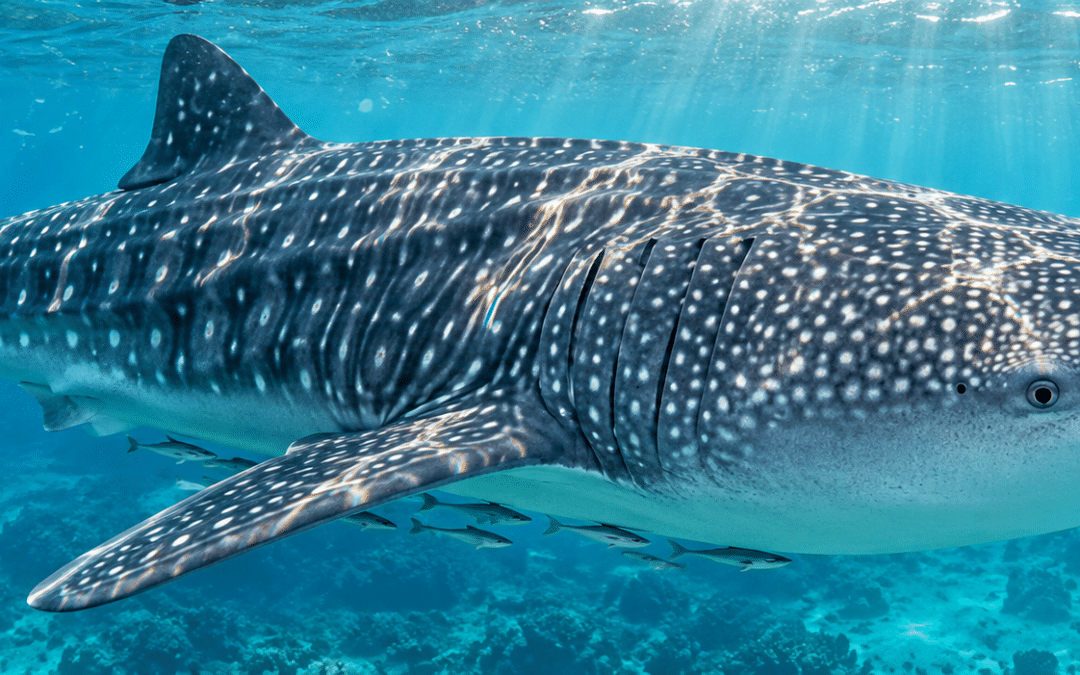
The Whale Shark (Rhincodon typus) is the largest living fish species in the world, an awe-inspiring gentle titan that graces warm tropical oceans across the globe. Belonging to the ancient carpet shark lineage, this colossal cartilaginous leviathan can grow to the length of a commercial passenger bus, yet feeds almost entirely on microscopic plankton and tiny schooling fish. Decorated with an iconic pattern of pale checkerboard spots and vertical stripes that resemble a celestial star map, the whale shark acts as an essential indicator of open-ocean productivity and coral reef health throughout circumglobal pelagic ecosystems.
Biology and Physical Characteristics
The massive body of Rhincodon typus is engineered for hydrodynamic efficiency and bulk filtration. Its broad, flattened head terminates in an immense, terminal mouth that can measure over five feet (1.5 m) wide, containing more than 300 rows of tiny, vestigial teeth that play no role in feeding. As one of only three known filter-feeding shark species, the whale shark utilizes cross-flow filtration across specialized spongy gill rakers to separate zooplankton and fish eggs from thousands of tons of seawater pumped through its gills every hour. Its tough, rubbery skin is up to four inches (10 cm) thick, reinforced with dermal denticles that provide armor against large marine predators. Remarkably, every whale shark features a completely unique arrangement of white spots and stripes behind its gill slits, functioning like a biological barcode that enables researchers to identify individuals via photo-recognition algorithms.
Behavior and Ecology
Whale sharks are docile, highly migratory oceanic wanderers that travel thousands of nautical miles across open ocean basins to rendezvous at predictable, seasonal feeding hot-spots. They gather in remarkable numbers at locations such as Ningaloo Reef in Western Australia, Isla Mujeres in Mexico, and Gladden Spit in Belize, timing their arrivals to synchronize with massive coral spawning and fish egg-laying events. While capable of deep dives into mesopelagic depths exceeding 6,000 feet (1,900 m) to feed on deep-sea squid, they spend long intervals cruising leisurely in surface sunlit waters. Females are ovoviviparous, retaining egg cases internally and giving birth to live, fully formed pups measuring roughly 20 inches in length.
Conservation and Human Impact
The global whale shark population has declined by more than 50 percent over the past three generations, resulting in its classification as Endangered by the IUCN. Decades of targeted commercial harpoon fishing for shark fins, liver oil, and meat—historically widespread across the Indo-Pacific—severely depleted regional stocks. Today, the most pressing hazards include fatal collisions with commercial cargo vessels (propeller strikes), accidental entanglement in industrial tuna purse-seine and gillnet fisheries (bycatch), and the ingestion of marine plastic pollution concentrated in oceanic current convergence zones. International treaties, vessel speed limits in known aggregations, and community-managed ecotourism programs provide critical frameworks for protecting this gentle giant.
Interesting Factoid
The whale shark’s skin is the thickest of any animal on Earth, measuring up to 4 inches (10 cm) deep and making its flank nearly impervious to bites from potential predators like killer whales or great white sharks.