
Overview
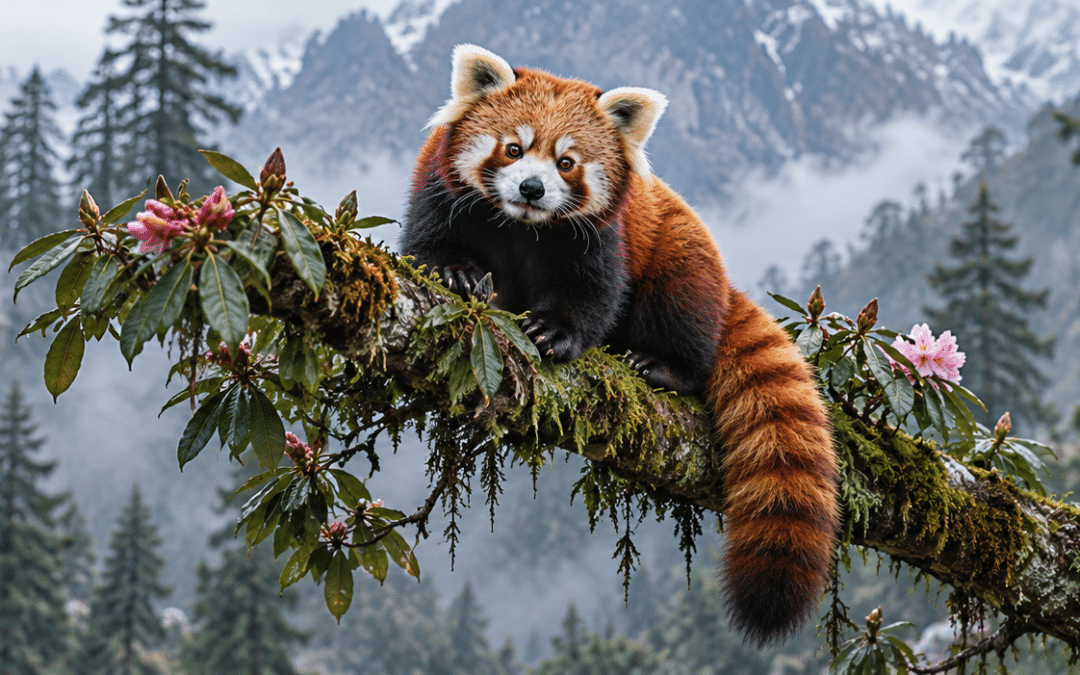
The Red Panda (Ailurus fulgens) is an enigmatic, arboreal mammal endemic to the high-elevation bamboo cloud forests of the Eastern Himalayas. Despite its colloquial name, it is not closely related to the giant panda, occupying its own distinct taxonomic family, Ailuridae. Adorned in a dense reddish-brown coat with a bushy ringed tail and white facial markings, it is a master of the canopy that fulfills a critical role in bamboo forest regeneration.
Biology and Physical Characteristics
The physical adaptations of the red panda are tailored for an acrobatic arboreal existence in chilly montane air. Like the giant panda, it possesses a modified wrist bone called a ‘false thumb’ (radial sesamoid) that allows it to grasp and manipulate slender bamboo shoots with precision. Its semi-retractable claws provide secure footing on slippery, lichen-encrusted branches, while its hind feet can rotate 180 degrees, enabling it to climb headfirst down tree trunks. The soles of its paws are fully cushioned with thick fur to insulate against freezing snow and prevent slipping on wet limbs.
Behavior and Ecology
Red pandas are solitary, territorial, and largely crepuscular, spending the daytime hours resting in tree crowns or hollow boughs curled into a ball with their tails wrapped around their snouts to conserve warmth. Territories are demarcated using anal scent glands, urine, and glandular secretions between foot pads. Communication involves head bobs, tail flicks, and soft bird-like whistles or twittering calls. Mothers build nests in tree cavities lined with leaves and moss, rearing one to four altricial cubs through early autumn.
Conservation and Human Impact
Red pandas are endangered due to rapid habitat fragmentation from road construction, timber harvesting, cattle grazing, and slash-and-burn agriculture across the Himalayan corridor. Fragmentation isolates small populations, exacerbating inbreeding depression. Accidental trapping in snares set for wild pigs and musk deer, alongside poaching for their striking pelts, continues to menace the species. Cross-border community-led conservation groups now actively train local forest guardians and build continuous wildlife canopy bridges.
Interesting Factoid
The red panda was taxonomically described in 1825—nearly five decades before the giant panda was known to Western science—making it the original and true owner of the name ‘panda.’