
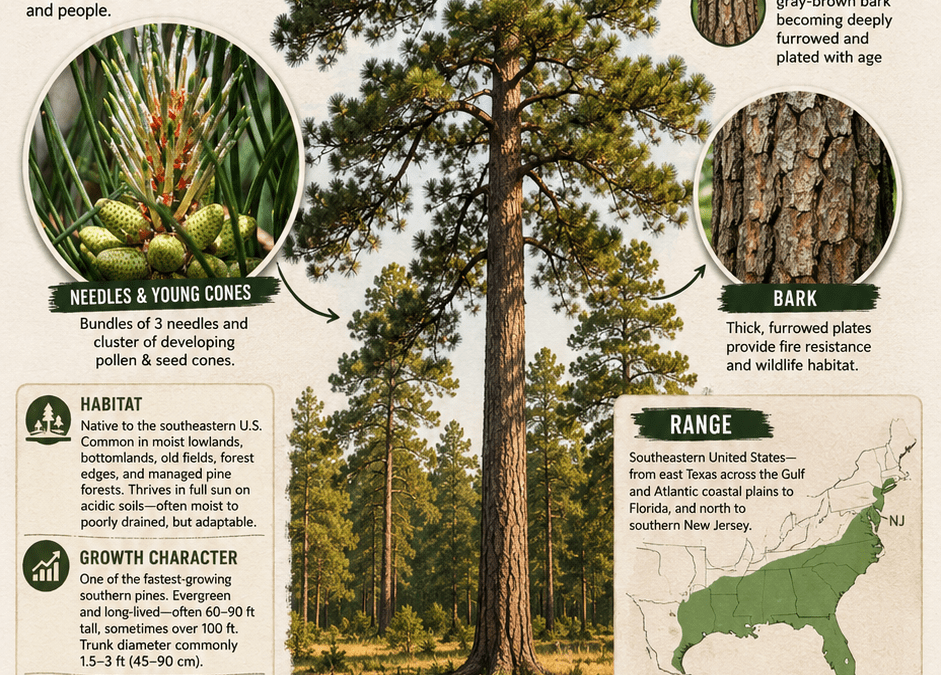

Overview
The Loblolly Pine (Pinus taeda), celebrated as the principal economic workhorse of the southern American timber industry, is the most abundant and commercially vital pine species across the southeastern United States. Dominating millions of acres of coastal plain flatwoods and rolling Piedmont hills, this fast-growing, straight-trunked conifer derives its common name from ‘loblolly’—an archaic colonial word referring to a low, moist, muddy depression or river bottom where the tree naturally flourished.
AT A GLANCE
- Common Name: Loblolly Pine
- Scientific Name: Pinus taeda
- Category: Plants
- Subcategory: Trees
- Size: Height 30 to 35 m (100 to 115 ft); trunk diameter 0.6 to 1.5 m (2 to 5 ft); record trees exceed 50 m (165 ft)
- Weight: Mature tree mass ranges from 10 to 30 metric tons
- Lifespan: 150 to 200 years; can exceed 250 years in undisturbed bottomlands
- Diet: Autotrophic; oxygenic photosynthesis requiring full sunlight and moist, acidic, clay or sandy loam soils
- Habitat: Lowland pine flatwoods, coastal plains, river floodplains, abandoned agricultural fields, and moist piedmont forests
- Range: Southeastern United States, spanning fourteen states from southern New Jersey and Delaware south to central Florida and west to eastern Texas and Oklahoma
- Conservation Status: Least Concern (IUCN Red List)
Ecologically, the loblolly pine is a foundational pioneer species that drives forest succession and carbon sequestration across the American South. Its expansive stands and dead standing snags provide irreplaceable nesting cavities for endangered red-cockaded woodpeckers, brown-headed nuthatches, and bald eagles, while its abundant seed crops sustain pine warblers, bobwhite quail, and fox squirrels. Comprising over half of all standing pine timber volume in the South, it forms the economic backbone of sustainable American lumber and pulp production.
Biology and Physical Characteristics
Pinus taeda is characterized by its slender, tall columnar trunk and open, rounded crown of dense foliage. Its needles are borne in fascicles (bundles) of three, measuring 12 to 23 cm (5 to 9 in) long, exhibiting a dark yellow-green to rich emerald-green coloration with fine stomatal lines. The bark of young trees is scaly and dark greyish-brown, maturing into thick, deeply furrowed, rectangular plates of reddish-brown that provide crucial insulation against low-intensity surface fires. The species is monoecious; male pollen strobili are cylindrical and yellow-red, releasing immense clouds of golden pollen in early spring. Female seed cones are sessile, oblong-conic, 7 to 13 cm (3 to 5 in) long, and armed with stout, sharp, triangular prickles on each scale that deter seed predators.
Behavior and Ecology
Loblolly pine is an aggressive, light-demanding colonizer that rapidly reclaims abandoned agricultural land, earning it the historic colloquial name ‘oldfield pine’. It establishes a deep, massive taproot anchored by expansive lateral roots that adapt readily to both waterlogged river bottoms and drought-prone sandy uplands. It grows with astonishing speed, often adding over a meter in height annually during its first two decades. In the presence of natural periodic fire regimes, thick mature bark protects the cambium, while exposed mineral soil created by burns provides an optimal seedbed for its wind-dispersed winged seeds.
Conservation and Human Impact
Currently assessed as Least Concern on the IUCN Red List, Pinus taeda is exceedingly abundant, biologically secure, and extensively propagated across millions of hectares of managed commercial timberland. The primary biological threats facing loblolly forests include cyclical outbreaks of the southern pine beetle (Dendroctonus frontalis), which bore into the vascular cambium of crowded or drought-stressed trees, and fusiform rust (Cronartium quercuum f. sp. fusiforme), an endemic fungal pathogen that produces distorting galls on stems.
Interesting Factoid
The Loblolly Pine is the second most common tree species in the entire United States (after the red maple), making up more than half of all the standing pine timber in the American South.