
Overview
The Madagascan Pitcher Plant (Nepenthes madagascariensis) holds a celebrated position in botanical history as the very first pitcher plant ever described by Western science, documented by French colonial governor Étienne de Flacourt in 1658. As the westernmost representative of the primarily Southeast Asian genus Nepenthes, this striking carnivorous plant is endemic exclusively to the fragile coastal bogs of eastern Madagascar. Thriving in extremely nutrient-poor, waterlogged peat soils, Nepenthes madagascariensis has evolved elaborate passive pitfall traps that lure, drown, and digest arthropods to extract life-sustaining nitrogen and phosphorus.
Biology and Physical Characteristics
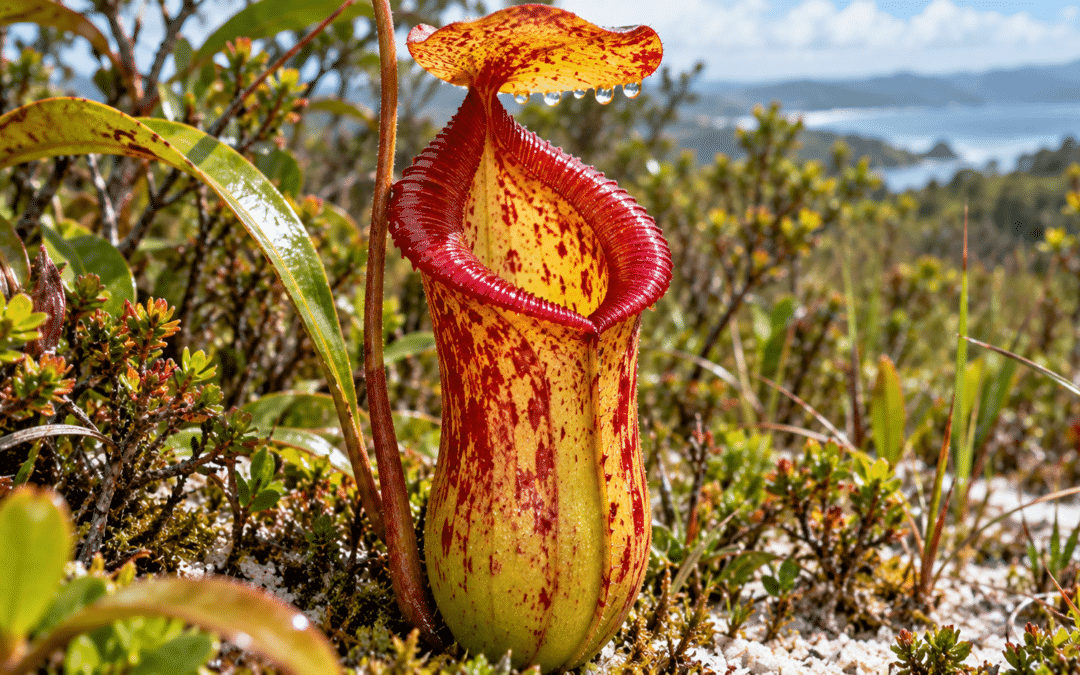
Nepenthes madagascariensis grows as an erect shrub or climbing vine reaching up to two meters in height, bearing thick, leathery leaves with parallel venation. From the leaf tips, tendrils extend downward to form spectacular, dimorphic pitfall pitchers. The lower pitchers, produced by young rosettes, are bulbous and squat, featuring vivid bright yellow to scarlet coloration with a broad, ribbed peristome (lip). Upper pitchers, produced as the plant climbs, are slender, funnel-shaped, and predominantly brilliant lemon-yellow. The interior walls are lined with microscopic, waxy slippery scales above a deep pool of digestive enzyme fluid rich in nepenthesin proteases and chitinases.
Behavior and Ecology
Carnivory in Nepenthes madagascariensis is driven by extreme soil nutrient deficits in coastal white sand podzols. The plant lures prey using a dual sensory strategy: sweet, nectar-secreting glands lining the peristome emit sugary fragrances, while bright yellow and red anthocyanin pigments provide strong visual contrast. When foraging ants, wasps, or beetles step onto the peristome, its microscopic groove architecture—rendered frictionless by a microscopic film of water—causes the insects to lose footing and plunge into the acidic liquid below. Downward-pointing hairs prevent escape, while specialized digestive glands rapidly dissolve the insect’s soft tissues, absorbing vital amino acids directly through the pitcher wall.
Conservation and Human Impact
While categorized as Least Concern by the IUCN due to several viable coastal colonies, Nepenthes madagascariensis faces escalating localized pressures along Madagascar’s eastern coast. Commercial ilmenite and titanium sand mining, conversion of peat swamps for rice agriculture, and charcoal production have degraded significant tracts of coastal wetland habitat near Fort Dauphin (Taolagnaro). In addition, excessive wild collection for horticulture poses risks. Protecting coastal wetlands within the Mandena Conservation Zone and establishing local ecotourism trails are central to safeguarding this botanical pioneer.
Interesting Factoid
Nepenthes madagascariensis was the very first carnivorous pitcher plant ever recorded by Europeans: in 1658, French explorer Étienne de Flacourt wrote in wonder of an ‘eight-inch hollow flower with a lid’ that collected fresh rainwater and swallowed insects whole on the shores of Madagascar.