
Overview
The Splendid Waxcap (Hygrocybe splendissima) is one of the most brilliant jewels of European fungal diversity. Belonging to the family Hygrophoraceae, this radiant agaric features a gleaming scarlet-to-ruby cap and thick, waxy gills that illuminate ancient, sheep-grazed hillsides in late autumn. Beyond its arresting aesthetic beauty, Hygrocybe splendissima serves as a premier bio-indicator of ancient unimproved grasslands—fragile agricultural habitats that have remained undisturbed by chemical fertilizers, artificial drainage, or plowing for over a century.
Biology and Physical Characteristics
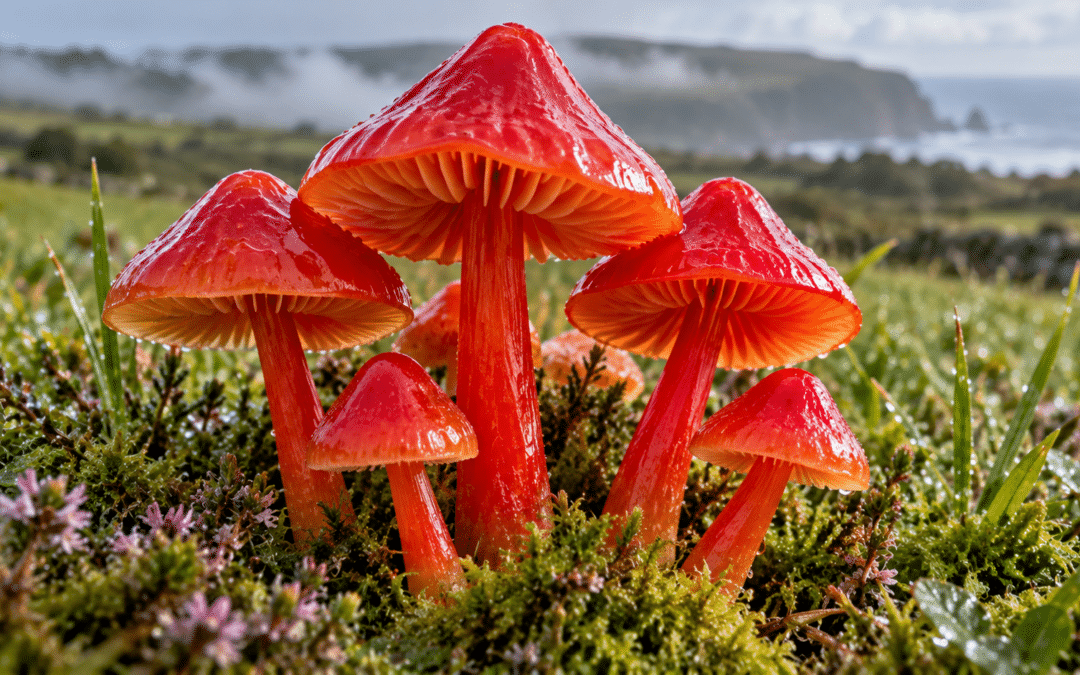
The fruiting body of Hygrocybe splendissima is distinguished by a bell-shaped to broadly conical cap that expands to become flat with a wavy margin, measuring up to 8 cm across. When fresh, the cap surface is moist, waxy, and drenched in an intense, non-fading scarlet-red or fiery vermilion color. Its thick, distant gills are pale yellow to orange-red, attached narrowly to the stipe, and feel characteristically waxy to the touch due to elongated basidial structures. The hollow, flattened stipe matches the cap in vivid crimson, often yellowing near the base. When drying, the flesh emits a distinct, sweet honey-like fragrance that serves as a key diagnostic identifier separating it from similar scarlet waxcaps.
Behavior and Ecology
Unlike woodland mushrooms that decompose fallen leaves or form mycorrhizal bonds with tree roots, waxcaps occupy a mysterious ecological niche known as CHEGD grasslands (Clavariaceae, Hygrocybe, Entoloma, Geoglossaceae, Dermoloma). Research indicates that Hygrocybe splendissima lives biotrophically or endophytically within the root systems and moss mats of unimproved pastures. It is exquisitely sensitive to nitrogen and phosphorus; even a single application of modern agricultural chemical fertilizer or lime will instantly kill the underground mycelium, eliminating fruiting bodies for decades. As such, its presence signifies a pristine grassland soil ecosystem of international conservation significance.
Conservation and Human Impact
Hygrocybe splendissima is evaluated as Vulnerable on the global IUCN Red List of Fungi, having suffered drastic population declines exceeding 30 to 50 percent across Western Europe over the past half-century. Intensive agricultural industrialization, conversion of sheep pastures to arable crop farming, atmospheric nitrogen deposition, and urban sprawl have decimated traditional waxcap habitats. Conservation strategies spearheaded by the British Mycological Society and Plantlife focus on protecting historic churchyards, national commons, and upland traditional pastures, advocating for non-chemical grazing regimes to maintain short, mossy turf.
Interesting Factoid
As the splendid waxcap dries out in late autumn or in a collection basket, its cap and gills release a potent, sweet aroma that smells exactly like fresh clover honey.