
Overview
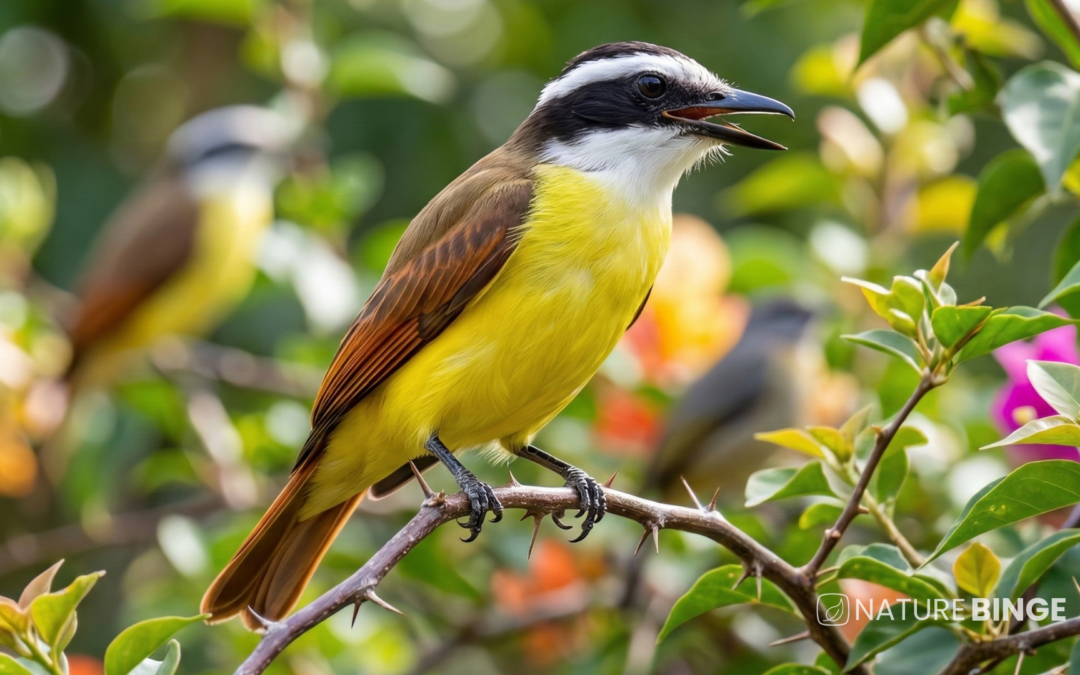
The Great Kiskadee (Pitangus sulphuratus) is one of the most charismatic and vocal members of the tyrant flycatcher family. Named for its loud, onomatopoeic “kis-ka-dee” call, it is a master of adaptation found from the southern tip of Texas to the heart of Argentina. With its vibrant yellow belly, bold black-and-white striped head, and large, powerful beak, the kiskadee is a dominant presence in open woodlands, gardens, and along the banks of rivers. Unlike most flycatchers that specialize in insects, the Great Kiskadee is a versatile generalist, preying on everything from beetles and frogs to small fish and fruit. Its presence is a quintessential sign of the Neotropical landscape, a species that has successfully integrated into urban environments and remains a primary focus of cultural identity across the Americas.
Biology and Physical Characteristics
The biology of the Great Kiskadee is optimized for powerful, versatile hunting. They possess a robust build with a large head and a massive, dagger-like beak that is hooked at the tip. This beak is a formidable tool used for subduing a wide variety of prey, from hard-shelled beetles to slippery fish. Their plumage is a striking mix of cinnamon-brown on the wings and tail, a brilliant yellow belly, and a stark black-and-white crown. One of their most specialized adaptations is the “concealed” yellow or orange patch on their crown, which they raise during territorial displays or when agitated.
Their sensory adaptations are highly refined for opportunistic survival. Kiskadees have exceptional vision, including high-contrast focus and the ability to detect movement from a distance. Their eyes are dark and positioned for a wide field of view. One of their most unusual biological behaviors is their “kingfisher-like” fishing technique; they will hover over the water and dive to snatch small fish and tadpoles from the surface. Their vocal apparatus is also highly specialized, capable of producing the complex and echoing calls that serve as territorial proclamations and social signals. This combination of physical power, visual precision, and behavioral flexibility makes the Great Kiskadee one of the most successful avian predators in its range.
Behavior and Ecology
Great Kiskadees are predominantly solitary or found in pairs, but they are highly social and vocal within their territories. They are aggressively territorial, often chasing away larger birds like hawks and caracaras. Their hunting strategy is a masterclass in opportunistic foraging: they sit on an open branch, scanning for any potential food item, and launch direct, powerful strikes. Their diet is incredibly diverse, including crickets, lizards, frogs, berries, and even the occasional small rodent—a versatility that has allowed them to thrive in human-altered landscapes.
Ecologically, the Great Kiskadee is a vital regulator of the Neotropical food web. By preying on a wide variety of species, they help maintain the balance of the local ecosystem. Their presence is a sign of a healthy and diverse environment with adequate prey and varied vegetation. They are known for building large, domed nests of sticks and grass, often located near water or in tall trees. This structural complexity provides protection for the eggs and chicks from both weather and predators. Their role in the ecosystem is that of a “generalist regulator,” a species whose success is inextricably linked to the diversity and productivity of the landscape. The relationship between the kiskadee and its habitat is a perfect example of the “voice of the wild” integrated into the human world.
Conservation and Human Impact
The Great Kiskadee is currently listed as Least Concern by the IUCN, as it remains widespread and highly adaptable. However, they face ongoing threats from habitat loss and the impacts of urbanization. The clearing of woodlands and the pollution of local water bodies can affect their food sources and nesting success. In many regions, they have become highly adapted to humans, often nesting in garden trees and foraging from outdoor tables, a behavior that promotes public engagement with wildlife.
Conservation efforts focus on the preservation of diverse forest edges and the protection of urban green spaces. Promoting “bird-friendly” gardening and avoiding the use of broad-spectrum pesticides are essential for supporting local populations. Scientific research into their population dynamics and behavioral flexibility is providing new insights into how species adapt to environmental change. Protecting the Great Kiskadee is about more than just saving a vocal bird; it is about acknowledging the value of the vibrant and resilient lives that sustain our connection to the natural world. Their bold patterns and echoing calls remain a permanent fixture of the American dawn, reminding us of the enduring beauty of the wild. Protecting the kiskadee ensures that the “art of the air” continues to thrive for generations to come.