
Overview
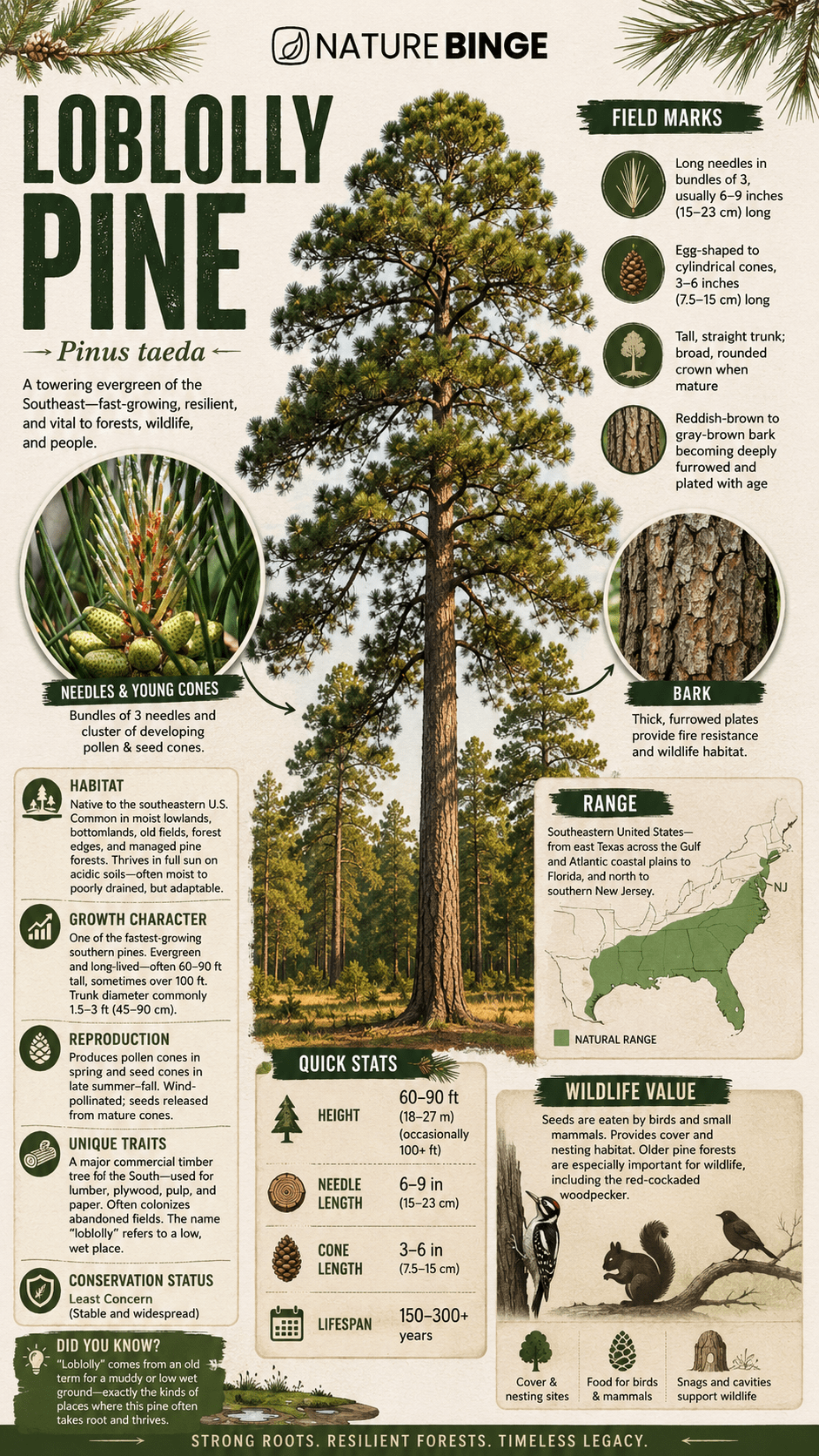
The Loblolly Pine (Pinus taeda) is one of the most majestic, valuable, and ecologically significant trees in the world. As the most commercially important timber species in the United States, it is the definitive giant of the Southeastern American forest.
Found from the coastal plains to the Piedmont region, the Loblolly Pine is a master of adaptation in moist, low-lying areas—originally known as “loblollies.” As a foundation species, it supports an extraordinary diversity of wildlife and is a primary driver of carbon sequestration in the southern wilderness.
Its existence is a remarkable study in structural resilience, specialized fire adaptation, and the vital role of “fast-growing evergreens” in maintaining the health and productivity of the American wild. Beyond its ecological value, the Loblolly Pine remains a cornerstone of the global timber industry and a primary resource for paper and construction.
In the mind’s eye, the tree is facing the camera, its straight, reddish-brown trunk rising high toward the sun and its massive canopy creating a dappled light on the forest floor.
Biology and Physical Characteristics
The biology of the Loblolly Pine is optimized for rapid growth and dominance in competitive forest environments. Their most striking feature is their bark—thick, reddish-brown, and broken into large, rectangular plates as the tree matures, providing exceptional protection against insects and low-intensity fires.
Their needles are long, dark green, and arranged in clusters of three, providing a dense canopy that supports a unique community of understory plants. Unlike many pines, the Loblolly is exceptionally adaptable to a variety of soil types, although it prefers the deep, moist alluvial soils of the coastal plain.
Loblolly Pines are gymnosperms, producing large, woody cones that open to release winged seeds in the autumn. Their root system is uniquely wide-reaching and possesses a powerful taproot that provides exceptional stability in high winds.
Biologically, they are among the most fast-growing trees on Earth, reaching maturity within 60 years and capable of living for two centuries. Their wood is uniquely strong, resinous, and resistant to decay, a trait that historically made it the primary material for American shipbuilding and railroad ties.
This structural efficiency and biological resilience make the Loblolly Pine the definitive master of the southern lowlands.
Behavior and Ecology
In the southern forest, the Loblolly Pine is a primary agent of stability. It is a “pioneer-climax” species, representing both the early and late stages of ecological succession in moist, warm environments.
Its dense canopy provides a cool and sheltered microclimate on the forest floor, supporting a diverse community of mosses, ferns, and specialized songbirds that cannot survive in open fields. Ecologically, the Loblolly Pine forest is a hub of biodiversity.
Its seeds and bark are a primary winter food source for birds like the Brown-headed Nuthatch and mammals like the grey squirrel, while its massive branches provide nesting habitat for numerous species, including the Red-cockaded Woodpecker.
The relationship between the Loblolly Pine and the nutrient cycle is one of total interdependence. The tree acts as a natural water regulator, facilitating the transport of nutrients from the subsoil to the forest floor through its needle litter.
Furthermore, loblolly pine forests are among the most effective carbon sequesterers in the temperate region, locking away massive amounts of organic carbon within their dense wood and the forest soil.
However, this reliance on stable, moist environments makes the tree sensitive to over-management and the impacts of invasive pests like the southern pine beetle. The health of a loblolly grove is a direct measure of the integrity and resilience of the landscape, representing a balance between rapid growth and centuries of ecological support.
Conservation and Human Impact
While the Loblolly Pine is currently listed as Least Concern, localized populations face threats from habitat loss due to development and the impacts of intensive industrial logging.
Historically, over-harvesting for the timber and turpentine industries decimated the original old-growth pine forests. Today, while the species is widely planted in managed forests, the protection of the remaining wild groves is a high priority.
The primary modern threats are habitat loss driven by development and the impacts of climate change, which can alter the frequency and intensity of summer rainfall. Conservation efforts focus on the protection of diverse forest tracts and the restoration of natural fire cycles in pine systems.
Maintaining forest connectivity and protecting the native wildlife that depends on pine cover are essential for the long-term survival of the species. Scientific research into the genetics of disease resistance and wood density in Loblolly Pine is providing new insights into how forests can adapt to a changing world.
Protecting the Loblolly Pine is about more than just saving a tree; it is about safeguarding the incredible biological wealth and history of the American wilderness. These dark-barked titans remain a powerful symbol of the raw energy and beauty of the natural world.
Protecting the pine ensures that the “lungs of the south” continue to breathe for generations to come.