
Overview
Welwitschia (Welwitschia mirabilis) is one of the most bizarre and physiologically remarkable botanical relics on Earth. A solitary monotypic gymnosperm belonging to the order Welwitschiales, this living fossil thrives in the hyper-arid wastes of the Namib Desert—one of the oldest deserts in the world. Producing only two true leaves that grow continuously throughout its entire multi-millennial lifespan, Welwitschia has defied extreme heat, drought, and wind for prehistoric epochs.
Biology and Physical Characteristics
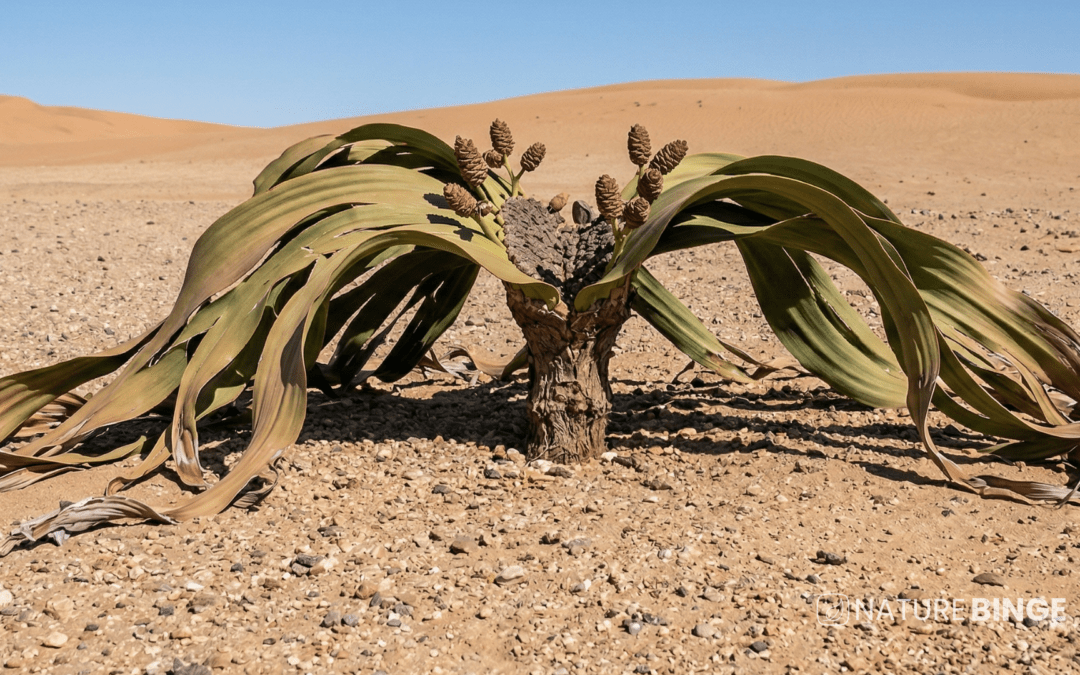
The morphology of Welwitschia mirabilis is unique in the plant kingdom. Above ground, it consists of an obconical, woody stem that broadens into a concave disc with age. From a basal meristematic groove along this disc, the plant produces exactly two strap-like leaves that never shed. Over centuries, relentless desert sandstorms tear and fray these two original leaves into tangled ribbons that snake across the desert floor. Its leaves possess thousands of specialized stomata on both surfaces that absorb vital moisture from dense nocturnal Atlantic fog blankets.
Behavior and Ecology
Welwitschia is dioecious, with separate male and female plants producing cone-like reproductive strobili on branched stems above the woody crown. Pollination is facilitated by specialized insects, notably the welwitschia bug (Probergrothius angolensis), which feeds on sugary nectar droplets secreted by the cones. The extensive root system features a deep, anchoring taproot descending to subterranean water tables, flanked by a network of shallow lateral roots that absorb brief flash flood moisture.
Conservation and Human Impact
The IUCN evaluates Welwitschia mirabilis as Least Concern due to substantial, healthy populations distributed across remote, inaccessible desert landscapes. Major strongholds exist within Namibia’s Namib-Naukluft National Park and Angola’s Iona National Park. While long-term threats include off-road vehicle damage and unregulated desert mining, the extreme resilience and international legal protection of this botanical marvel ensure its ongoing survival in its harsh ancestral home.
Interesting Factoid
A mature Welwitschia mirabilis possesses only two leaves—the very same pair it grew when it germinated from seed over a thousand years ago, growing constantly from the base like human fingernails while weathering and curling at the tips.
Last updated: October 2026