
Overview
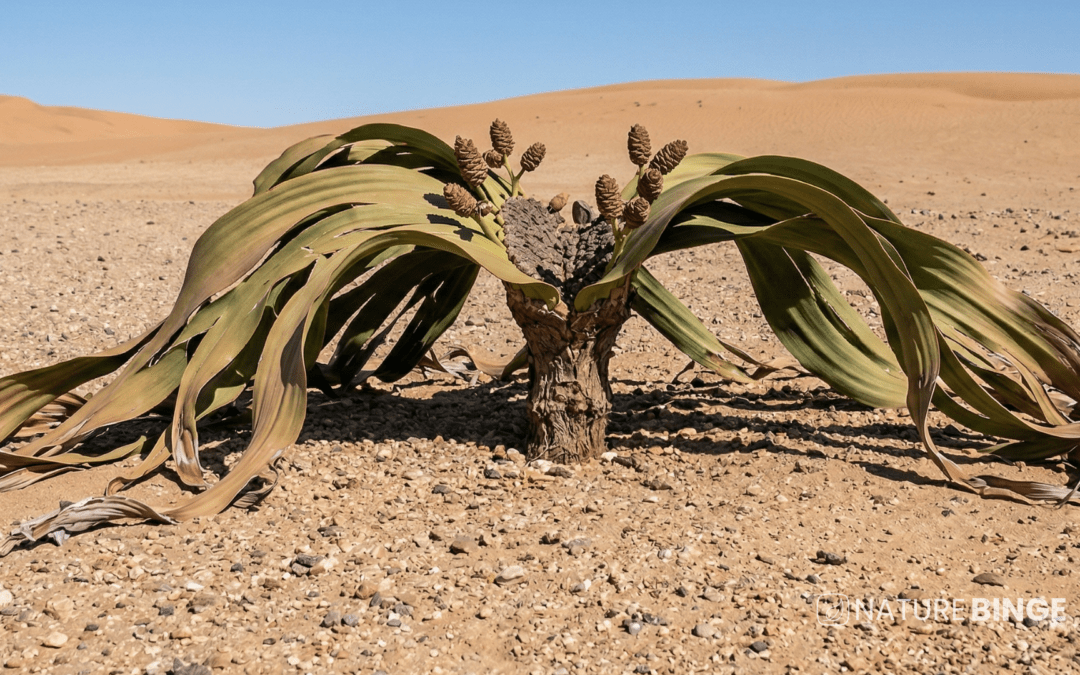
Welwitschia (Welwitschia mirabilis), termed by botanist Joseph Dalton Hooker as ‘the most wonderful plant ever brought to this country,’ is an ancient gymnosperm that represents an isolated monotypic evolutionary lineage dating back to the Early Cretaceous. Endemic to the hyper-arid Namib Desert, this living botanical monument survives in one of the most extreme desert environments on Earth, enduring temperatures exceeding 45°C and annual rainfall below 10 millimeters.
Biology and Physical Characteristics
The morphology of Welwitschia mirabilis is unique in the plant kingdom. Growing from an unbranched woody crown that broadens with age into an inverted cone, the plant produces only two true leaves throughout its entire millennium-long lifespan. These two strap-shaped foliage leaves grow continuously from a basal meristem, splitting into frayed, twisted ribbons over centuries under the force of desert sandstorms. Microscopic stomata on both leaf surfaces absorb vital water droplets directly from rolling coastal sea fogs.
Behavior and Ecology
Welwitschia is dioecious, bearing separate male and female reproductive cone-like structures on distinct individuals. Pollination is facilitated by desert insects, particularly the specialized pyrrhocorid bug *Probergrothius angolensis*. Its expansive root system features a deep taproot that penetrates downward toward deep subsurface aquifers, while extensive lateral runner roots scavenge sparse surface moisture. The sprawling, frayed foliage provides vital shade and moisture shelters for desert beetles, adders, and oryx.
Conservation and Human Impact
Evaluated as Least Concern by the IUCN, Welwitschia mirabilis populations remain abundant and stable within vast protected areas such as Namib-Naukluft National Park in Namibia and Iona National Park in Angola. Due to strict legal protections and low human population density across its desert habitat, threats from illegal collection or grazing are low. The species is celebrated globally on Namibia’s coat of arms as a symbol of resilience.
Interesting Factoid
Radiocarbon dating of large wild Welwitschia specimens in the Namib Desert has confirmed individual plant ages exceeding 1,500 years, meaning some living specimens were already growing during the fall of the Western Roman Empire.
Last updated: October 2026