
Overview
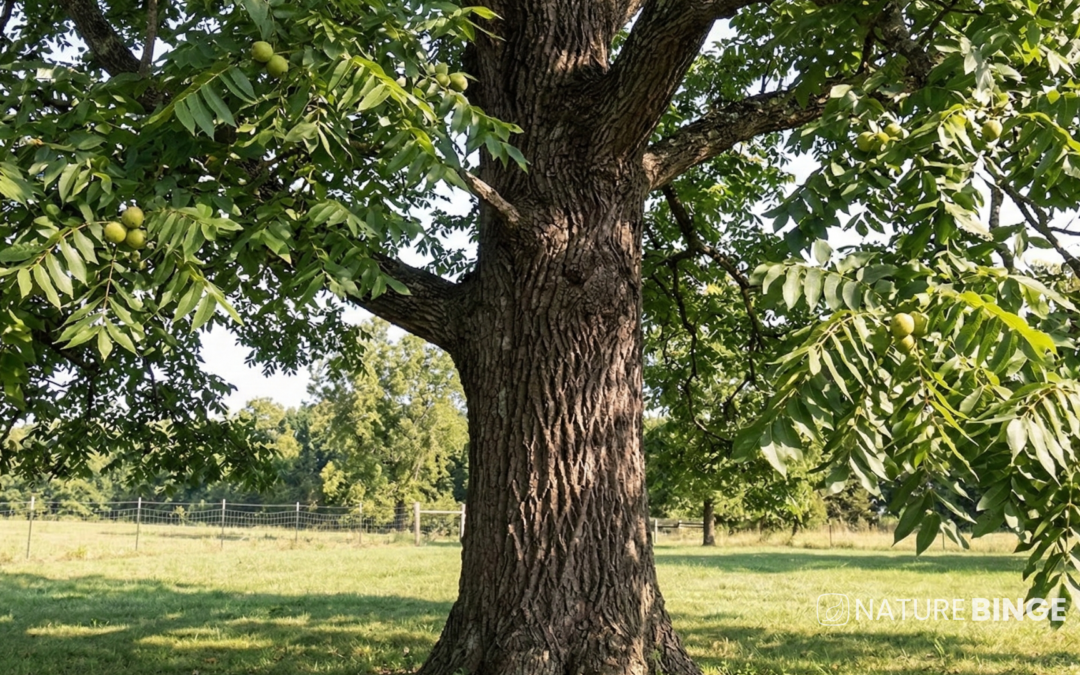
The Black Walnut (Juglans nigra), often revered as the aristocrat of North American hardwoods, is one of the most prestigious, culturally storied, and economically valuable deciduous trees native to the United States and Canada. Commanding fertile river bottomlands and sunny woodland margins across eastern North America, this grand canopy tree is celebrated for its rich, chocolate-brown figured timber, fragrant pinnate foliage, and deeply furrowed dark bark.
AT A GLANCE
- Common Name: Black Walnut
- Scientific Name: Juglans nigra
- Category: Plants
- Subcategory: Trees
- Size: Height 25 to 40 m (80 to 130 ft); trunk diameter 0.8 to 1.5 m (2.5 to 5 ft); crown spread can exceed 30 m (100 ft)
- Weight: Mature tree mass ranges from 12 to 30 metric tons
- Lifespan: 150 to 250 years; exceptional specimens live over 300 years
- Diet: Autotrophic; oxygenic photosynthesis requiring deep, fertile, moisture-retentive, well-drained limestone soils
- Habitat: Rich mesic deciduous forests, river valleys, alluvial bottomlands, and limestone hillsides
- Range: Eastern and central North America, from southern Ontario and New York west to South Dakota and south to central Texas and Georgia
- Conservation Status: Least Concern (IUCN Red List)
Ecologically, the black walnut is a keystone mast producer that sustains wildlife communities throughout harsh winters. Its large, thick-shelled nuts are a critical high-fat, protein-dense food resource cached by eastern fox squirrels, grey squirrels, and wild turkeys. Scientifically, Juglans nigra is universally famous for its biochemical warfare—allelopathy—secreting the chemical compound juglone into the surrounding soil to actively suppress competing plants, sculpting the botanical composition of the forest understory.
Biology and Physical Characteristics
Juglans nigra is characterized by large, alternate, pinnately compound leaves measuring 30 to 60 cm (12 to 24 in) in length, bearing 13 to 23 finely toothed, lanceolate leaflets that emit a sharp, spicy, citrus-like fragrance when bruised. Its bark is dark brown to near black, forming a rugged diamond-patterned lattice of deep furrows and narrow ridges. The tree is monoecious, producing drooping green male catkins and small female flower clusters in spring. The fruit consists of a spherical, green, fleshy, fibrous husk that encases a deeply corrugated, exceptionally hard, dark brown nut shell containing sweet, oily, strongly flavored edible meat. Biologically, the roots, husks, and leaves synthesize hydrojuglone, an odorless, nontoxic glucoside that oxidizes in soil into juglone (5-hydroxy-1,4-naphthoquinone), a potent respiratory inhibitor that stunts or kills juglone-sensitive plants like tomatoes, apples, and pines.
Behavior and Ecology
Black walnut is a light-demanding, fast-growing pioneer-to-climax tree that relies on a deep, massive taproot to access subterranean water tables and stabilize its expansive crown against storms. Because the hard nut shell is almost impenetrable to most animals, the tree depends almost exclusively on scatter-hoarding rodents—principally squirrels—for seed dispersal; squirrels bury thousands of nuts across forest meadows each autumn, and the forgotten caches germinate in spring. Its late spring leaf flush and early autumn leaf drop represent an adaptation to maximize sunlight penetration to its own seedlings during key growth windows.
Conservation and Human Impact
Currently assessed as Least Concern on the IUCN Red List, the Black Walnut remains widespread and heavily cultivated across agroforestry plantations. While wild old-growth specimens were intensely harvested over centuries for gunstocks, fine cabinetry, and architectural woodwork, secondary stands and commercial walnut orchards flourish. The most severe modern biological threat is Thousand Cankers Disease, a deadly disease complex caused by the invasive walnut twig beetle (Pityophthorus juglandis) and its associated fungal pathogen (Geosmithia morbida), which has caused severe localized tree mortality in western states.
Interesting Factoid
The Black Walnut secretes a natural biochemical herbicide called juglone through its roots and rotting leaf litter, creating an underground ‘exclusion zone’ that inhibits the respiration and growth of competing trees, shrubs, and garden crops.