
Overview
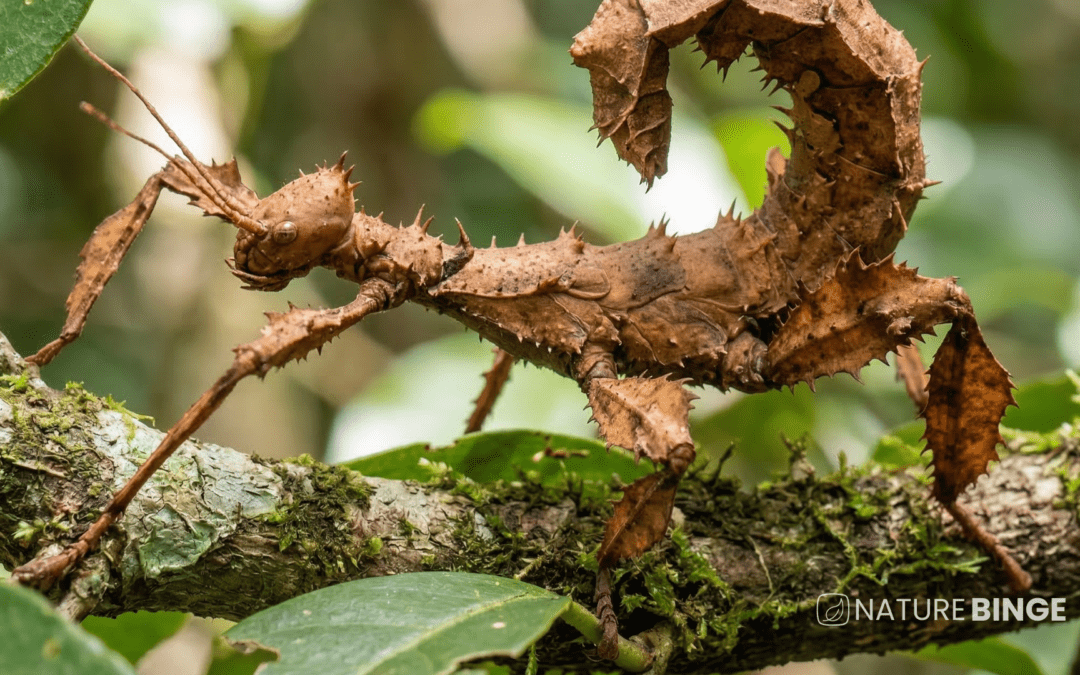
The Giant Prickly Stick Insect (Extatosoma tiaratum), also known as the Macleay’s Spectre or the Spiny Leaf Insect, is one of the most spectacular masters of disguise in the invertebrate world. Native to the tropical rainforests and coastal woodlands of Australia and New Guinea, it has evolved a morphology that almost perfectly mimics a dried, curled eucalyptus leaf. Characterized by its spiny exoskeleton, lobed limbs, and the unique scorpion-like posture adopted by the females, this insect is a symbol of evolutionary ingenuity. As a specialized herbivore, it plays a vital role in forest nutrient cycling by processing massive quantities of foliage. Its existence is a remarkable study in passive defense, specialized mimicry, and the incredible efficiency of life cycles that utilize both sexual and asexual reproduction to ensure survival in the competitive tropical canopy.
Biology and Physical Characteristics
The biology of the Giant Prickly Stick Insect is entirely optimized for deception and defense. They possess a robust, elongated body covered in sharp, thorn-like spines (tubercles) that break up their silhouette against the vegetation. Their limbs are equipped with large, leaf-like lobes that enhance their resemblance to organic debris. One of their most specialized adaptations is sexual dimorphism: while males are slender and possess long, functional wings for flight, the larger females are wingless and adopt a defensive posture where they curl their abdomen over their head to mimic a scorpion—a behavior known as thanatosis.
Their sensory adaptations are highly refined for a life spent in the canopy. They possess large compound eyes and long antennae used to locate host plants and detect chemical signals from mates. One of their most unusual biological traits is their reproductive flexibility; they are capable of parthenogenesis, meaning females can produce fertile eggs without mating with a male—though this results in only female offspring. Their eggs are equally specialized, mimicking the appearance of seeds (specifically those of acacias) to encourage “dispersal” by ants, who carry the eggs to their underground nests where they are protected from predators. This combination of physical mimicry, behavioral posturing, and reproductive resilience makes the Giant Prickly Stick Insect one of the most successful and fascinating invertebrates of the Australasian wild.
Behavior and Ecology
Giant Prickly Stick Insects are predominantly solitary and nocturnal feeders. They spend their days hanging motionlessly from the undersides of leaves, often swaying gently to mimic a leaf caught in the breeze. Their behavior is characterized by extreme patience; they move slowly and deliberately to avoid detection by birds and arboreal mammals. Their diet is highly specialized, consisting almost exclusively of the leaves of eucalyptus, acacia, and other native Australian trees. During the night, they forage voraciously, processing large amounts of plant matter.
Ecologically, the Giant Prickly Stick Insect is a vital regulator of forest vegetation. By consuming large quantities of foliage, they facilitate the turnover of organic matter and return essential nutrients to the forest floor through their droppings (frass). Their presence is a definitive sign of a healthy and productive tropical ecosystem with high biodiversity. They occupy a middle tier in the food web, serving as both effective recyclers and a primary food source for large birds, reptiles, and mammals. Their role in the ecosystem is that of a “canopy architect,” a species whose feeding habits and dispersal strategies influence the structure of the forest understory. The relationship between the insect and its ant partners is a perfect example of the complex mutualistic bonds that sustain tropical biodiversity.
Conservation and Human Impact
While the Giant Prickly Stick Insect is currently not a species of conservation concern, they face ongoing threats from habitat loss due to land clearing and the impacts of urbanization in Australia. Because of their spectacular appearance and relatively easy care, they are one of the most popular species in the global invertebrate pet trade and are frequently utilized in educational displays worldwide. Historically, they have been a subject of fascination for naturalists due to their extreme morphology.
Conservation efforts focus on the protection of primary rainforest tracts and the maintenance of diverse woodland corridors. Promoting the preservation of native eucalyptus forests is essential for the long-term survival of the species. Scientific research into their genetics and reproductive biology is providing new insights into the evolution of complex defensive strategies in insects. Protecting the Giant Prickly Stick Insect is about more than just saving a large bug; it is about safeguarding the incredible biological heritage and innovation of the Australasian tropics. Their gnarled, leaf-like forms remain a powerful symbol of the hidden beauty and success of the wild world. Protecting the insect ensures that the “spectres of the rainforest” continue to haunt our forests for generations to come.