
Overview
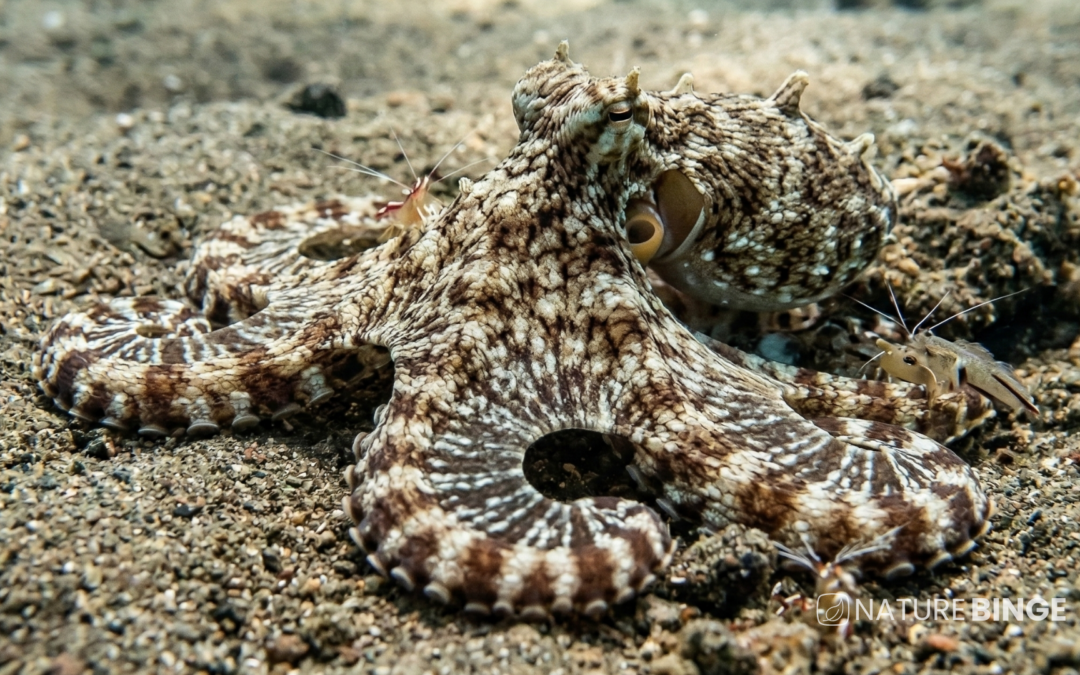
The Mimic Octopus (Thaumoctopus mimicus) is universally acknowledged as one of the most astonishing cognitive and evolutionary wonders of the animal kingdom. Discovered by marine biologists in 1998 off the coast of Sulawesi, this intelligent cephalopod is the only known marine animal capable of dynamically and consciously impersonating multiple distinct venomous and predatory species to deter threats and ambush prey across barren, shelterless sand plains.
Biology and Physical Characteristics
Thaumoctopus mimicus possesses a modest mantle measuring only a few inches long, offset by eight exceptionally slender, elongated arms reaching up to two feet in total span. Its skin contains a dense layer of thousands of neural-controlled pigment cells (chromatophores), iridophores, and leucophores, which interact with muscular skin papillae to alter color, pattern, and three-dimensional texture in fractions of a second. Normally exhibiting a base pattern of brown and white zebra stripes, it can instantly flatten, contort, and reconfigure its entire body geometry to mimic specific regional marine fauna.
Behavior and Ecology
Inhabiting barren sand and silt bottoms where hiding crevices and coral reefs are absent, the mimic octopus relies on dynamic mimicry for survival. When threatened by territorial damselfish, it buries six of its arms into the sand while protruding two arms banded in black and white in opposite directions, waving them to replicate a venomous banded sea snake (Laticauda colubrina). When traversing open water, it draws its arms together into a tapered teardrop shape and undulates along the seabed, flawlessly imitating a toxic banded sole (Zebrias zebra) or a spiny lionfish (Pterois volitans).
Conservation and Human Impact
While the mimic octopus enjoys a relatively broad distribution across tropical Indo-Pacific estuaries, nearshore habitats are increasingly subjected to coastal reclamation, destructive bottom-trawling fisheries, and heavy sediment pollution from coastal construction. Additionally, rising popularity in the specialized private aquarium trade has led to localized harvesting. Marine conservationists work to establish protected muck-diving ecotourism zones that monitor water quality and prevent disruptive harvesting in iconic biological hotspots like Indonesia’s Lembeh Strait.
Interesting Factoid
The mimic octopus does not just blindly shift shapes—it actively assesses the specific predator threatening it and selects an impersonation tailored to intimidate that exact enemy, such as mimicking a sea snake specifically when confronted by territorial damselfish!
Last updated: October 2026