
Overview
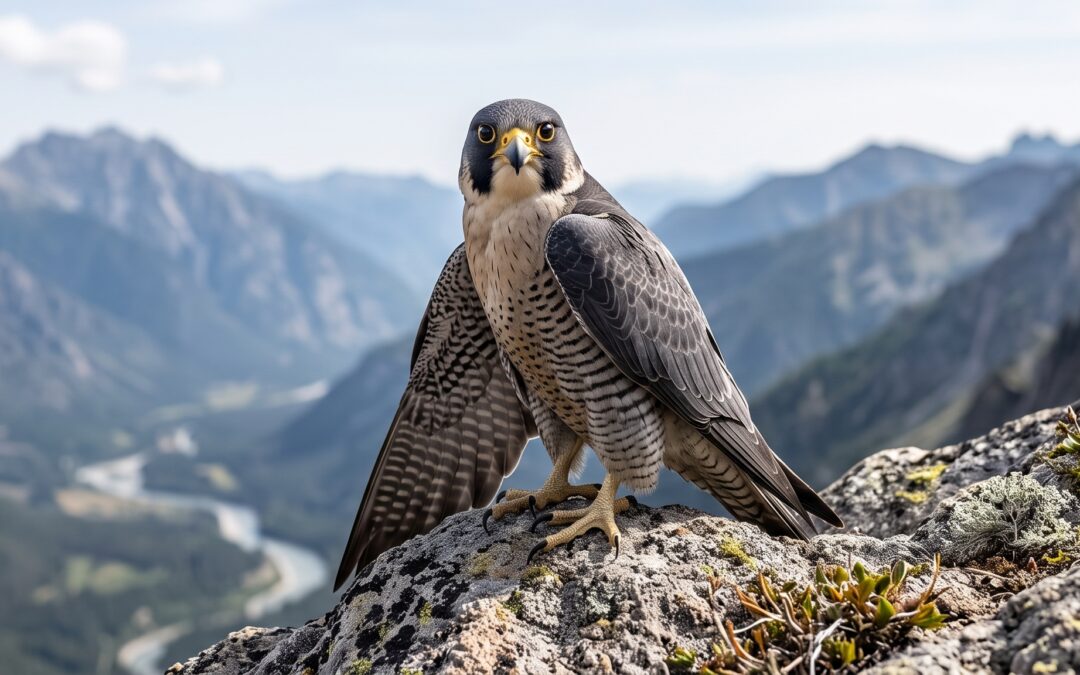
The Peregrine Falcon (Falco peregrinus) reigns supreme as the fastest animal on planet Earth and one of the most widely distributed avian species globally. Celebrated across centuries for its peerless aerial acrobatics and noble presence in classical falconry, this apex raptor is engineered for blinding velocity, executing terminal hunting dives (stoops) that shatter aerodynamic records. Found on every continent except Antarctica, the peregrine occupies extreme ecological landscapes ranging from windswept Arctic tundra cliffs and sea stacks to modern metropolitan skyscrapers, functioning as a specialized aerial predator that keeps mid-sized bird populations in natural equilibrium.
Biology and Physical Characteristics
The peregrine falcon exhibits radical physiological specializations that allow it to operate safely at extreme speeds exceeding 200 miles per hour (320 km/h). Its streamlined, torpedo-shaped torso, pointed swept-back wings, and stiff primary feathers minimize air turbulence during high-g dives. Inside its nostrils, tiny conical bony tubercles (baffles) regulate high-pressure airflow, permitting the falcon to breathe normally without damaging lung tissues while diving at near-sonic velocities. A clear, protective third eyelid (nictitating membrane) cleans and lubricates the eyes at high speeds, while a dark ‘mustache’ feather pattern beneath each eye reduces solar glare, ensuring pinpoint tracking of flying prey against bright sky backgrounds.
Behavior and Ecology
Hunting primarily in open skies, the peregrine falcon locates airborne prey from soaring altitudes before folding its wings into a tight diamond profile to execute its signature high-speed stoop. The impact of the dive—delivered via half-clenched talons—is typically sufficient to stun or dispatch quarry instantly in mid-air, with the falcon immediately circling back to catch the falling carcass before it hits the ground. Pairs establish lifelong monogamous partnerships, returning year after year to traditional nesting ledges (eyries) scraped into sheer rock cliffs or bridge beams. Both parents participate in raising the clutch, with the male (‘tiercel’) performing daring food passes in mid-air to transfer catches to the female.
Conservation and Human Impact
Following World War II, the peregrine falcon suffered a catastrophic global decline driven by bioaccumulation of organochlorine insecticides, notably DDT. The chemical disrupted calcium metabolism, causing severe eggshell thinning that led to widespread reproductive failure; by the mid-1960s, the species was virtually extirpated from eastern North America. In response, conservationists and ornithologists pioneered revolutionary captive-breeding, hacking, and reintroduction programs spearheaded by The Peregrine Fund. Supported by the 1972 federal ban on DDT, wild populations made a historic recovery, leading to the species being officially delisted from the US Endangered Species Act in 1999.
Interesting Factoid
During its high-speed hunting dive, the peregrine falcon has been scientifically clocked at an astonishing 242 miles per hour (389 km/h), making it not only the fastest bird, but the fastest recorded member of the entire animal kingdom.