
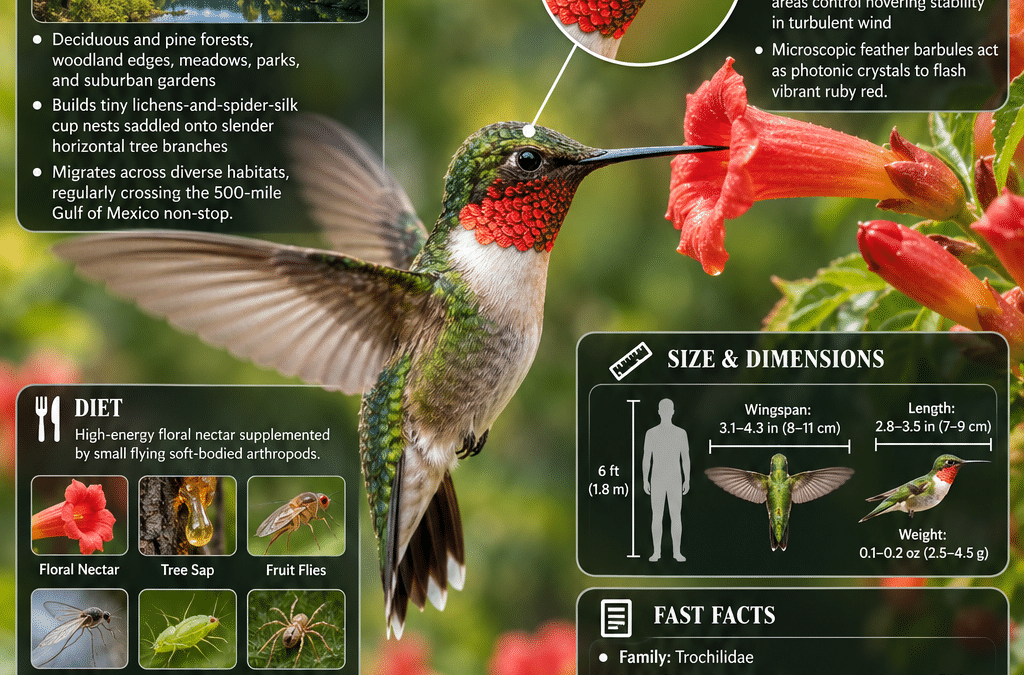

Overview
AT A GLANCE
- Common Name: Ruby-throated Hummingbird
- Scientific Name: Archilochus colubris
- Category: Birds
- Subcategory: Hummingbirds
- Size: Body length: 7–9 cm (2.8–3.5 in); wingspan: 8–11 cm (3.1–4.3 in)
- Weight: 2.5–4.5 g (0.09–0.16 oz)
- Lifespan: 3–5 years in the wild; maximum recorded wild longevity of over 9 years
- Diet: Nectarivore and insectivore (floral nectar, tree sap, tiny spiders, gnats, mosquitoes)
- Habitat: Deciduous and pine woodlands, forest edges, orchards, meadows, and suburban botanical gardens
- Range: Breeds in eastern North America; winters in southern Mexico and Central America
- Conservation Status: Least Concern
The ruby-throated hummingbird (Archilochus colubris) is the sole breeding hummingbird species across the vast deciduous forests and gardens of eastern North America. Belonging to the specialized family Trochilidae, this miniature avian jewel represents an extraordinary evolutionary extreme in avian metabolism, aerodynamics, and ecological co-evolution with flowering plants. Each autumn, this tiny bird completes an astounding non-stop migratory crossing of the Gulf of Mexico, flying over 800 kilometers (500 miles) of open ocean without food or rest.
Functioning as a crucial specialist pollinator for dozens of native tubular wildflower species, including trumpet creeper and cardinal flower, the ruby-throated hummingbird maintains long-standing mutualisms that drive plant reproduction across eastern ecosystems. Their spring arrival aligns precisely with the bloom cycles of native nectar sources and sapsucker tree wells that sustain them during chilly early migrations. Despite their diminutive weight of less than a single nickel coin, they exhibit fierce territorial aggression, fearlessly driving away much larger birds from favored foraging patches.
Biology and Physical Characteristics
Males feature an iridescent ruby-red throat gorget that glitters brilliantly in direct sunlight through crystalline structural feather platelets, contrasted by emerald-green dorsal plumage and a white collar. Their specialized wing anatomy attaches to an enlarged sternal keel via flexible shoulder joints, permitting 180-degree figure-eight wing rotations at up to fifty-three beats per second, enabling full backwards, upside-down, and stationary hovering flight. Their metabolic rate is among the highest in the animal kingdom, supported by a resting heart rate exceeding 600 beats per minute that surges past 1,200 beats per minute in active flight.
Behavior and Ecology
To fuel their astronomical metabolic burn, individuals must consume more than their own body weight in floral nectar and tiny insects daily, feeding every ten to fifteen minutes throughout daylight hours. During frigid nights or severe resource deficits, they enter nocturnal torpor, dramatically dropping their internal body temperature and slowing metabolic rates to conserve precious energy reserves. Highly solitary and pugnacious, males fiercely defend nectar territories from rivals using high-speed aerial dive-bombing displays and sharp chittering vocalizations.
Conservation and Human Impact
The ruby-throated hummingbird is designated as Least Concern by the IUCN, with widespread and stable populations across eastern North America that readily take advantage of residential nectar feeders and urban gardens. Nonetheless, they remain vulnerable to habitat loss across their critical overwintering grounds in Central American cloud forests and lowland scrub. Climate change also poses emerging risks by causing phenological mismatches between their spring arrival dates and the peak flowering times of foundational native host plants.
Interesting Factoid
Before embarking on its annual autumn migration across the open waters of the Gulf of Mexico, a ruby-throated hummingbird nearly doubles its body mass by accumulating thick deposits of fat, providing the continuous fuel necessary for a twenty-hour nonstop ocean flight.