
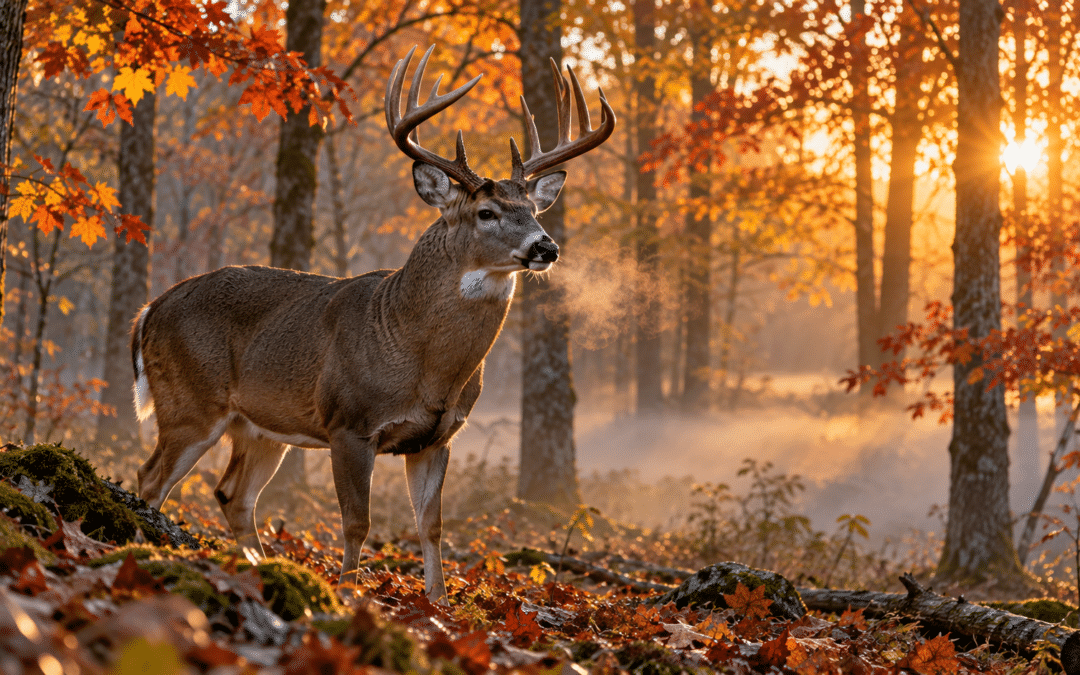
As autumn arrives across temperate woodlands, a subtle yet profound shift sweeps through the natural world. Leaves blaze in crimson and gold, temperatures plummet, and throughout suburban borders and deep timber alike, deer suddenly appear everywhere. Drivers encounter solitary bucks darting across dusk-lit rural roads, homeowners find bark stripped raw from saplings in their backyards, and quiet forest glades echo with the resonant clash of bone against bone. To the casual observer, deer seem to have lost their characteristic wariness. In reality, they are deep in the throes of the annual rut—a high-stakes breeding season that reconfigures cervid biology, daily movement, and survival strategy.
The Clock in the Sky: Photoperiodism and the Hormonal Trigger
The engine driving autumn deer activity is not falling temperatures or changing leaf colors, but astronomical geometry. As the Northern Hemisphere tilts away from the sun following the autumn equinox, the duration of daily sunlight—known scientifically as the photoperiod—contracts rapidly. This decreasing daylight is detected by retinal receptors and processed by the pineal gland, which increases nocturnal secretion of the hormone melatonin.
In species like the White-tailed Deer (Odocoileus virginianus) and its western counterpart, the Mule Deer (Odocoileus hemionus), this sustained melatonin cascade signals the hypothalamus to ramp up gonadotropin-releasing hormone (GnRH). In bucks, the pituitary gland responds by flooding the bloodstream with luteinizing hormone, driving testicular development and causing serum testosterone concentrations to skyrocket by up to tenfold between August and late October.
Hard Horns and Battle Armor: The Antler Transformation
Throughout spring and summer, buck antlers are living, vascular appendages coated in a fuzzy, blood-rich skin called velvet. As testosterone levels peak in early autumn, blood vessels at the antler base constrict, cutting off blood supply. The bone beneath mineralizes into dense, dead calcium and phosphorus. Bucks vigorously thrash small trees and brush to shred the dried velvet, revealing hard, polished headgear ready for competition.
Simultaneously, elevated testosterone induces substantial morphological changes. The muscles of a mature buck’s neck can swell to twice their summer circumference, functioning as biological shock absorbers designed to withstand head-to-head collisions during territorial disputes. This seasonal weaponry and physiological armor equip bucks for several weeks of relentless social hierarchy testing.
The Chemical Billboard: Scrapes, Rubs, and Scent Communication
Long before direct mating begins, deer transition into an intensive scent-communication phase. Bucks establish ‘rubs’ by gouging tree trunks with their antler bases, depositing secretions from their forehead glands to signal dominance and status. More critically, they construct ‘scrapes’—shallow oval depressions pawed clean down to bare soil beneath low-hanging tree branches known as licking branches.
At each scrape, a buck deposits an elaborate chemical signature: saliva and glandular secretions onto the overhead branch, followed by urine passed over tarsal glands on its inner hocks onto the bare dirt. Does in estrus visit these scrapes to deposit their own chemical markers, signaling reproductive readiness. Because bucks must continually patrol and refresh dozens of scrapes across overlapping home ranges, their daily travel distances double or triple compared to tranquil summer grazing routines.
Peak Breeding: The Seeking and Tending Phases
By late October and November, deer behavior enters its most chaotic and visible chapter. During the initial ‘seeking phase,’ bucks travel almost continuously at all hours of the day, with neck lowered and nose to the ground, searching for does entering their brief 24- to 36-hour estrus cycle. Highly cautious nocturnal habits are cast aside in favor of urgent locomotion.
Once a receptive doe is located, the dynamic shifts into the ‘tending phase.’ The buck isolates the doe, shadowing her every step through dense cover and actively driving off rival suitors. Similar intensive reproductive behaviors unfold across other cervid relatives, from the bugling harems of wild Elk (Cervus canadensis) to the sprawling territorial clashes of solitary Moose (Alces alces) across northern boreal wetlands.
Ecological and Human Implications
While the rut is an essential reproductive milestone that ensures fawns are born during the abundant warmth of the following spring, it represents a period of extreme physical cost and mortality risk. Mature bucks may lose between 20 and 30 percent of their body mass during the rut, often neglecting feeding entirely while expending massive energy stores on territorial defense and mate pursuit.
For human communities, this surge in cervid locomotion directly intersects with human transportation networks. Autumn consistently marks the nationwide peak for wildlife-vehicle collisions across North America, as fast-moving deer cross roadways with heightened distraction. Wildlife biologists urge extra vigilance during dawn and dusk hours throughout October and November. Understanding the biology of the rut transforms an apparent autumn nuisance into an appreciation for one of nature’s most intense, finely tuned reproductive cycles.