
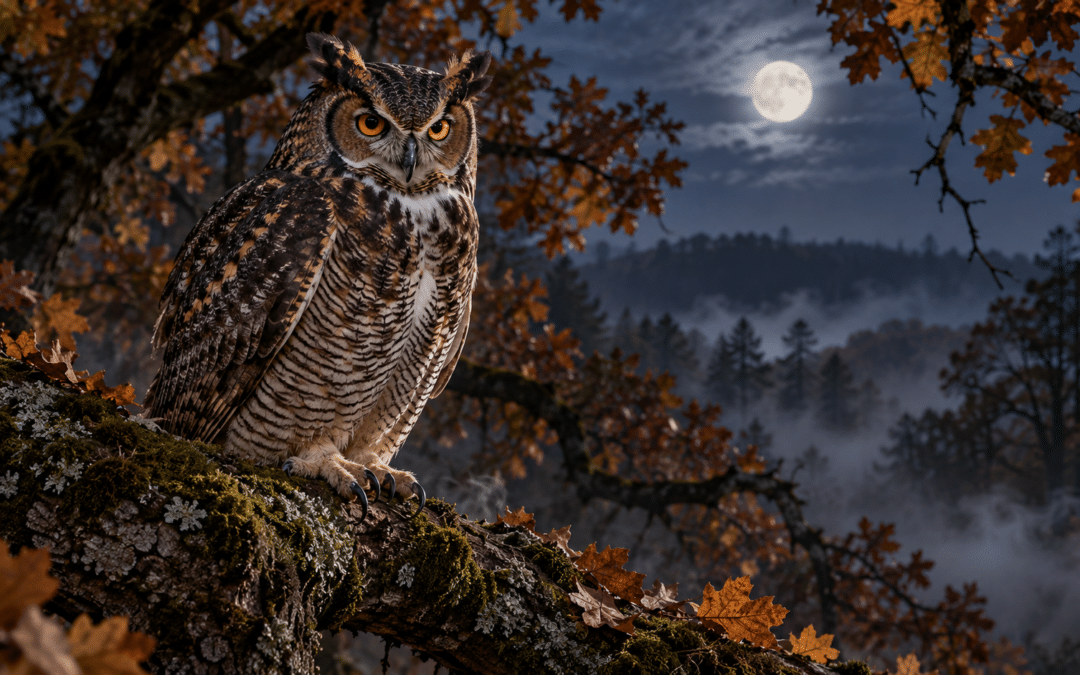
As October winds strip the last amber leaves from forest canopies and autumn nights lengthen, Halloween decorations begin to populate suburban front porches. Alongside carved jack-o’-lanterns, black cats, and fluttering bats, one creature reliably perches atop the seasonal menagerie: the owl. Staring outward with saucer-like eyes, framed against glowing full moons, or silhouetted on gothic branches, owls have been indelibly etched into the iconography of all things spooky. Yet, the long-standing cultural association between owls and Halloween is far more than a decorative coincidence. It is rooted in deep historical folklore, eerie autumn behavior, and some of the most extraordinary nocturnal adaptations ever produced by evolution.
From Roman Omens to Celtic Shadows: The Roots of the Myth
Human fascination and dread surrounding owls stretch across millennia. In ancient Rome, hearing the screech of an owl was interpreted as a dire omen presaging disaster or death; Roman mythology even told of the strix, a bloodthirsty night bird believed to feed on humans. Across the ancient Celtic lands of the British Isles, the seasonal festival of Samhain—the ancient cultural precursor to modern Halloween—marked the boundary between the harvest season and the onset of cold winter darkness. Samhain was believed to be a liminal night when the veil between the physical world and the spirit realm grew thin, and nocturnal creatures wandering between shadow and light were viewed as spiritual messengers or shapeshifting witches.
The pale, heart-shaped face and otherworldly screech of the Barn Owl (Tyto alba) particularly unnerved early agrarian communities. Often roosting unseen in abandoned church belfries, cemetery crypts, or cavernous barns, a barn owl erupting into the twilight sky with ghostly white plumage and a raspy, blood-curdling shriek effortlessly birthed ghost legends that persist to this day.
Silent Shadows: The Physics of Acoustic Stealth
Part of what makes owls feel supernatural to human observers is their complete absence of sound in flight. While ducks, pigeons, and even raptors like eagles produce audible wing flutters as displaced air forms turbulent eddies, an owl swooping directly past a human’s ear produces zero acoustic footprint. This stealth is engineered through three evolutionary feather adaptations that break down turbulence into imperceptible micro-vortices.
First, the leading edge of an owl’s primary wing feathers features a stiff, comb-like row of serrations that evenly divides incoming air into tiny streams. Second, the trailing edge of the feathers is trimmed with a soft, flexible fringe that prevents air from rushing together into noisy pressure waves as it leaves the wing. Finally, the upper surfaces of an owl’s wings are blanketed in a velvety down of microscopic hair-like pennula that absorbs frictional noise created by feather rubbing. This acoustic masking allows top predators like the formidable Great Horned Owl (Bubo virginianus) to drop out of complete darkness upon unsuspecting rodents without giving their prey a millisecond of advance acoustic warning.
Eyes in the Dark: Tubular Retinas and 270-Degree Vision
An owl’s piercing stare is legendary, and its anatomical construction is entirely unique among birds. Unlike spherical human eyeballs, an owl’s eyes are elongated, cylindrical tubes anchored securely into the skull by bony rings called sclerotic ossicles. Because their eyes are locked immovably in forward-facing sockets, owls cannot glance side-to-side; instead, they have evolved fourteen specialized cervical vertebrae (twice the human count) and flexible blood vessel reservoirs that permit them to swivel their heads up to 270 degrees in either direction without pinching carotid blood flow.
Internally, an owl’s retina is dominated by tightly packed rod cells specialized for low-light sensitivity, complemented by an oversized cornea and an expansive lens designed to capture every available photon of moonlight and starlight. When light strikes an owl’s eyes in darkness, a reflective layer behind the retina known as the tapetum lucidum bounces unabsorbed photons back through the photoreceptors for a second pass, producing the eerie ‘eye-shine’ glow that startled historical night travelers and fueled supernatural folklore.
Uncanny Acoustics: Asymmetrical Ears and Pinpoint Ambush
While owls boast exceptional night vision, their most lethal hunting sensor is hearing. Hidden beneath dense facial plumage, many owl species possess vertically asymmetrical ear openings—one positioned higher on the skull and angled upward, the other positioned lower and angled downward. Sound waves generated by a mouse scurrying beneath autumn leaves reach each ear a fraction of a millisecond apart and at slightly different volumes.
The facial disc—the circular arrangement of stiff, concave feathers framing an owl’s face, prominently seen in the Barred Owl (Strix varia)—acts as an organic satellite dish, funneling high-frequency rustles directly into the ear canals. By calculating horizontal and vertical time differentials in its auditory cortex, an owl can pinpoint prey hidden under deep leaf litter or blanketed in pitch-black darkness with an accuracy within one degree of azimuth.
Why Owls Call More in October: The Autumn Spike in Activity
The association between owls and mid-autumn is not merely folklore; it aligns directly with real shifts in avian seasonal behavior. October marks a critical window of juvenile dispersal and territorial defense across North America and Europe. Young owls that fledged earlier in summer are driven out of parental home ranges to establish territories of their own, leading to increased movement and vocalization.
Simultaneously, mature resident pairs begin establishing winter hunting grounds and reinforcing lifelong pair bonds ahead of the mid-winter breeding cycle. Forest trails during crisp October evenings frequently resonate with the deep booming hoots of great horned owls, the inquisitive barking cadences of barred owls, and even early winter arrivals of northern migrants like the arctic Snowy Owl (Bubo scandiacus). To our ancestors walking darkened woodland paths before the advent of electric lighting, these pervasive autumn choruses cemented the owl’s status as the monarch of the dark season.
From Superstition to Ecological Guardianship
Today, the spooky myths surrounding owls have evolved into widespread scientific admiration. Rather than harbingers of doom or spectral familiars, owls are recognized as indispensable apex consumers that regulate rodent populations and stabilize woodland food webs. Every October, as owls claim their rightful spotlight in Halloween lore, they offer a reminder of the mysteries and evolutionary wonders thriving just beyond the edge of daylight in autumn’s midnight forests.