
Overview
The Venus Flytrap (Dionaea muscipula) is universally recognized as one of the botanical world’s most astonishing evolutionary achievements. Described by Charles Darwin as ‘one of the most wonderful plants in the world,’ this small, rosette-forming perennial is one of only a handful of vascular flora capable of rapid, autonomous thigmonastic movement. Endemic strictly to a fragile, narrow coastal corridor of the Carolinas, the flytrap overcomes extreme nutrient scarcity in waterlogged, acidic peat soils by luring, trapping, and digesting live arthropods to extract vital nitrates, phosphates, and minerals essential for cellular growth.
Biology and Physical Characteristics
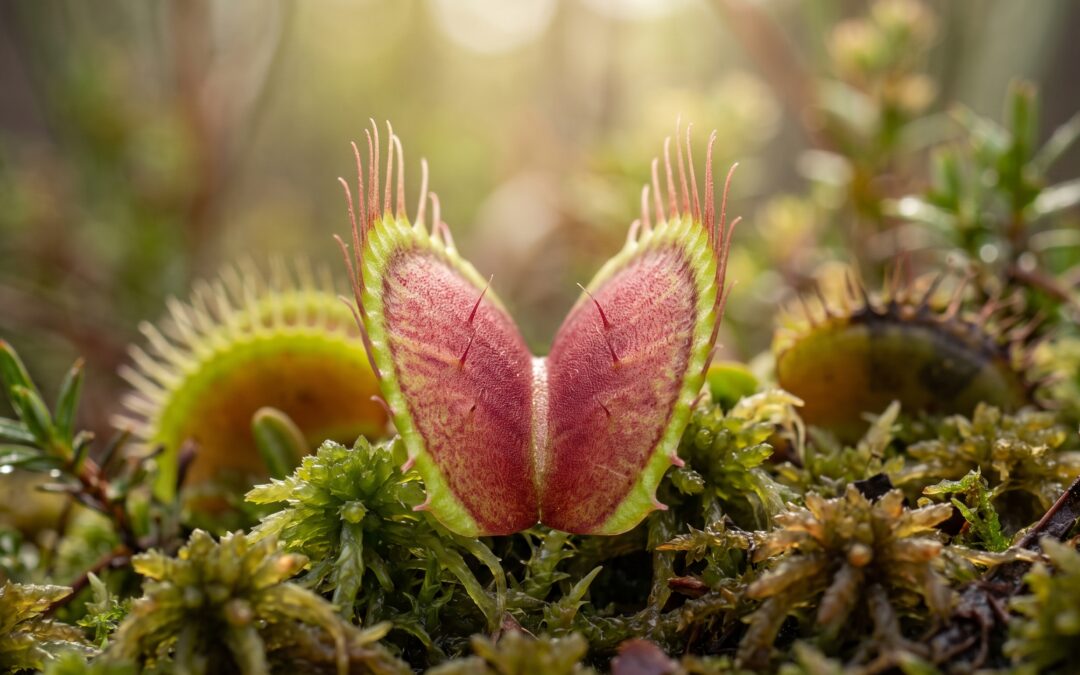
The trapping mechanism of Dionaea muscipula is a sophisticated biophysical snap-trap composed of a specialized, two-lobed terminal leaf lamina. The interior margins are lined with nectar-secreting glands and pigment anthocyanins that produce a seductive, insect-enticing reddish flush. Projecting from the inner surface of each lobe are three highly sensitive, microscopic trigger hairs (trichomes). The plant employs an ingenious biological counting and threshold system: a mechanical deflection of a single hair induces an initial calcium ion flux and action potential; a second deflection within approximately 20 seconds triggers an explosive shift in turgor pressure through the leaf parenchyma, causing the trap to snap shut in one-tenth of a second (100 milliseconds).
Behavior and Ecology
Once triggered, the interlocking marginal cilia (resembling bars of a prison cell) prevent escaping arthropods from slipping through. Continued struggling by the prey stimulates mechanical receptors, prompting the trap lobes to seal hermetically and form an external digestive pouch. The plant’s sessile digestive glands flood the chamber with an acidic cocktail containing proteases, phosphatases, nucleases, and esterases, dissolving the insect’s soft tissues over a five to twelve-day period before reabsorbing the liquefied nutrients. In late spring, to avoid accidentally consuming its own pollinators, the flytrap sends up a tall, slender flower stalk standing 8 to 12 inches above the rosette, bearing delicate white flowers safely isolated above the ground-level traps.
Conservation and Human Impact
Despite its ubiquitous presence in commercial nurseries and tissue-culture markets globally, wild populations of Dionaea muscipula are critically imperiled. Wild numbers have plummeted by over 80 percent due to commercial and residential coastal development, wetland drainage, and decades of fire suppression that allow encroaching woody shrubs to overshade sunny bog habitats. Chronic illegal poaching for the black-market plant trade further devastates natural colonies. In 2014, North Carolina upgraded wild flytrap theft to a felony offense. State conservation land trusts and fire managers now conduct systematic prescribed burns to maintain open longleaf pine savanna canopies necessary for wild survival.
Interesting Factoid
The Venus flytrap is effectively a plant that can ‘count’: it requires precisely two trigger hair touches within 20 seconds to snap shut, and three additional touches from the trapped insect to initiate the production of digestive enzymes, preventing wasted energy on falling raindrops or debris.