
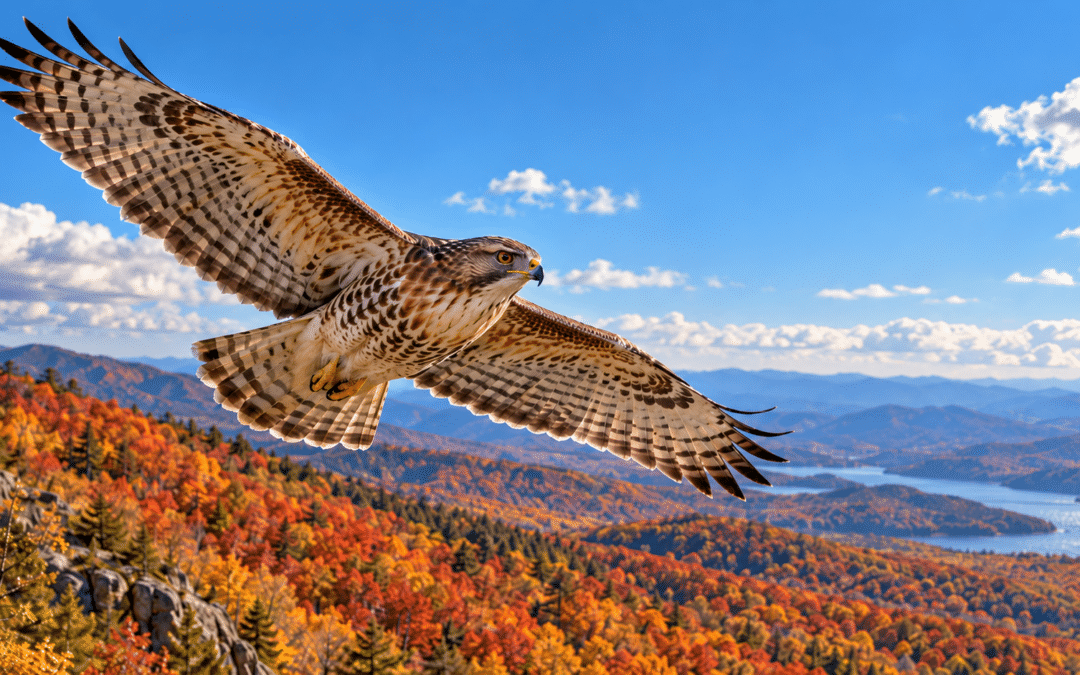
Each autumn across North America, a silent, breathtaking armada takes to the skies. While hundreds of migratory songbird species depart under cover of darkness to evade predators and navigate by starlight, the continent’s raptors choose broad daylight. From late August through November, hundreds of thousands of hawks, eagles, falcons, harriers, and vultures funnel southward along predetermined geological flight paths. Observers standing on mountain lookouts and coastal headlands witness one of the planet’s great aerial spectacles: swirling funnels of birds climbing thousands of feet into the atmosphere before gliding silently toward wintering grounds in Central and South America. Behind this annual phenomenon lies an elegant interplay of avian biomechanics, atmospheric thermodynamics, and continental geography.
Free Energy: Thermals and Mountain Updrafts
Flapping flight is among the most metabolically demanding forms of animal locomotion. For a heavy-bodied raptor like a Red-tailed Hawk (Buteo jamaicensis) or a majestic Bald Eagle (Haliaeetus leucocephalus), powered flapping across thousands of miles would burn through fat reserves within days. To circumvent this energetic bottleneck, migrating raptors harness environmental lift generated by the sun and the earth.
As solar radiation warms dark fields, bare rocky bluffs, and paved valleys, pockets of hot air expand, become buoyant, and detach from the ground, rising skyward as invisible vertical columns called thermals. Concurrently, prevailing winds colliding with linear mountain ridges—such as the Appalachians and the Rocky Mountains—are deflected upward, creating continuous corridors of mechanical ridge lift. By locking their broad, slotted primary feathers into place, soaring raptors ride these elevators of rising air with virtually zero expenditure of muscular energy.
The Kettle Phenomenon: Swirling Vortexes of Broad-winged Hawks
Among all North American raptors, none embodies the drama of autumn migration quite like the Broad-winged Hawk (Buteo platypterus). Breeding across dense eastern deciduous forests, these compact forest buteos must travel all the way to the subtropical rainforests of Colombia, Ecuador, and Brazil. Because they rely almost exclusively on thermal soaring over land, their migration window is tightly compressed into a dramatic two-week surge in mid-September.
When a rising thermal bubble is located, individual hawks converge into a tight, circular swarm known as a ‘kettle’—so named because the churning, rising mass of birds resembles boiling liquid in a cauldron. Within a single kettle, hundreds or even thousands of hawks bank and spiral upward in tight synchronization, using each other to pinpoint the core of maximum updraft. Once reaching the apex of the thermal—often 3,000 to 5,000 feet above the terrain—the birds peel off one by one in a long, descending glide toward the next thermal pocket, covering up to 300 miles per day while barely flapping their wings.
Aerodynamic Diversity: Buteos, Accipiters, and Falcons
Not every raptor migrates with the same aerodynamic strategy. Evolutionary differences in wing loading and aspect ratio dictate distinct flight modes across families. Broad-winged buteos and vultures maximize lift with broad, slotted wings designed for passive soaring. In contrast, woodland accipiters like the Sharp-shinned Hawk (Accipiter striatus) and Cooper’s Hawk utilize short, rounded wings and long rudder-like tails to maneuver through turbulent low-altitude drafts and chase migrating songbirds through autumn tree lines.
Meanwhile, long-distance aerial hunters like the bullet-shaped Peregrine Falcon (Falco peregrinus) and Merlin rely on high-speed powered flapping combined with offshore maritime thermals, tracing coastlines and barrier islands where migrating shorebirds provide abundant on-the-wing refueling opportunities.
The Cold Front Engine: Synoptic Timing and Flyway Funnels
Raptor migration is intimately synchronized with continental weather patterns. Peak flight days are consistently triggered by the passage of autumn cold fronts moving southeast from Canada. Behind a front, clear skies, plunging temperatures, dropping barometric pressure, and crisp northwest winds create ideal conditions for both thermal formation and tailwind assistance.
Because raptors avoid crossing wide expanses of open water where thermal updrafts do not form, geographic barriers like the Great Lakes, Delaware Bay, and the Gulf of Mexico act as colossal natural funnels. Tens of thousands of birds are compressed along narrow shorelines and peninsulas, leading to extraordinary concentrations at historic watch sites like Hawk Ridge in Duluth, Minnesota, Cape May in New Jersey, and the famed ‘River of Raptors’ in Veracruz, Mexico, where several million birds pass in a single season.
From Gunpowder to Citizen Science: Monitoring Raptor Health
A century ago, migratory bottlenecks were shooting galleries where thousands of migrating hawks were slaughtered each autumn. In 1934, conservationist Rosalie Edge founded Hawk Mountain Sanctuary in Pennsylvania, creating the world’s first refuge for birds of prey and pivoting raptor observation toward conservation science. Today, organized volunteer watch sites coordinated by the Hawk Migration Association of North America (HMANA) collect standardized hourly count data from August through December.
Because raptors sit at the apex of the trophic pyramid, migration counts serve as vital ecological barometers. Fluctuations in annual tallies provide early warnings of environmental contaminants, prey abundance collapse, and climate-driven shifts in migration phenology. Standing beneath an autumn sky as a kettle of hawks spirals upward reminds us of the profound global interconnectedness of our atmosphere, landscapes, and wildlife.