
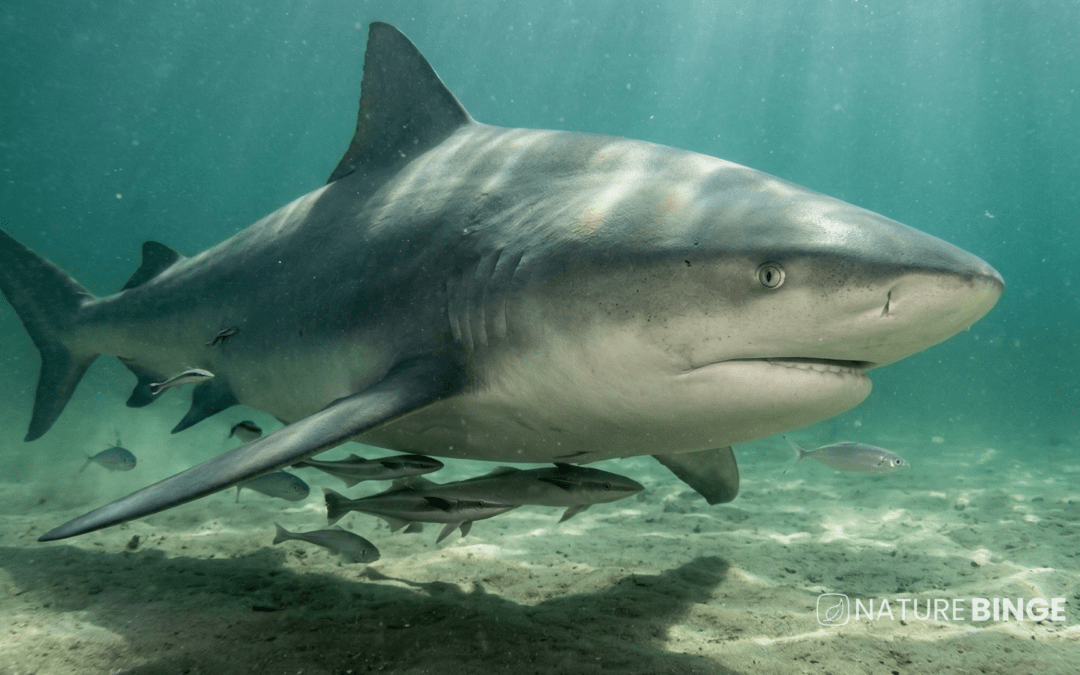
AT A GLANCE
- Common Name: Bull Shark
- Scientific Name: Carcharhinus leucas
- Category: Fish
- Subcategory: Requiem Sharks & Carcharhiniformes
- Size: Total length: 2.1–3.4 m (6.9–11.2 ft) for adults; females are larger than males; record specimens reach 4.0 m (13.1 ft)
- Weight: 90–230 kg (200–507 lb); exceptionally massive females exceed 315–350 kg (694–772 lb)
- Lifespan: 25–30 years in the wild; slow-maturing apex elasmobranch
- Diet: Opportunistic apex carnivore: teleost fish, other sharks, rays, sea turtles, marine mammals, river birds, and terrestrial livestock carcasses
- Habitat: Turbid coastal shorelines, shallow surf zones, brackish estuaries, and freshwater rivers up to 2,000 miles inland
- Range: Circumglobal tropical and warm coastal waters and major rivers
- Conservation Status: Vulnerable (IUCN Red List)
Overview
The Bull Shark (Carcharhinus leucas), widely renowned across elasmobranch physiology as one of the most astonishingly adaptable predators on the planet, is an immense, heavy-bodied requiem shark belonging to the family Carcharhinidae. Distributed throughout the warm coastal shallows, estuaries, and river mouths of all tropical and subtropical seas, this formidable marine predator is recognized by its stout, muscular build, broad and blunt snout, tiny eyes, pale gray to brownish-gray dorsal coloration, and exceptionally high bite-force-to-mass ratio. Unlike virtually all other marine sharks, it possesses the extraordinary physiological capability of thriving in completely fresh water.
Operating as an apex predator in both marine and freshwater riparian ecosystems, Carcharhinus leucas bridges oceanic and continental biomes: individuals regularly migrate thousands of miles up major river systems—including traveling over 2,500 miles up the Amazon River into Peru and inhabiting Lake Nicaragua and the Zambezi River. With an aggressive, opportunistic hunting strategy, the bull shark exercises critical top-down regulation over coastal teleost populations, smaller elasmobranchs, and riverine fauna. However, because its preferred nearshore habitats directly overlap with intense human coastal development, commercial fisheries, and river damming, global populations have suffered significant drops, leading to an evaluation of Vulnerable on the IUCN Red List.
Biology and Physical Characteristics
The anatomical and osmoregulatory adaptations of Carcharhinus leucas are celebrated in evolutionary physiology as one of nature’s greatest triumphs: marine sharks survive in saltwater by retaining high concentrations of urea and trimethylamine oxide (TMAO) in their blood, making their internal tissues isotonic to the sea. When a typical marine shark enters freshwater, water rushes into its body through osmosis, causing cells to burst and resulting in fatal kidney failure. The bull shark survives this by dynamically reprogramming its renal and hepatic physiology: upon entering freshwater, its kidneys dramatically reduce urea reabsorption, excreting massive volumes of dilute urine, while specialized rectal glands halt sodium and chloride pumping, and the liver downregulates urea synthesis, allowing the shark to maintain ionic homeostasis in pure freshwater indefinitely. Its dentition features broad, triangular, heavily serrated upper teeth designed for sawing through thick turtle shells and marine mammal blubber, powered by a bite force exceeding 5,900 newtons—the highest bite force relative to body mass of any shark studied.
Behavior and Ecology
Bull sharks are opportunistic, solitary ambush predators that frequently hunt in murky, sediment-laden waters near river deltas and breaking coastal surf, where poor water visibility gives the stealthy shark a decisive sensory advantage over visually oriented teleosts and sea turtles. Hunting is assisted by an exceptionally sensitive electrosensory array of Ampullae of Lorenzini covering the blunt snout, which detects the faint microvolt bioelectric fields emitted by the muscle contractions of wounded fish hidden in muddy substrates. When attacking large prey, the bull shark employs a violent ‘bump-and-bite’ tactic: ramming the prey with its solid, reinforced chondrocranium to stun and disorient it before delivering an explosive, bone-shattering bite and shaking its head laterally to saw out massive chunks of flesh. Mating takes place in brackish estuaries; females are viviparous, giving birth to litters of 1 to 13 live pups in protected shallow river mouths, where juveniles remain for up to five years before venturing into the open ocean.
Conservation and Human Impact
Carcharhinus leucas is categorized as Vulnerable on the IUCN Red List, having suffered steep demographic declines across multiple global coastal basins. Because of their strict reliance on shallow coastal bays, mangrove lagoons, and freshwater estuaries as nursery habitats, bull sharks face intense anthropogenic pressures: coastal wetland draining, port construction, and agricultural runoff degrade critical pupping grounds. Furthermore, the construction of hydroelectric dams and weirs across major tropical rivers physically fragments upstream migration corridors, trapping or blocking sharks. Bull sharks are also heavily targeted by commercial gillnet, longline, and shark fin fisheries, and are frequently captured in coastal bather protection nets (shark nets) along beaches in Australia and South Africa. Conservation actions emphasize protecting estuarine nursery reserves, regulating shark fin trade under CITES Appendix II, and promoting sustainable circle-hook fisheries.
Interesting Factoid
Bull sharks have been documented navigating over 2,500 miles (4,000 kilometers) upstream from the Atlantic Ocean into the Amazon River basin, reaching as far inland as Iquitos, Peru, where they swim in pure freshwater alongside pink river dolphins.