
Overview
The Sydney Funnel-web Spider (Atrax robustus) is celebrated as one of the world’s most infamous, formidable, and medically significant arachnids. Belonging to the family Atracidae, this heavy-set mygalomorph spider is endemic strictly to the coastal sclerophyll forests and moist sandstone valleys of the Sydney Basin in New South Wales, Australia. Armed with massive downward-striking fangs and venom loaded with the neurotoxin delta-atracotoxin, the funnel-web is an ancient, highly specialized ambush hunter that has lived in Australia’s forests since the age of the dinosaurs.
Biology and Physical Characteristics
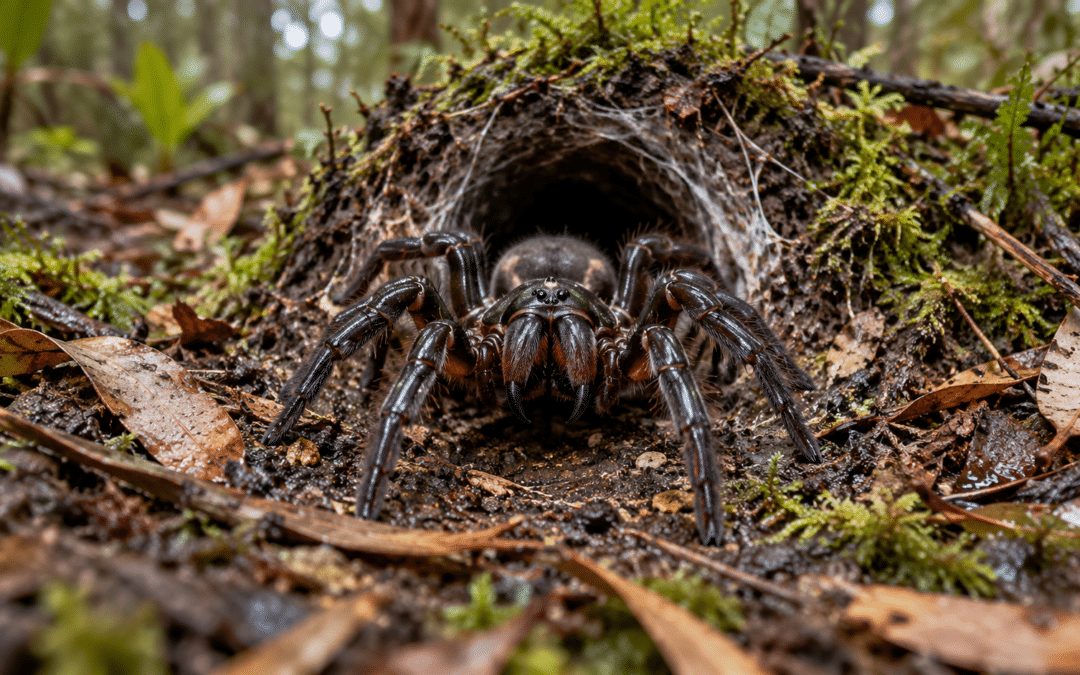
Atrax robustus is a stocky, muscular spider with a glistening, hairless blue-black cephalothorax and a dark brown to matte-black abdomen clothed in fine velvety hairs. Unlike modern araneomorph spiders, it belongs to the primitive infraorder Mygalomorphae, possessing massive chelicerae with downward-pointing fangs that can exceed a quarter-inch in length—large and strong enough to pierce soft shoe leather or human fingernails. Adult males are slightly smaller and more slender than females, distinguished by a prominent mating spur midway along the second pair of legs and noticeably longer spinnerets protruding from the rear of the abdomen.
Behavior and Ecology
Sydney funnel-web spiders are fossorial ambush predators that construct distinctive subterranean silk-lined burrows beneath rocks, logs, or rotting tree stumps. At the entrance of the burrow, the spider weaves an irregular, funnel-shaped silk vestibule with radiating silk ‘trip lines.’ Resting just inside the mouth, the spider detects the micro-vibrations of an unsuspecting beetle or millipede brushing against a tripwire, erupting with blinding speed to strike and inject digestive venom. During warm, humid summer nights following rain, adult males abandon their burrows and wander nomadically in search of receptive females, occasionally blundering into suburban swimming pools where they can survive underwater for over 24 hours.
Conservation and Human Impact
Evaluated as Least Concern by the IUCN, Atrax robustus remains common across bushland reserves and sandstone gullies throughout the greater Sydney metropolitan area. While its venom is exceptionally lethal to primates due to delta-atracotoxin causing spontaneous nerve firings, the development and introduction of a highly effective antivenom by the Australian Reptile Park and Commonwealth Serum Laboratories in 1981 has resulted in zero human fatalities in over four decades. Public milking programs rely on safely captured wild specimens to produce lifesaving antivenom batches annually.
Interesting Factoid
Funnel-web venom is completely harmless to almost all native Australian mammals like dogs, cats, and birds, but by a bizarre evolutionary coincidence, a specific peptide in the venom happens to be catastrophic only to primates and humans.
Last updated: October 2026