
Overview
The Common Octopus (Octopus vulgaris), celebrated across marine science, cognitive ethology, and classical mythology as the undisputed genius of the invertebrate world, is a highly intelligent, solitary benthic cephalopod mollusk belonging to the family Octopodidae within the order Octopoda. Distributed throughout the coastal waters of the eastern and western Atlantic Ocean and the Mediterranean Sea, it is renowned as the primary model organism that revolutionized our scientific understanding of animal consciousness and alien-like non-vertebrate intelligence.
AT A GLANCE
- Common Name: Common Octopus
- Scientific Name: Octopus vulgaris
- Category: Invertebrates
- Subcategory: Octopodids & Octopoda
- Size: Total span 60–100 cm (24–39 in); mantle length 15–25 cm (5.9–9.8 in); arm reach up to 1.3 m
- Weight: 3–10 kg (6.6–22 lb); record specimens exceed 12 kg (26 lb)
- Lifespan: 1–2 years in the wild; semelparous reproductive cycle ends in senescence
- Diet: Carnivorous benthic predator (crabs, spiny lobsters, bivalve mollusks, polychaete worms, small fish)
- Habitat: Rocky coastal reefs, coral rubble, sandy mud seabeds, sea grass beds, and coastal tide pools (depth 0–200 m)
- Range: Cosmopolitan throughout the temperate, subtropical, and tropical coastal waters of the Atlantic Ocean and the Mediterranean Sea
- Conservation Status: Least Concern (IUCN Red List)
Armed with a colossal nervous system containing over 500 million neurons—two-thirds of which are distributed throughout its eight autonomous, semi-independent arms—Octopus vulgaris exhibits cognitive feats once thought unique to higher mammals, including complex maze learning, tool use, problem-solving, opening child-proof jars, and distinct individual play behavior. Its body is a boneless, shape-shifting marvel that can squeeze through any crevice larger than its hard chitinous beak. In camouflage biomechanics, its skin is a living dynamic video screen: using thousands of neurally controlled pigment sacks (chromatophores), light-reflecting cells (iridophores and leucophores), and muscular papillae, it can alter both its color pattern and three-dimensional skin texture in less than 200 milliseconds to vanish against reef rocks.
Biology and Physical Characteristics
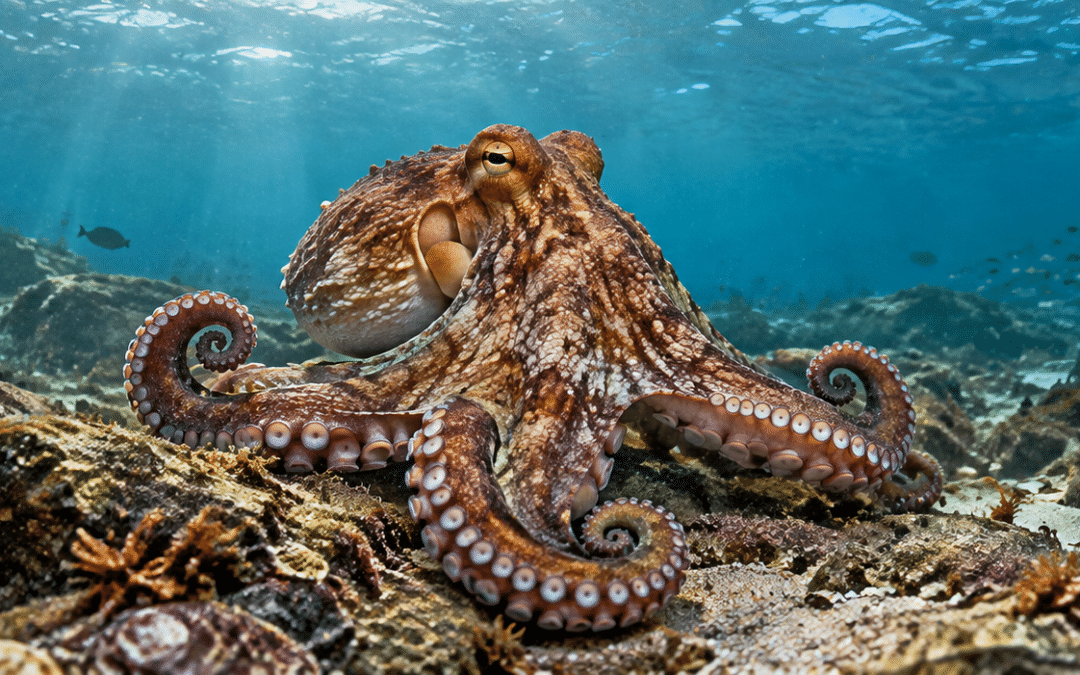
The Common Octopus possesses a soft, saccular body consisting of a muscular mantle that houses all internal organs, a distinct head with large, highly developed camera-type eyes, and eight muscular arms lined with two alternating rows of circular suckers (averaging roughly 240 suckers per arm). The eyes feature horizontal, rectangular pupils that maintain horizontal orientation regardless of body angle via specialized statocysts; their retinas lack blind spots and possess polarized light vision. Its circulatory system is powered by three hearts: one systemic heart that pumps blood throughout the body, and two branchial hearts that pump blood through the gills. Its blood is blue, relying on copper-based hemocyanin to transport oxygen in cold, low-oxygen seawater.
The suckers are independently articulating hydraulic marvels, capable of vacuum adhesion while functioning as external sensory organs packed with hundreds of thousands of chemoreceptors that taste and smell objects upon physical touch. Its mouth is armed with a sharp, parrot-like beak composed of chitin and cross-linked proteins, surrounded by a salivary gland that secretes cephalotoxin—a neurotoxic venom containing eledoisin that immobilizes struggling crabs and begins extra-oral digestion.
Behavior and Ecology
Common Octopuses are solitary, territorial hunters that establish well-defended dens inside rocky crevices, empty sea shells, discarded glass bottles, or hollow cinder blocks, building fortified barricades of stones and shells in front of the entrance (‘octopus gardens’). They hunt by creeping silently across the sea floor or jetting backward by violently expelling water through their muscular siphon. When hunting crabs, the octopus stalks within striking distance, pounces with an expanded web of skin between its arms, injects venom through its beak, and uses its radula (toothed tongue) to drill neat holes through hard shells.
When threatened by moray eels, sharks, or dolphins, the octopus deploys an array of deceptive defenses: instantaneous camouflage, blanching white, or expelling a dense cloud of dark melanin ink from its ink sac that acts as a visual smoke screen and olfactory disorienter while it jets away. Reproduction is semelparous (single-reproduction): the male uses a specialized third right arm (hectocotylus) to transfer spermatophores into the female’s mantle. The female deposits 100,000 to 500,000 tiny eggs in braided strings hanging from the roof of her den. For five to eight months, she cleans, oxygenates, and defends the eggs without eating a single meal, succumbing to programmed cellular senescence and dying as her tiny planktonic paralarvae hatch into the sea.
Conservation and Human Impact
The Common Octopus is categorized as Least Concern on the IUCN Red List, supported by rapid growth rates, high fecundity, and opportunistic feeding habits across broad oceanic ranges.
However, Octopus vulgaris is the focus of immense commercial artisanal and industrial trap and trawl fisheries worldwide, particularly along the Saharan Bank of Northwest Africa, Spain, Portugal, and Japan, landing hundreds of thousands of metric tons annually. Emerging commercial octopus aquaculture projects have sparked intense ethical debate among neurobiologists and animal welfare scientists regarding the welfare of captive sentient cephalopods. Management frameworks enforce seasonal fishing closures, minimum landing weight limits, and pot escape gaps to maintain sustainable wild fisheries.
Interesting Factoid
An octopus’s arms have a mind of their own: two-thirds of all the neurons in an octopus are located directly inside its eight arms, meaning a severed arm can still explore its environment, taste objects, and catch food completely on its own.