
AT A GLANCE
- Common Name: Death’s-head Hawkmoth
- Scientific Name: Acherontia atropos
- Category: Invertebrates
- Subcategory: Insects
- Size: Wingspan: 3.5–5.1 in (9–13 cm); Body length: 2.0–2.4 in (5–6 cm)
- Weight: 0.1–0.25 oz (3–7 g); One of the heaviest and most robust insects in Europe
- Lifespan: Adult moth lives 4–7 weeks; complete metamorphic lifecycle spans 3–4 months
- Diet: Herbivore / Honey specialist (honey stolen from honeybee hives, fermented tree sap, and rotting sweet fruits)
- Habitat: Potato fields, vegetable gardens, and warm Mediterranean agricultural valleys
- Range: Africa, southern Europe, and the Middle East
- Conservation Status: Not Evaluated (IUCN Red List) / Common and migratory across southern Europe and Africa
Overview
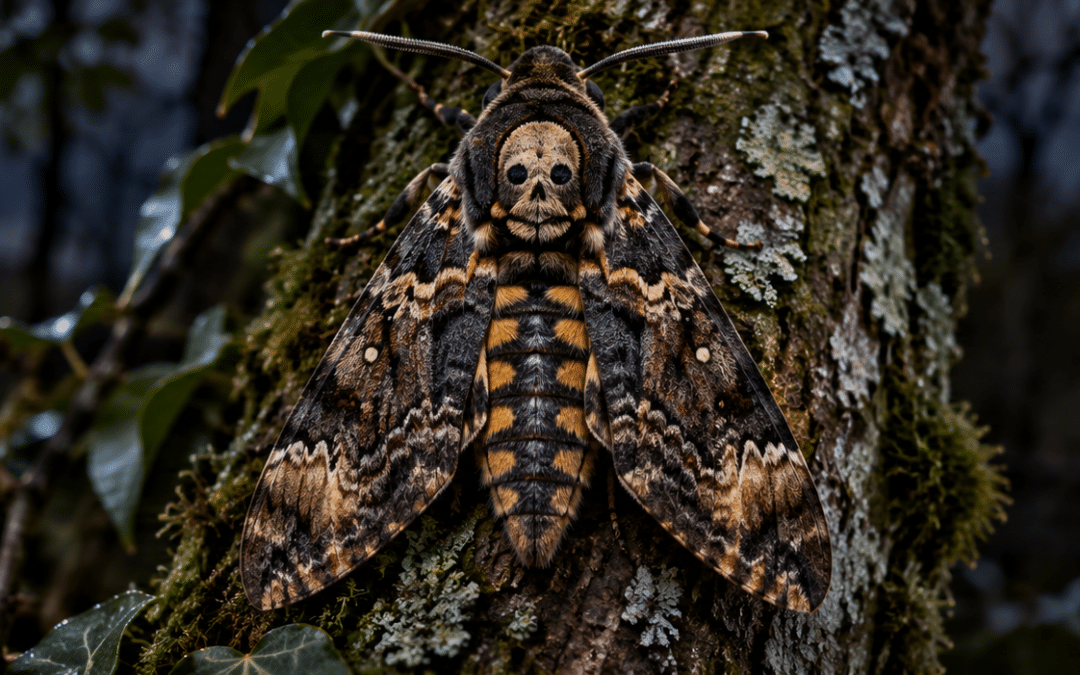
The Death’s-head Hawkmoth (Acherontia atropos), also known as the African death’s-head hawkmoth, is a large, heavily built, and culturally legendary nocturnal moth belonging to the sphinx or hawk moth family Sphingidae. Celebrated and feared across European and African folklore for centuries—and immortalized in world popular culture in Bram Stoker’s Dracula and the film The Silence of the Lambs—the death’s-head hawkmoth is instantly identified by the startling, human-skull-like marking etched in yellow and black across the top of its velvety dark thorax, long mottled brown forewings, and bold black-and-gold banded abdomen.
In European and African agricultural and scrub ecosystems, the death’s-head hawkmoth occupies a fascinating and unique ecological niche as a stealthy nocturnal honey raider and plant consumer. As massive caterpillars feeding upon solanaceous crops like wild nightshades and potatoes, they recycle vegetative biomass before pupating deep underground. As adult moths, their daring nocturnal raids on Western honeybee (Apis mellifera) hives represent a masterclass in chemical camouflage, playing a specialized role in nocturnal insect-plant trophic networks.
Biology and Physical Characteristics
Acherontia atropos possesses sensational anatomical and biochemical adaptations for raiding fortified beehives and producing defensive sound. Uniquely among all known adult Lepidoptera, the moth can emit loud, audible, high-pitched acoustic squeaks when threatened: it draws air into its muscular pharynx and expels it past an internal epipharynx flap, vibrating the tissue like an accordion reed to startle predators. To invade honeybee colonies unscathed, its cuticle produces a cocktail of fatty acids that mimic the scent profile of honeybees, providing total chemical invisibility so worker bees ignore the massive moth as it uses its short, reinforced proboscis to puncture wax cappings and drink honey.
Behavior and Ecology
Death’s-head hawkmoths are strong, fast-flying nocturnal migrants capable of traveling thousands of miles across the Mediterranean Sea and European continent every spring. Adults are attracted to the scent of honey, entering active beehives after sunset; their thick cuticle and chemical mimicry protect them from stings while they feast on honey stores. Females lay large greenish eggs on the leaves of potato and deadly nightshade plants; the resulting giant caterpillars grow up to 5 inches long, armed with a distinctive S-shaped anal horn, before burrowing into topsoil to pupate.
Conservation and Human Impact
Not formally evaluated on the global IUCN Red List, Acherontia atropos is widespread, common, and ecologically stable across its core African and Mediterranean range. In northern Europe, where it occurs as a seasonal summer breeding migrant, localized populations have experienced fluctuations due to heavy agricultural pesticide use on potato crops, but its vast migratory reservoir prevents overall endangerment.
Interesting Factoid
The death’s-head hawkmoth can produce a loud, shrill squeak like a mouse by forcing air through its pharynx, and it secretes a chemical perfume that tricks honeybees into letting it walk right into their hive and steal honey.