

AT A GLANCE
- Common Name: Fly Agaric
- Scientific Name: Amanita muscaria
- Category: Fungi
- Subcategory: Mushrooms
- Size: Cap diameter: 3–8 in (8–20 cm); Stipe height: 4–8 in (10–20 cm); Stem diameter: 0.8–1.5 in (2–4 cm)
- Weight: Fruiting body mass: 2.5–7.0 oz (70–200 g)
- Lifespan: Fruiting body persists 1–3 weeks; underground mycelial network is perennial, living for decades to centuries
- Diet: Ectomycorrhizal Mutualist (exchanges soil water, nitrogen, and phosphorus for host tree photosynthetic carbohydrates)
- Habitat: Boreal taiga, temperate mixed woodlands, subalpine conifer forests, and acidic birch-pine heathlands
- Range: Circumboreal across the Northern Hemisphere (North America, Europe, Scandinavia, Siberia); widely introduced into the Southern Hemisphere (Australia, New Zealand, South Africa, South America)
- Conservation Status: Least Concern (IUCN / Globally Secure)
Overview
The Fly Agaric (Amanita muscaria) is universally recognized as the quintessential, iconic archetypal mushroom of human culture, folklore, and mycological science. Adorned with a radiant, glossy scarlet-to-crimson cap studded with delicate white pyramidal warts, this instantly recognizable toadstool has captured the human imagination across centuries, appearing prominently in European fairy tales, shamanic rituals, Victorian illustrations, and modern digital media. Native across the circumboreal conifer and birch forests of the Northern Hemisphere, Amanita muscaria is an evolutionary triumph of fungal morphology and neurochemical synthesis.
Surpassing its ubiquitous cultural presence, the fly agaric fulfills an indispensable ecological keystone function as an obligate ectomycorrhizal symbiote. Rather than acting as a wood-rotting decomposer, its vast underground mycelial web forms an intricate mutualistic partnership with the root systems of forest trees, exchanging vital soil minerals for plant sugars. Famous for its potent, mind-altering isoxazole alkaloids (muscimol and ibotenic acid), the fly agaric embodies the complex chemical defenses, spiritual histories, and ecological symbioses that govern temperate and boreal forest ecosystems.
Biology and Physical Characteristics
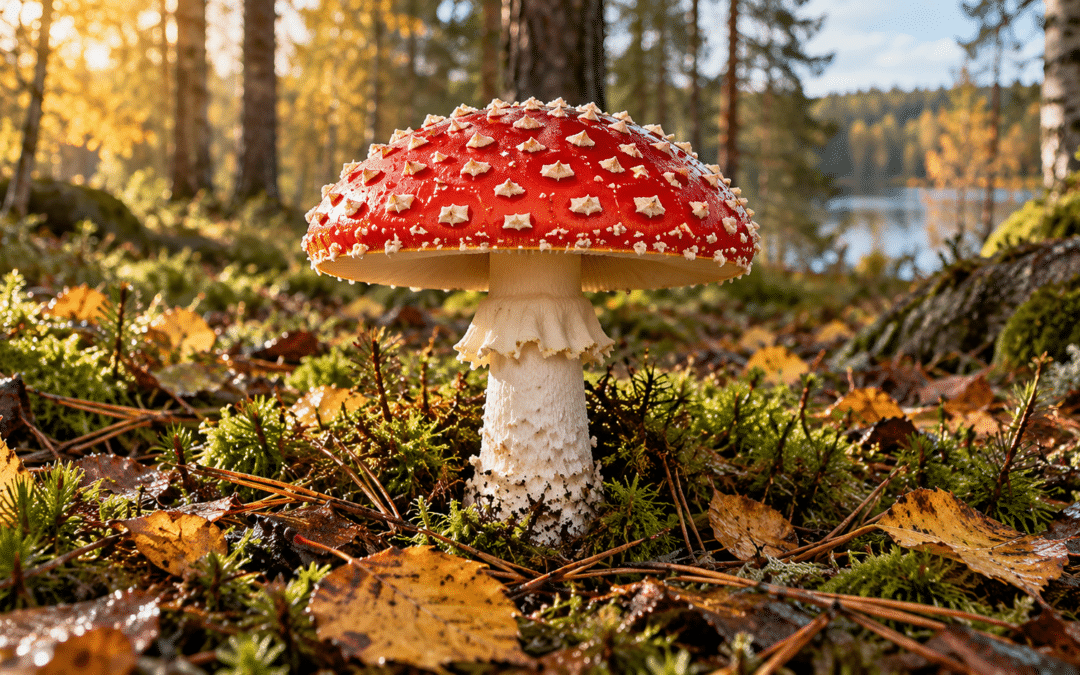
The fruiting body (basidiocarp) of Amanita muscaria begins development as a compact, egg-shaped white ‘universal veil’ resting on the forest floor. As the mushroom expands, the outer veil ruptures, leaving behind distinct, concentric fragments that become the iconic white-to-cream pyramidal warts or patches scattered across the expanding cap. The pileus (cap) matures from convex to broadly flattened, measuring up to eight inches across and displaying intense scarlet-crimson coloration generated by betalain-like water-soluble betaxanthins and betacyanin pigments that intensify under forest moisture.
Beneath the cap, the hymenium consists of crowded, free, chalk-white gills that produce millions of smooth, non-amyloid, hyaline elliptical basidiospores. The tall, sturdy white stipe (stem) features a delicate, pendulous membranous ring (annulus) derived from the partial veil, terminating at the base in a swollen, bulbous volva marked by distinct concentric rings of scales. Biochemically, the mushroom produces no psilocybin; instead, its psychoactive and toxic properties stem from isoxazole derivatives, primarily ibotenic acid (which decarboxylates into muscimol upon drying), a potent GABAA receptor agonist that induces profound central nervous system depression, hallucinations, and motor ataxia in mammals.
Behavior and Ecology
The fundamental ecological life of Amanita muscaria takes place out of sight beneath the forest floor as a vast perennial mycelial network. The fungal hyphae envelop the feeder roots of compatible host trees—predominantly birches (Betula), pines (Pinus), spruces (Picea), and firs (Abies)—forming a dense outer fungal mantle and an intercellular interface known as a ‘Hartig net.’ Through this biological marketplace, the fungus channels soil nitrogen, phosphorus, and moisture to the host tree, receiving in return up to 20 percent of the tree’s photosynthetically synthesized carbohydrates, a mutualism essential for the survival of boreal forest biomes.
Fruiting occurs in late summer and autumn, triggered by soaking seasonal rains and dropping temperatures. In open woodland clearings, mature mycelia produce expansive fruiting rings known as ‘fairy rings,’ expanding outward across forest soils at a rate of several inches per year as the central mycelium depletes localized nutrients. Historically, European rural households crumbled the cap into saucers of milk to attract, intoxicate, and dispatch houseflies—giving rise to the common name ‘fly agaric’—due to ibotenic acid’s paralyzing neurotoxic effect on insect physiology.
Conservation and Human Impact
Amanita muscaria is globally classified as Least Concern, thriving as one of the most widespread and abundant macrofungi across temperate and subarctic woodlands of the Northern Hemisphere. Because it forms robust mycorrhizal bonds with commercially planted conifers (such as radiata pine), it has been inadvertently introduced into non-native regions across Australia, New Zealand, South Africa, and South America, where it thrives vigorously in timber plantations.
While the species faces no extinction risk, mycologists monitor localized disruptions to old-growth boreal forest mycorrhizal networks caused by intensive clear-cut logging, commercial timber monocultures, and soil nitrogen pollution from atmospheric agricultural deposition, which can suppress delicate ectomycorrhizal fruitings. Protecting intact mixed birch-pine woodlands ensures the vibrant persistence of this legendary forest fungus.
Interesting Factoid
The red-and-white fly agaric mushroom is the real-world inspiration behind the iconic ‘Super Mushroom’ in the Super Mario video game franchise, as well as the classic fairytale toadstool in Alice in Wonderland.