
Overview
AT A GLANCE
- Common Name: Giant Water Bug
- Scientific Name: Lethocerus americanus
- Category: Invertebrates
- Subcategory: True Bugs
- Size: Length: 2.0–2.6 in (50–65 mm); Width: 0.8–1.0 in (20–25 mm)
- Weight: 0.15–0.30 oz (4–8 g)
- Lifespan: 1–2 years across aquatic nymph and adult terrestrial flight stages
- Diet: Apex aquatic carnivore (tadpoles, small fish, minnows, frogs, salamanders, aquatic insects, and occasional baby turtles)
- Habitat: Densely vegetated freshwater wetlands, weed-choked ponds, marshy sloughs, and littoral zones of lakes
- Range: North America (transcontinental across the United States and Canada)
- Conservation Status: Least Concern / Unassessed globally (abundant and widespread)
The Giant Water Bug (Lethocerus americanus), also known colloquially as the ‘toe-biter’ or ‘electric light bug,’ is an immense, formidable aquatic hemipteran that reigns as the undisputed apex invertebrate predator of North American freshwater wetlands. Growing up to 6.5 centimeters in length, this colossal true bug belongs to the family Belostomatidae, possessing an ancient evolutionary design optimized for stealth, ambush, and overwhelming predatory power. Often mistaken for an aquatic beetle, it is a true bug equipped with piercing-sucking mouthparts capable of subduing prey many times its own size.
Ecologically, Lethocerus americanus occupies an extraordinary top-predator niche in fishless vernal pools, marsh sloughs, and pond margins, directly regulating populations of larval amphibians, minnows, snails, and aquatic insect larvae. Equipped with large wings concealed beneath its flat, leathery hemelytra, it undertakes mass nocturnal dispersal flights between water bodies, frequently converging around artificial bright parking lot lights. Feared by human swimmers for its excruciatingly painful defensive bite delivered if accidentally stepped on in mud, the giant water bug is nonetheless a vital pillar of healthy wetland biodiversity.
Biology and Physical Characteristics
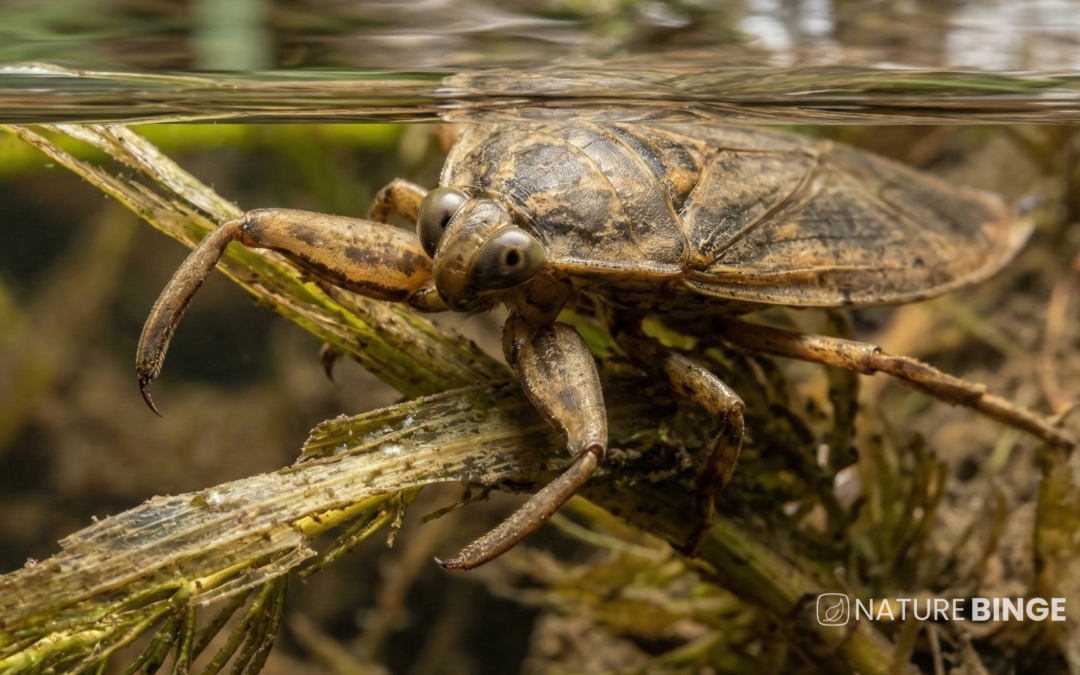
The morphology of Lethocerus americanus represents a masterclass in aquatic predatory engineering. Its body is strongly flattened, oval, and dull brown, providing impeccable camouflage amidst dead submerged leaves and muddy substrate. The front legs are massively enlarged and raptorial, functioning like vice-like mantis claws equipped with sharp terminal hooks designed to clamp onto slippery, struggling vertebrates. Its hind legs are flattened and fringed with stiff, dense swimming hairs that function like oars in rapid underwater propulsion. Unlike fish that breathe dissolved oxygen, the bug breathes atmospheric air via a pair of retractable, snorkel-like spiracular breathing tubes (siphons) positioned at the posterior tip of its abdomen, allowing it to remain submerged while lying in wait at the surface.
Behavior and Ecology
Lethocerus americanus is an ambush predator of relentless efficiency. Concealed among submerged aquatic plants, it hangs head-down with its breathing siphon piercing the surface film, waiting motionless until vibrations indicate approaching prey. In a lightning-fast strike, it snaps its raptorial forelegs around the victim, instantly driving its sharp, dagger-like rostrum into the prey’s flesh. It injects a potent cocktail of neurotoxic digestive saliva containing powerful proteolytic enzymes that rapidly liquefy the internal tissues of fish, frogs, or salamanders, subsequently sucking out the pre-digested nutrients. During late spring, females lay masses of 100 or more eggs on emergent reeds just above the water line, which the female diligently guards against predators and parasites until hatching.
Conservation and Human Impact
Lethocerus americanus is common, widespread, and secure across North America, thriving in unpolluted freshwater wetlands from coast to coast. However, local populations are vulnerable to the widespread drainage of ephemeral marshes, urban wetland destruction, and heavy pesticide or chemical runoff that decimates both the bugs and their aquatic prey base. In addition, intense outdoor light pollution near wetlands disorients flying adults during nocturnal dispersal migrations, causing hundreds to exhaust themselves or become crushed on asphalt roads. Maintaining natural shoreline vegetation and clean wetland corridors ensures their continued ecological prominence.
Interesting Factoid
The giant water bug possesses one of the most painful bites of any insect in the world: its venomous digestive saliva liquefies muscle tissue and causes an immediate, searing pain that can last for hours, earning it the dreaded nickname ‘toe-biter.’