

AT A GLANCE
- Common Name: Great Blue Heron
- Scientific Name: Ardea herodias
- Category: Birds
- Subcategory: Wading Birds
- Size: Standing height: 3.2–4.5 ft (97–137 cm); Wingspan: 5.5–6.6 ft (167–201 cm)
- Weight: 4.6–7.3 lb (2.1–3.3 kg)
- Lifespan: 15–20 years in the wild; record banding longevity of 24 years
- Diet: Carnivore / Opportunistic apex wetland predator (fish, frogs, salamanders, snakes, crabs, small rodents, and birds)
- Habitat: Estuaries, salt marshes, lake edges, river bends, cypress swamps, and urban wetlands
- Range: Transcontinental across North America, from southern Alaska to northern South America
- Conservation Status: Least Concern (IUCN Red List)
Overview
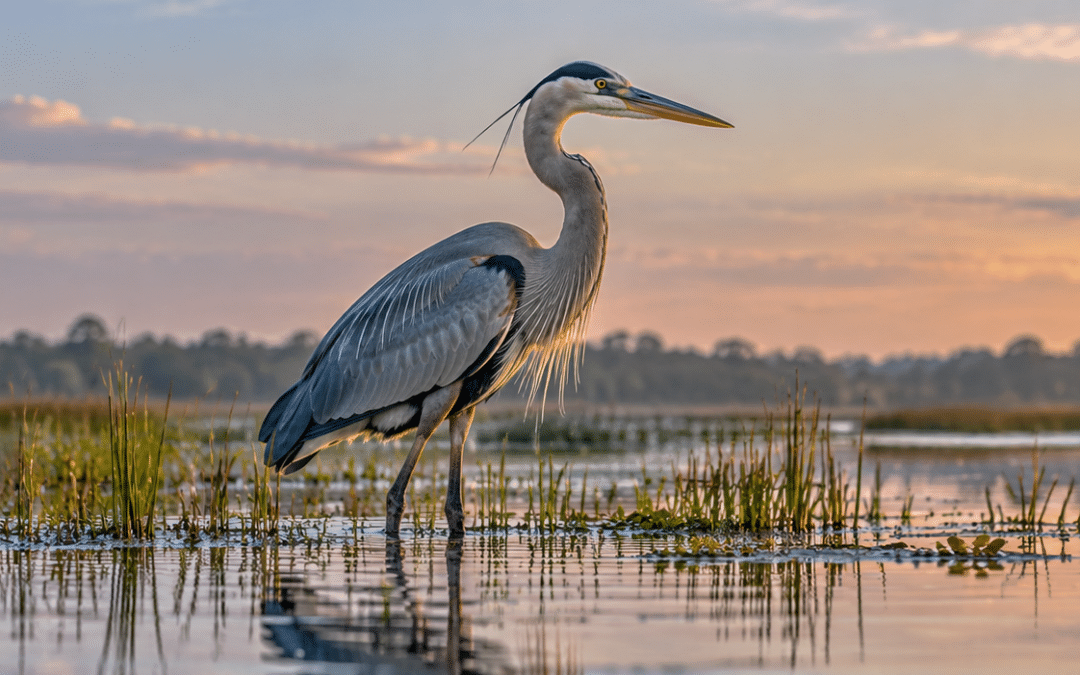
The Great Blue Heron (Ardea herodias) is the largest, most majestic, and widely distributed wading bird in North America belonging to the heron family Ardeidae. Standing over four feet tall with an impressive six-foot wingspan, this statuesque wetland hunter is recognized by its slate-blue body plumage, black-and-chestnut thighs, white crown flanked by dramatic black plumes extending behind the head, and a formidable, dagger-shaped yellow bill. Silhouetted against mist-shrouded riverbends and tidal estuaries, the great blue heron represents a living connection to the avian prehistoric past.
In aquatic ecosystems, great blue herons serve as top-tier wetland consumers that regulate populations of forage fish, amphibians, water snakes, and marsh rodents, keeping aquatic food webs balanced. They are adaptable hunters capable of utilizing both freshwater and marine environments, from fast-flowing mountain streams to saltwater barrier island flats. Nesting communally in noisy multi-tiered treetop colonies known as heronries, they act as important umbrella bioindicators for the ecological health and water clarity of North American watershed basins.
Biology and Physical Characteristics
The hunting anatomy of Ardea herodias is a masterpiece of biomechanical lever mechanics. Its elongated neck contains specialized cervical vertebrae (notably an enlarged sixth vertebra) that form a perpetual ‘S-curve,’ allowing the neck to cock backward like a spring and drive the bill forward with blinding, spear-like speed to impale fish underwater. The bird’s long legs allow it to wade through chest-deep water without disturbing surface ripples. Special feathered patches on its breast called ‘powder down’ continuously disintegrate into a fine talc-like keratin powder, which the heron combs through its feathers with a serrated middle claw to clean fish slime, mud, and aquatic oils from its plumage.
Behavior and Ecology
Great blue herons hunt primarily through patient, motionless ‘stand-and-wait’ ambush techniques or deliberate, slow stalking along shallow water margins, fixing their keen binocular eyes downward until prey swims within range. In flight, unlike cranes and storks which fly with their necks outstretched, herons pull their head tight against their shoulders in a deep folded S-curve, with their long legs trailing straight behind. During the spring breeding season, they gather in towering colonial heronries high in mature sycamores or pines, where males perform ritualized stick-presentation displays and bill-snapping duets to reinforce pair bonds.
Conservation and Human Impact
Classified as Least Concern by the IUCN Red List, Ardea herodias boasts a healthy, expanding population estimated at over 700,000 breeding individuals across North America. Fully protected under the Migratory Bird Treaty Act of 1918, which halted historical feather hunting for women’s millinery trade, the species has shown remarkable resilience. Key contemporary conservation priorities include safeguarding mature wetland forest stands required for communal colonial nesting, preserving wetland buffer corridors from commercial drainage, and reducing toxic heavy metal and chemical pesticide runoff in river watersheds.
Interesting Factoid
Unlike cranes, storks, and geese that fly with their necks stretched out straight, herons fly with their long necks pulled back tight in a deep S-shape against their shoulders, an aerodynamic posture that balances their massive center of gravity in flight.