
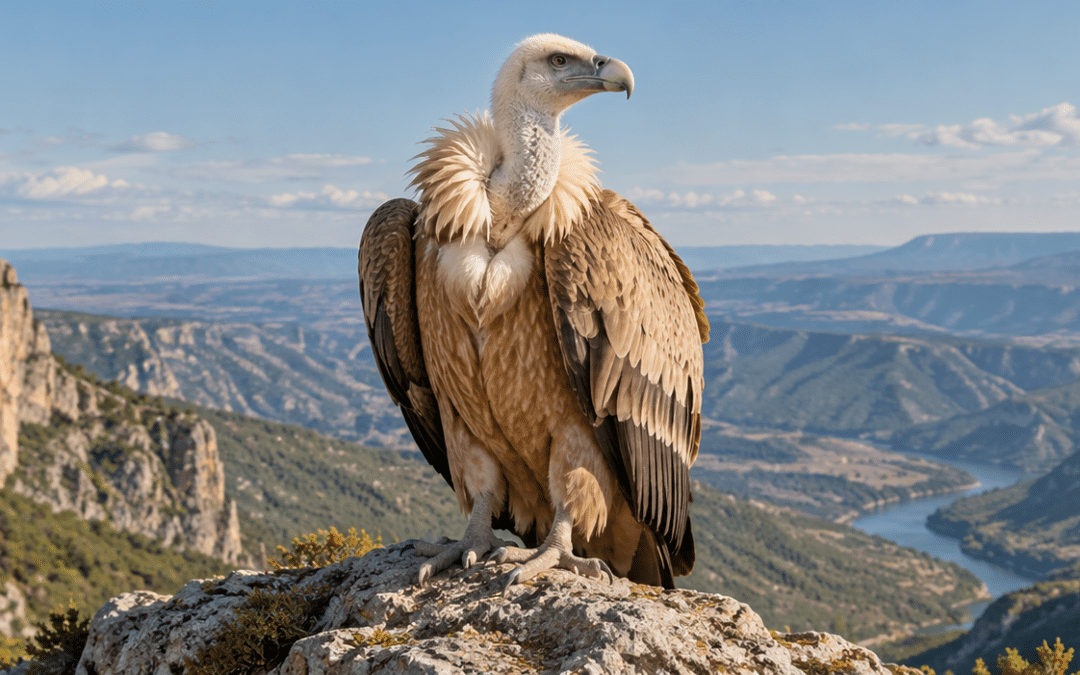

Overview
The Griffon Vulture (Gyps fulvus), widely venerated across Mediterranean Europe and the Middle East as the stately sovereign of montane thermals, is a massive Old World scavenging raptor belonging to the hawk and eagle family Accipitridae within the order Accipitriformes. Indigenous to the rugged limestone gorges, sun-drenched canyon systems, and alpine pastures of southern Europe, northern Africa, and central Asia—from the Iberian Peninsula and Pyrenees across the Balkans and Caucasus to the Himalayas—it is one of the largest and most ecologically essential flying birds in the Palearctic realm.
AT A GLANCE
- Common Name: Griffon Vulture
- Scientific Name: Gyps fulvus
- Category: Birds
- Subcategory: Accipitrids & Accipitriformes
- Size: Body length 95–110 cm (37–43 in); wingspan 240–280 cm (94–110 in)
- Weight: 6.0–11.0 kg (13.2–24.3 lb); colossal, broad-winged scavenging raptor build
- Lifespan: 20–30+ years in the wild; documented captive records exceed 40 years
- Diet: Obligate scavenger (carcasses of large mammals: sheep, cattle, deer, ibex, wild boar, horses)
- Habitat: Montane gorges, limestone cliff faces, arid steppes, Mediterranean scrub, and pastoral plateaus (elevation 100–3,500 m)
- Range: Southern Europe, North Africa, and the Middle East east across Central Asia to northern India
- Conservation Status: Least Concern (IUCN Red List)
An indispensable keystone scavenger, Gyps fulvus performs vital ecological sanitation services by rapidly consuming carcasses of large wild and domestic ungulates before rotting meat can proliferate lethal bacterial pathogens like anthrax (Bacillus anthracis), botulism, and cholera. Armed with an astonishing digestive system featuring gastric juices with a pH near zero—as acidic as battery acid—it digests decaying, putrid flesh without succumbing to fatal toxins. Soaring effortlessly on broad, rectangular wings spanning up to 2.8 meters (over 9 feet), it rides convective mountain thermals for hundreds of kilometers each day without flapping, scanning the terrain below with telescopic visual acuity.
Biology and Physical Characteristics
The Griffon Vulture is a colossal, heavy-bodied raptor characterized by a long, serpentine neck, broad chest, and immense, finger-tipped flight wings. Its plumage is a warm sandy-buff to tawny brown, accented by dark chocolate-brown flight feathers and tail. At the base of the neck sits a conspicuous, decorative ruff of fluffy, snow-white down (which transforms into a rougher, yellowish collar in older adults). In a brilliant adaptation for feeding deep inside messy carcasses, its head and neck are covered only in sparse, velvety white down: this bare skin allows the bird to probe inside body cavities without soiling feathers, and allows rapid cleaning and solar UV sterilization as it perches in the sun.
Its beak is massive, hooked, and horn-colored, powered by heavy jaw adductor muscles capable of tearing through tough mammalian hide, tendons, and muscle. Its feet, unlike those of eagles, are blunt and weak, with flat claws ill-suited for gripping live prey but perfectly adapted for running and bounding across rocky slopes. Its respiratory system is extraordinarily efficient, containing large air sacs that facilitate prolonged high-altitude soaring in thin mountain air, while its eyes possess two foveae per retina, providing dual sharp-focus fields for binocular forward vision and wide peripheral scanning.
Behavior and Ecology
Griffon Vultures are gregarious, colonial birds that roost and nest communally on sheer, inaccessible limestone cliff ledges and canyon walls. They are late risers: because their heavy bodies require powerful convective lift, they wait until late morning for solar heat to generate rising thermal air columns before launching into flight. Once airborne, vultures form expansive aerial surveillance networks: hundreds of vultures soar kilometers apart within line-of-sight of one another. When one vulture spots a carcass and spirals downward, neighboring birds immediately notice the descent and follow, converging by the dozens at the kill within minutes.
At a carcass, a strict hierarchical frenzy unfolds: up to 50 vultures can strip a full-grown cow or deer skeleton down to clean bone in less than 30 minutes. Reproduction occurs on dizzying cliff crevices during midwinter (January to February): pairs mate for life and perform synchronized aerial soaring displays. The female lays a single chalky-white egg, which both parents incubate for 52 to 58 days. The chick is brooded and fed regurgitated meat for four months, fledging in midsummer but remaining dependent on parental feedings into autumn.
Conservation and Human Impact
The Griffon Vulture is categorized as Least Concern on the IUCN Red List, with a thriving, expanding European population estimated at over 30,000 to 40,000 pairs, primarily concentrated in Spain, which hosts over 85 percent of the continental total.
However, historic populations suffered catastrophic collapses in the 20th century due to intentional poisoning by pastoralists, electrocution on high-voltage power lines, and European sanitation regulations (post-BSE crisis) that mandated the removal of all livestock carcasses from pastures. More recently, veterinary use of non-steroidal anti-inflammatory drugs like diclofenac (which caused the near-extinction of Asian vultures) remains a critical threat. The recovery in Western Europe has been driven by dedicated reintroduction programs, the establishment of protected ‘vulture restaurants’ (supplementary feeding stations), and strict bans on toxic agricultural poisons.
Interesting Factoid
The stomach acid of a Griffon Vulture is so corrosively strong that it can dissolve bone and instantly kill lethal diseases like anthrax, cholera, and rabies—making vultures nature’s ultimate cleanup crew that stops deadly plagues from spreading.