

AT A GLANCE
- Common Name: King Oyster Mushroom
- Scientific Name: Pleurotus eryngii
- Category: Fungi
- Subcategory: Mushrooms
- Size: Cap diameter: 2.0–5.0 in (5–13 cm); Stem height: 4.0–8.0 in (10–20 cm); Stem thickness: 1.5–2.5 in (4–6 cm)
- Weight: Fresh basidiocarp: 3.5–10.5 oz (100–300 g)
- Lifespan: Fruiting body: 2–3 weeks in moist conditions; Mycelium: perennial in soil and root systems
- Diet: Weakly parasitic / Saprotrophic (colonizes decaying roots and dead tissue of sea holly Eryngium and other Umbellifers)
- Habitat: Arid Mediterranean calcareous grasslands, steppe pastures, and sawdust-block commercial growing rooms
- Range: Indigenous to the Mediterranean Basin and Central Asia; extensively cultivated worldwide
- Conservation Status: Least Concern (IUCN Red List)
Overview
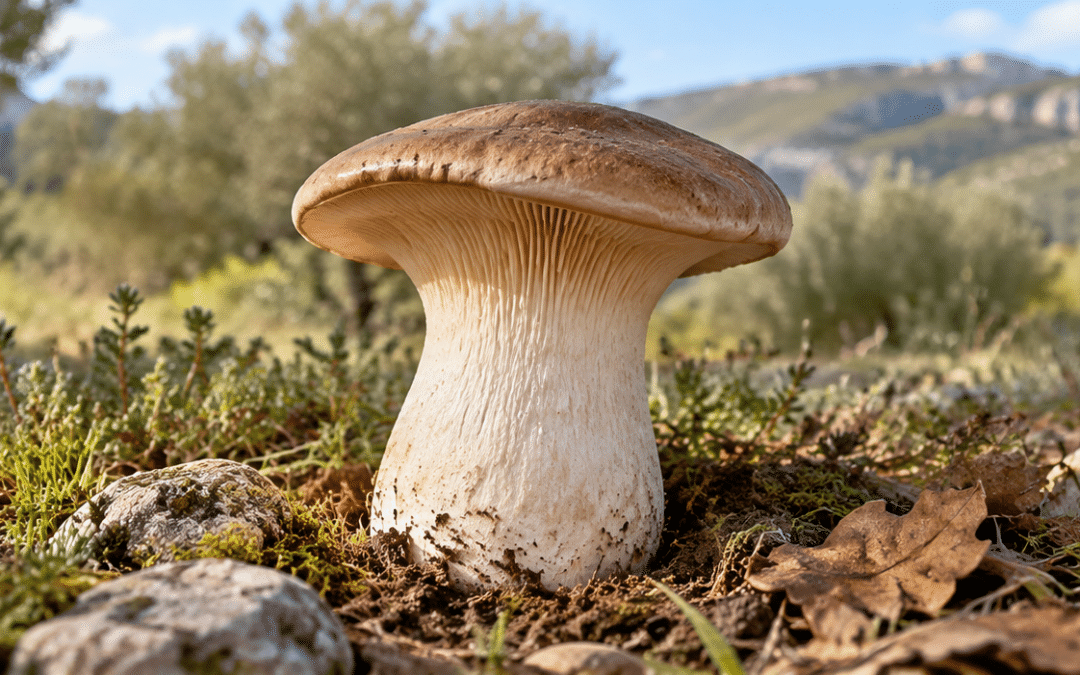
The King Oyster Mushroom (Pleurotus eryngii), widely celebrated across global gastronomy as the king trumpet mushroom, french horn mushroom, or boletus of the steppes, is the largest and most prized species in the oyster mushroom genus Pleurotus within the family Pleurotaceae. Unlike typical oyster mushrooms that form clustered, shelf-like brackets on dead tree trunks, the king oyster produces a magnificent, solitary, upright basidiocarp featuring a thick, cylindrical, pristine white fleshy stipe crowned with a small, pale tan-to-brown convex cap. Revered for its dense, meaty, abalone-like texture that remains firm and succulent when cooked, it is a culinary royalty among cultivated fungi.
In native Mediterranean and Eurasian steppe ecosystems, Pleurotus eryngii occupies an intriguing ecological niche as a facultative parasite and saprotroph closely associated with the roots of perennial umbellifers, especially field eryngo (Eryngium campestre). By decomposing dead root matter and recycling subterranean organic carbon in arid soils, it contributes fundamentally to grassland soil regeneration. Globally, the king oyster mushroom represents a massive commercial agricultural industry, particularly in East Asia and Europe, where millions of metric tons are produced annually on supplemented sawdust substrates.
Biology and Physical Characteristics
The cellular architecture of Pleurotus eryngii is characterized by dense, thick-walled hyphal networks throughout its massive stipe, providing a dense, non-crumbly texture comparable to scallop meat or calamari. Like other members of the genus Pleurotus, the mycelium is carnivorous (nematophagous): when cultured in nitrogen-poor environments, the hyphae produce microscopic glandular secretory droplets containing powerful trans-2-decenedioic acid toxins that paralyze soil nematodes, allowing the fungal hyphae to penetrate and digest the worms to acquire scarce nitrogen. The mushroom is packed with bioactive lovastatin, beta-glucan polysaccharides, and extraordinarily high levels of the powerful natural antioxidant L-ergothioneine.
Behavior and Ecology
In the wild, Pleurotus eryngii mycelium associates symbiotically and saprotrophically with the taproots of dying umbelliferous plants in open pasture soils, biding its time through arid Mediterranean summers. Following autumn and spring rains, the subterranean mycelial network triggers rapid fruiting, sending up solitary or small clusters of heavy sporocarps directly through the turf. The gills are decurrent, running down the upper portion of the stout stipe, where they discharge billions of smooth, cylindrical, hyaline basidiospores that are dispersed across windswept steppe plains.
Conservation and Human Impact
Assessed as Least Concern by the IUCN Red List, Pleurotus eryngii enjoys complete commercial security as one of the most widely cultivated gourmet mushrooms in the world. Wild populations remain locally common across traditional Mediterranean calcareous pastures, although they are sensitive to agricultural intensification, deep soil plowing, and the application of chemical fungicides that eradicate the wild Eryngium host plants. Preservation of traditional pastoral grazing regimes in southern Europe is vital to safeguarding wild ancestral genetic diversity.
Interesting Factoid
Unlike almost all other mushrooms where the tender cap is the primary culinary prize, with the king oyster mushroom, the massive, dense, snow-white stem is actually the most flavorful and prized part, prized by chefs as a plant-based alternative to sea scallops.