

Overview
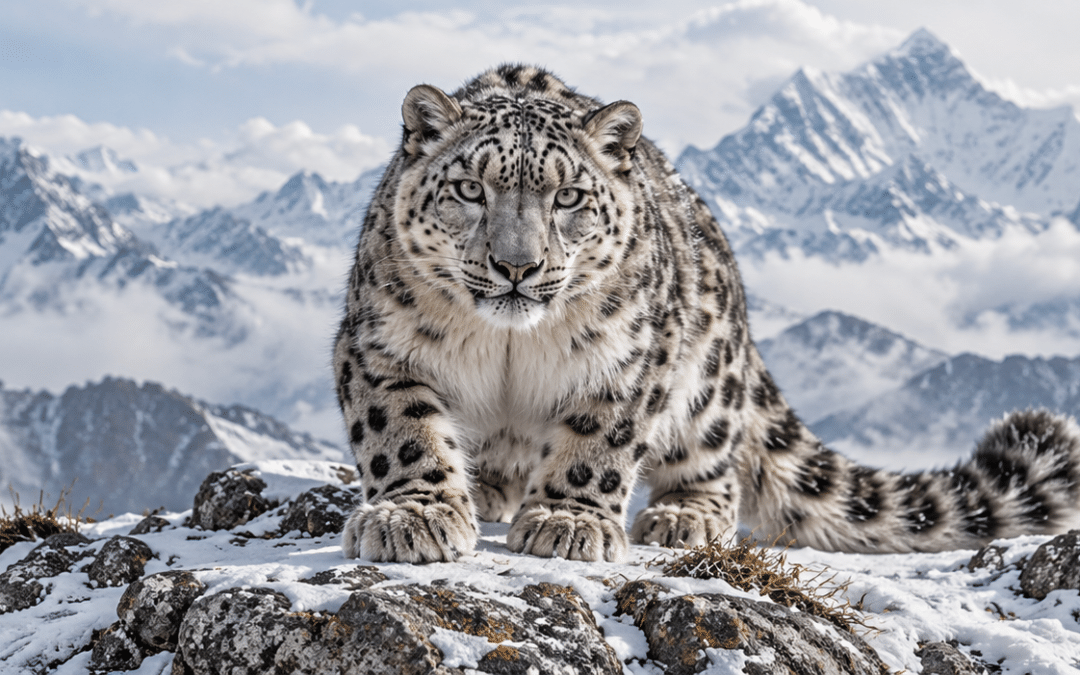
The Snow Leopard (Panthera uncia), known colloquially as the ‘ghost of the mountains,’ is an elusive big cat exquisitely adapted to the freezing alpine crags of Central Asia. Clothed in a dense, smoky-gray coat patterned with dark rosettes, this solitary apex predator moves silently across jagged precipices, acting as an indicator of environmental vitality for high-altitude river basins that sustain millions downstream.
Biology and Physical Characteristics
The snow leopard possesses striking morphological specializations for life at extreme elevations. Its wide nasal cavity warms frigid mountain air before reaching the lungs, while its compact body and small, rounded ears minimize thermal dissipation. Massive, fur-padded paws act as natural snowshoes, distributing body mass across soft powder and shielding paw pads from razor-sharp granite shards. Its exceptionally long, thick tail—measuring almost as long as its entire body—provides essential counterbalance during bounding leaps across chasms and wraps over the face to shield the airway during blizzards.
Behavior and Ecology
Snow leopards are crepuscular and highly solitary wanderers traversing colossal home ranges that frequently exceed 200 square kilometers. They navigate rugged ridgelines, scouting for prey from vantage points hundreds of feet above scree slopes. Instead of roaring, they communicate across vast valleys through non-aggressive chuffs, yowls, and extensive territorial markings, including scrape depressions and scent sprays on prominent boulders. Mating occurs in late winter, with mothers raising two to three cubs in isolated rock caverns until they disperse at roughly two years of age.
Conservation and Human Impact
With an estimated wild population between 4,000 and 6,500 individuals, snow leopards confront intensifying ecological hazards. Habitat fragmentation driven by extractive mining, new road infrastructure, and warming alpine treelines reduces hunting ranges. Human-wildlife conflict remains acute; retaliatory killings by pastoralist herders following livestock predation, alongside illegal poaching for fur and traditional medicine, threaten local sub-populations. Conservation partnerships focus on predator-proof coral corrals, community-based ecotourism, and transboundary corridor protections.
Interesting Factoid
Unlike lions, tigers, and jaguars, the snow leopard cannot roar due to the absence of a specialized fibro-elastic tissue layer in its vocal cords, producing instead a gentle blowing snort known as a ‘chuff.’