
Overview
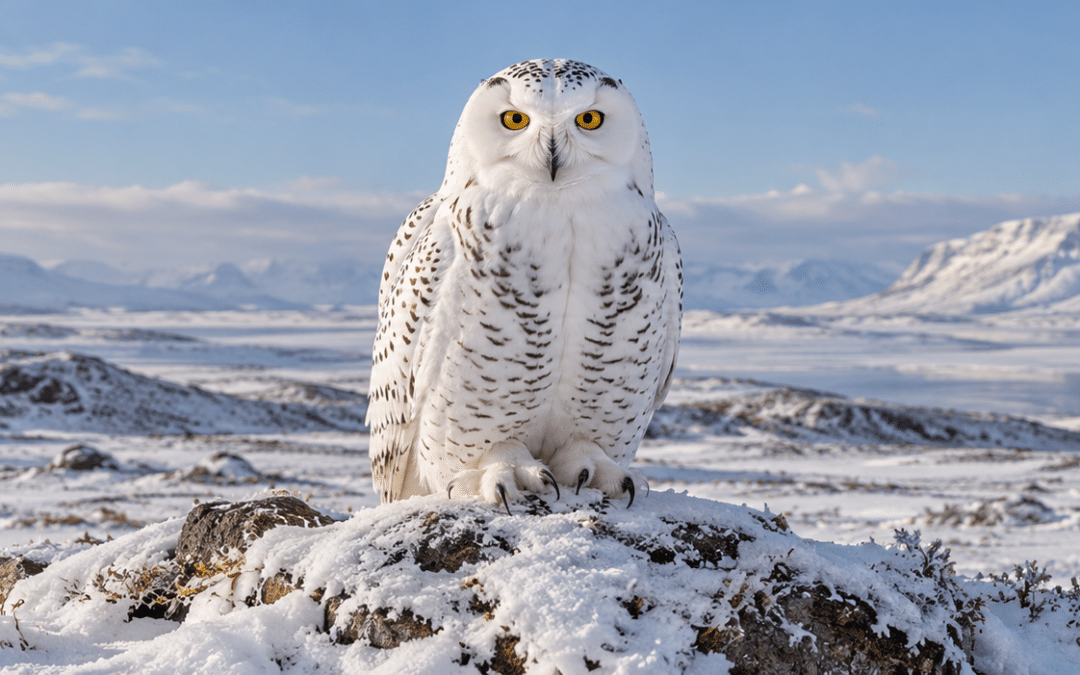
The Snowy Owl (Bubo scandiacus) is a regal, white raptor that commands the frozen horizons of the circumpolar Arctic tundra. Unlike most owls, this magnificent predator is diurnal, hunting under the relentless light of the 24-hour midnight sun. Characterized by its piercing yellow eyes, heavily feathered talons, and pristine plumage that blends seamlessly into polar snowdrifts, it is a master of one of Earth’s harshest environments.
Biology and Physical Characteristics
The snowy owl’s biology is engineered to withstand temperatures plunging past minus 50 degrees Fahrenheit. Its plumage is among the densest of any avian species, with feathers covering even its beak, legs, and toes down to the black talons. The down layer traps a protective air cushion equivalent in warmth to the fur of an arctic fox. Its golden eyes, rich in rods, provide acute visual detection across barren plains, while asymmetrical ear openings beneath facial disc feathers allow it to triangulate lemmings moving invisibly beneath several feet of packed snow.
Behavior and Ecology
Snowy owls are nomadic hunters whose movements and reproductive output are tied directly to fluctuating cycles of tundra lemmings. In years of lemming abundance, pairs may raise up to a dozen chicks in scrape nests constructed on open tundra mounds; in lean years, they may forego breeding entirely. When winter freezes Arctic hunting grounds, they undertake irruptive southward migrations, appearing in coastal grasslands, agricultural plains, and airports across North America and Eurasia.
Conservation and Human Impact
Recent satellite tracking studies revealed that the global snowy owl population is much smaller than previously estimated, numbering fewer than 30,000 mature individuals. Rapid warming in the Arctic is altering snow cover patterns, disrupting lemming population dynamics, and degrading tundra nesting grounds. In wintering zones, threats include vehicle collisions, electrocution on power poles, and secondary poisoning from rodenticides.
Interesting Factoid
A single adult snowy owl can consume up to 1,600 lemmings in a single year—translating to roughly three to five rodents swallowed whole every single day.