
AT A GLANCE
- Common Name: Welwitschia
- Scientific Name: Welwitschia mirabilis
- Category: Plants
- Subcategory: Gnetophytes
- Size: Foliage spread: 6–13 ft (1.8–4.0 m) across; Stem height: 1.0–2.0 ft (30–60 cm); Taproot depth: up to 10 ft (3 m)
- Weight: Mature biomass can reach 200–600 lb (90–270 kg)
- Lifespan: 1,000–2,000+ years; among the longest-lived botanical organisms on Earth
- Diet: Autotroph / Xerophytic Photosynthesis (CAM/C3 photosynthetic pathway absorbing coastal ocean fog moisture)
- Habitat: Hyper-arid coastal desert gravel plains, rocky desert washes, and dry sandstone canyons
- Range: Southwestern Africa, confined strictly to a narrow coastal belt (Namib Desert) of Namibia and southern Angola, within 60 miles of the Atlantic coast
- Conservation Status: Least Concern (IUCN Red List; strictly legally protected)
Overview
Welwitschia (Welwitschia mirabilis) is undeniably one of the most bizarre, ancient, and botanically unique gymnosperm plants on the face of the Earth. Confined strictly to the hyper-arid gravel plains of the Namib Desert in Namibia and southern Angola—one of the oldest and driest desert landscapes in existence—this living fossil is the sole surviving species in its entire taxonomic family (Welwitschiaceae) and order (Welwitschiales). Having diverged from primitive gnetophyte gymnosperms over 110 million years ago during the Early Cretaceous epoch, Welwitschia has persisted virtually unchanged, outliving the dinosaurs and enduring millennia of blistering hyper-arid drought.
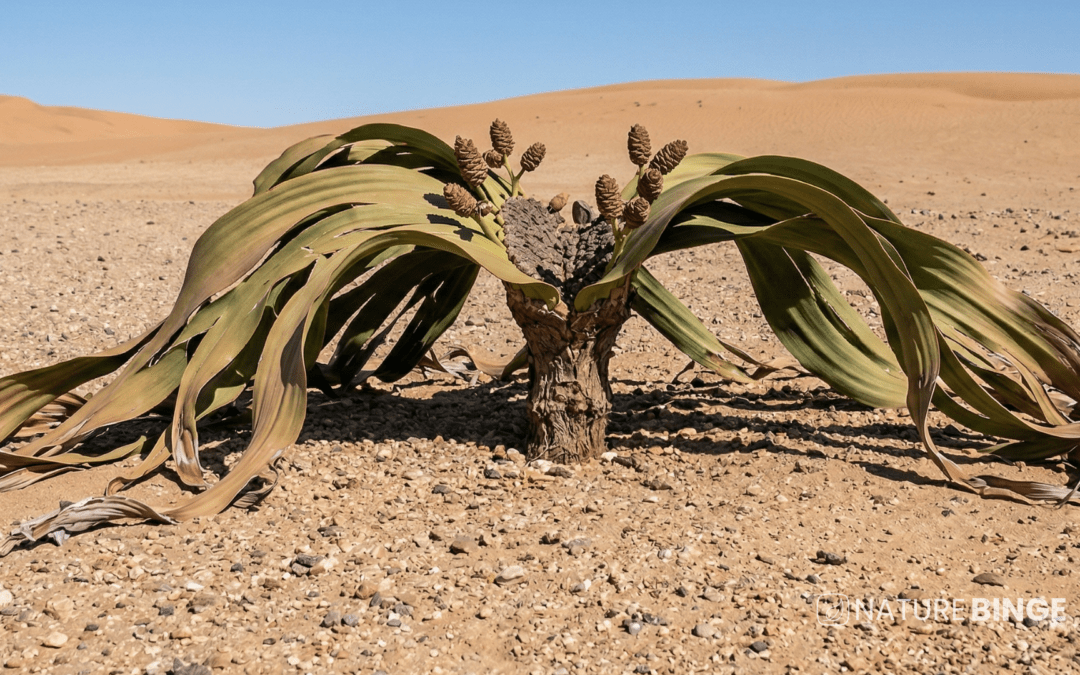
Surpassing all conventional understandings of plant architecture, an individual Welwitschia produces only two true leaves in its entire multi-thousand-year lifespan. These two basal leaves grow continuously from an underground, obconical woody stem, never shedding, but rather becoming shredded, split, and twisted by fierce coastal desert winds into a chaotic tangle of leathery green ribbons that resembles a stranded desert octopus. Reaching ages exceeding 2,000 years, Welwitschia stands as the supreme botanical testament to extreme xerophytic adaptation, relying on coastal ocean fog to sustain life where virtually no other vascular plant can survive.
Biology and Physical Characteristics
The morphological anatomy of Welwitschia mirabilis is a masterclass in hyper-arid survival engineering. The plant consists of a short, squat, unbranched woody stem that widens into a concave, disc-like crown barely rising 20 inches above the desert gravel. From the margin of this central crown emerge precisely two broad, strap-like, opposite leaves. These two leaves possess a unique basal meristem (growing zone) that pushes leaf tissue outward continuously throughout the plant’s life at a rate of 3 to 6 inches per year; as the leaf tips age, wither, and fray under intense solar radiation and scouring sand, the base continually regenerates new green leaf matter.
To hydrate in an environment where rainfall often measures less than 0.5 inches (12 mm) annually, Welwitschia possesses an extraordinary physiological adaptation to harvest coastal advection fog rolling inland from the cold Benguela Current. The leaves are packed with thousands of microscopic, modified stomata on both upper and lower surfaces that open during foggy night hours to absorb condensed atmospheric moisture directly into leaf tissues. A massive, elongated conical taproot extends downward up to ten feet (3 m) to tap deep subterranean water tables, surrounded by a dense network of shallow lateral roots that absorb flash-dew moisture from surface sands.
Behavior and Ecology
Welwitschia is a gymnosperm and strictly dioecious, meaning individual plants are entirely male or female. During the hot desert summer, the central woody crown produces clusters of reproductive strobili (cones) on branching stalks. Male plants bear small, salmon-pink to orange pollen cones resembling miniature pinecones, while female plants produce larger, glaucous green-to-burgundy seed cones. The cones secrete sweet, sugar-rich nectar droplets that attract specialized desert pollinators, primarily the Welwitschia bug (Odontopus sexpunctatus), which transfers pollen between plants across the desert plains.
Following wind pollination, female cones mature over nine months, producing thousands of lightweight, papery winged seeds that are dispersed across desert gravels by howling Atlantic gales. Seeds remain dormant for years in dry sand, germinating only during rare, episodic rainfall events that saturate the soil. Mature plants act as self-contained micro-oases in the barren desert: their sprawling mats of shade-casting leaves lower soil temperature underneath by up to 20 degrees Fahrenheit, collecting wind-blown organic detritus and sheltering desert adders, darkling beetles, and lizards from the scorching midday sun.
Conservation and Human Impact
Welwitschia mirabilis is officially evaluated as Least Concern by the IUCN and is granted strict national statutory protection under Namibian and Angolan nature conservation legislation. Because the overwhelming majority of populations reside within remote, hyper-arid wilderness areas (such as Namib-Naukluft National Park and the Skeleton Coast National Park), human agricultural and urban development pressures are virtually non-existent.
However, localized populations face threats from off-road vehicular tourism, which crushes fragile lateral root networks beneath desert crusts, illegal poaching of mature wild specimens for rare botanical collectors, and the potential impacts of uranium strip mining in central Namibia. Global botanical institutions maintain extensive cultivated collections, and strict export permits under CITES Appendix II safeguard wild desert specimens from commercial exploitation.
Interesting Factoid
A single Welwitschia plant grows only two true leaves in its entire life; those same two leaves grow continuously from the base for over 2,000 years, becoming shredded by desert winds into dozens of tangled, leathery ribbons.