
Overview
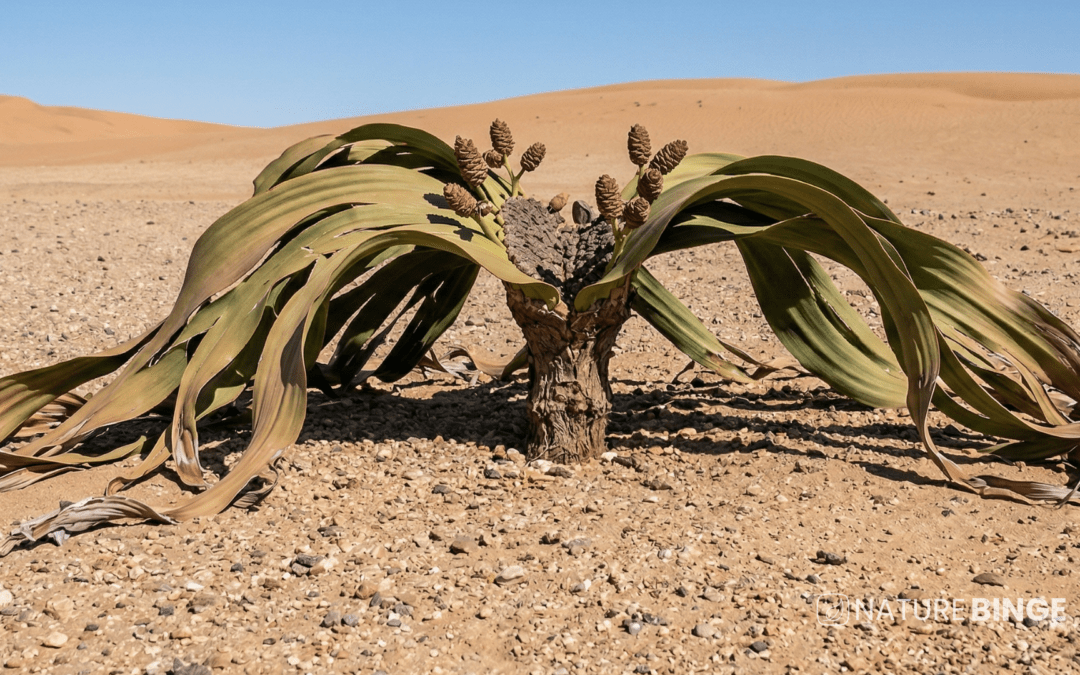
Welwitschia (Welwitschia mirabilis) is an iconic botanical living fossil that defies traditional plant classification, occupying its own monotypic order, Welwitschiales. Endemic exclusively to the blistering expanses of the Namib Desert—one of the oldest and driest deserts on Earth—this ancient gymnosperm survives for millennia under extreme arid conditions, growing only two permanent leaves throughout a lifespan that can span more than two thousand years.
Biology and Physical Characteristics
The morphology of Welwitschia mirabilis is unique in the plant kingdom. It consists of a stout, unbranched, woody subterranean stem crown that widens into a concave disk, anchored by an exceptionally deep, straight taproot descending into subterranean moisture zones. The plant produces only two true foliage leaves from a basal meristem throughout its entire multi-century life. These broad, leathery, strap-like leaves never shed; instead, they grow continuously from their base while windswept desert sands and scorching sun fray, split, and twist the aging ends into a tangled ribbon-like mound that resembles an enormous pile of stranded seaweed.
Behavior and Ecology
Surviving in an environment where rainfall averages less than 10 millimeters annually, Welwitschia relies on an ingenious physiological adaptation to harvest moisture: coastal advection fog rolling inland from the cold Benguela Current. The sprawling leaves are covered on both surfaces with tens of thousands of specialized stomata that open during dense dawn fog events, condensing and absorbing water droplets directly into the plant tissues. Welwitschia is dioecious, bearing separate male and female plants that produce cone-like reproductive strobili pollinated by specialized desert true bugs (Probergrothius angolensis) and wasps.
Conservation and Human Impact
Although Welwitschia plants are naturally protected by their remote, inhospitable desert distribution, wild populations face modern pressures. Vehicle tire tracks from off-road tourism cause severe, permanent damage to fragile surface feeder roots that take centuries to recover. In certain areas, mining concessions for uranium and diamonds disrupt local hydrology. Namibia strictly protects the species under national conservation laws and encloses ancient specimen groves within the Namib-Naukluft National Park.
Interesting Factoid
Carbon dating has revealed that individual living Welwitschia specimens thriving today in the scorching Namib gravel plains first germinated during the height of the Roman Empire, having weathered two millennia with just the exact same two leaves!
Last updated: October 2026